- Plants
- ›Vascular Plants
- ›flowering plants
- ›Dicots
- ›Mints, Plantains, Olives, and Allies
- ›Mint Family
- ›Nepetoideae
- ›Mentheae
- ›balms, mints, and thymes
- ›Thymbra
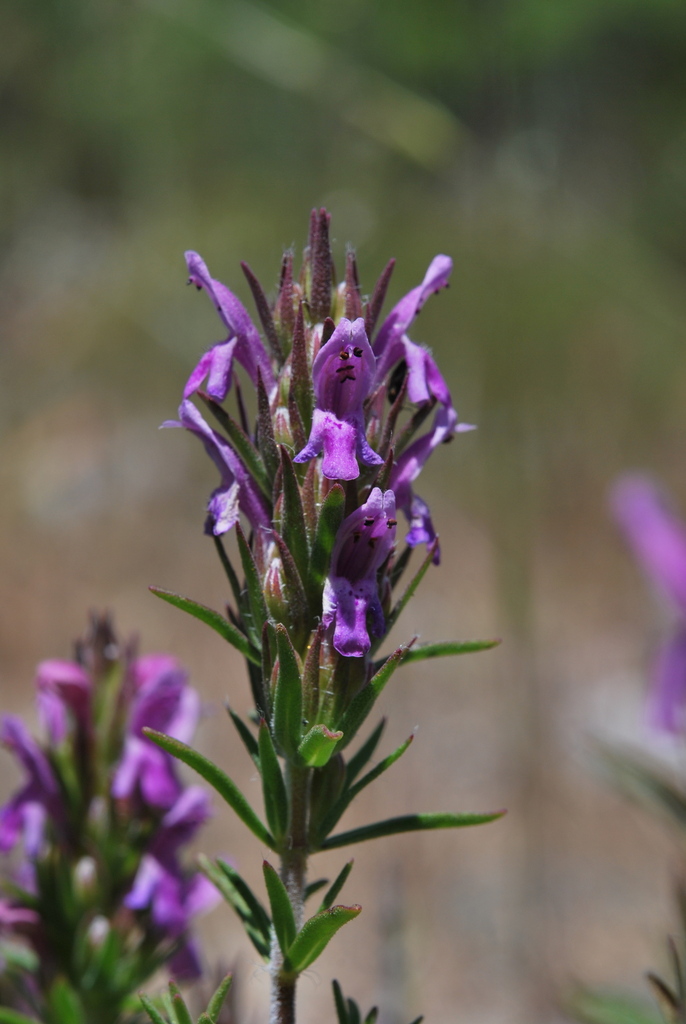
Thyme Spike
Thymbra spicata
Thymbra spicata, also commonly known as spiked savoury, spiked thymbra, thyme spike and donkey hyssop, is a perennial-green dwarf shrub of the family Lamiaceae, native to Greece, Cyprus, Turkey, Syria, Lebanon, Israel, Palestine, Jordan, Iraq and Iran, having erect stems bearing strongly scented leaves, rich in polyphenols such as rosmarinic acid, carvacrol (CVL) and different flavonoids.
From the article Thymbra spicata on Wikipedia (CC BY-SA), quoted section by section
Description
Thymbra spicata resembles Satureja thymbra in the shape and color of its leaves (the former tending to be more linear and arranged in a crisscross pattern), and is quite close to it in the color, size, and shape of its flowers. However, the flowers in this shrub are not arranged in nest-like clusters, as in Satureja thymbra, with gaps between them in leaps, but are crowded together in a dense raceme at the top of the stem. The petiole of the plant is extremely long and narrow, 9–12 mm (3⁄8–1⁄2 in) long. The plant reaches a height of 20–30 cm. The leaves are covered with tiny glandular hairs, and their edges have long cilia. The flowers are bright lilac in color, blossoming between April and June (in Israel) and between June and August (in Turkey). The flowers are arranged at the ends of the stems in dense oval inflorescences that lengthen as they ripen. The plant's leaf glands secrete essential oils, which give to Thymbra spicata its pungent odor. For this reason, the plant is used as a spice (some add it to the spice mixture zaatar), but it is too pungent for making tea. In Arabic, the plant is known as za'tar sebele (زعتر سبلة), while others call it za'tar farsi (زعتر فارسي). Although the plant is protected under Israeli law, the leaves of the plant are sometimes foraged by the local population between April and June, in preparation for making a spice mixture. …
Range & habitat
Garrigues are the natural habitat of Thymbra spicata. The plant is typical of exposed marlstone and chalk patches in the mountains, where it accompanies thyme or dominates independent patches. It prefers dry sunny hillsides and high dry meadows.
Wikipedia: “Habitat”
Where it lives
Recorded sightings
—
geo-referenced records in GBIF, from museums, herbaria and field observers.
Drag the globe to turn it. Dots are where records exist, not a range map; darker means more records.
In the stacks
Searching the stacks…
Every page naming Thymbra spicata in the Biodiversity Heritage Library →
This page is assembled live from iNaturalist, GBIF, Wikipedia, the Source Library and the Internet Archive. It is not yet part of the hand-edited codex. iNaturalist taxon 559346.