- Plants
- ›Vascular Plants
- ›flowering plants
- ›Dicots
- ›myrtles, evening primroses, and allies
- ›myrtle family
- ›Myrtoideae
- ›Leptospermeae
- ›Kunzea
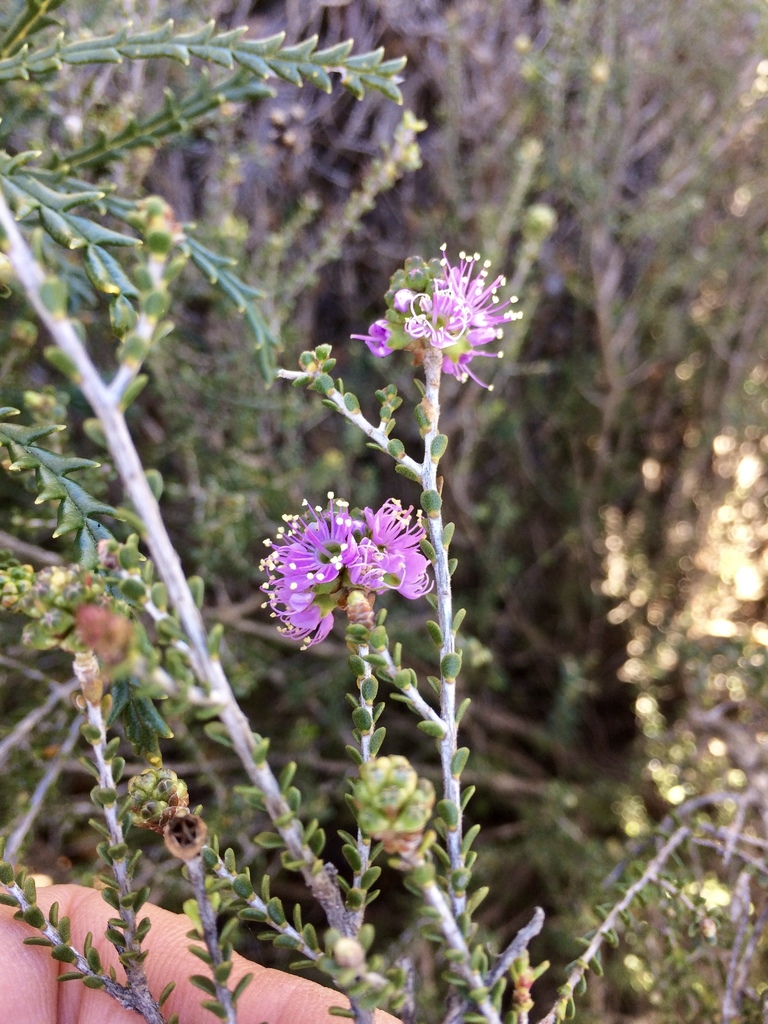
Kunzea jucunda
Kunzea jucunda is a flowering plant in the myrtle family, Myrtaceae and is endemic to the south-west of Western Australia where it occurs on sandy or rocky soils of undulating plains. It is similar to Kunzea affinis and where the ranges of the two species overlap, hybrids occur.
From the article Kunzea jucunda on Wikipedia (CC BY-SA), quoted section by section
Description
Kunzea jucunda is a shrub with a few erect main stems and many short side branches. It usually grows to a height of 0.6–1.2 m (2–4 ft) and is mostly glabrous except for a few hairs around the flowers and youngest leaves. The leaves are glabrous, mostly elliptic in shape, about 3 mm (0.1 in) long and 1–1.5 mm (0.04–0.06 in) wide with a petiole less than 1 mm (0.04 in) long. The flowers are arranged in heads of mostly two to four on the ends of the side branches. The flowers are surrounded by bracts which are about 2 mm (0.08 in) long and wide, mostly glabrous except for a few hairs around the edges and by pairs of smaller bracteoles. The floral cup is about 2–3 mm (0.08–0.1 in) long and the five sepals are lance-shaped, glabrous and about 1 mm (0.04 in) long. The five petals are spatula-shaped to almost round, about 2 mm (0.08 in) long and pink to deep mauve. There are eighteen to twenty four stamens in several rows in each flower. Flowering occurs mainly between August and October and is followed by fruit which are urn-shaped capsules with five vertical ridges. This kunzea is similar to K. affinis but is distinguished mainly by the mostly glabrous leaves and bracts. Where the ranges of the two species meet, hybrids often occur.
Range & habitat
This kunzea grows in a wide range of habitats, but often occurs on sandy or rocky soils of undulating plains, mostly between the Stirling Range and Ravensthorpe in the Esperance Plains and Mallee biogeographic regions.
Wikipedia: “Distribution and habitat”
Where it lives
Recorded sightings
—
geo-referenced records in GBIF, from museums, herbaria and field observers.
Drag the globe to turn it. Dots are where records exist, not a range map; darker means more records.
In the stacks
Searching the stacks…
Every page naming Kunzea jucunda in the Biodiversity Heritage Library →
This page is assembled live from iNaturalist, GBIF, Wikipedia, the Source Library and the Internet Archive. It is not yet part of the hand-edited codex. iNaturalist taxon 559356.