- Plants
- ›Vascular Plants
- ›flowering plants
- ›Dicots
- ›Sunflowers, Bellflowers, Fanflowers, and Allies
- ›Sunflowers, Daisies, Asters, and Allies
- ›Asteroideae
- ›bonesets, blazingstars, and allies
- ›Eupatoriinae
- ›Eupatorium
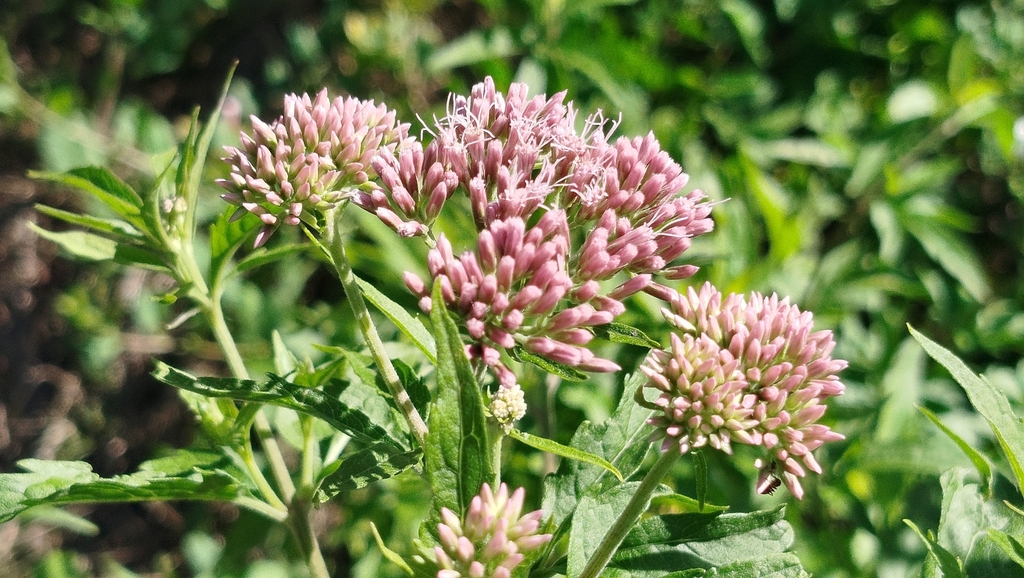
hemp agrimony
Eupatorium cannabinum
Eupatorium cannabinum, commonly known as hemp-agrimony, is a herbaceous plant in the family Asteraceae. It is a robust perennial native to Europe, Northwestern Africa, Turkey, Syria, Iran, Iraq, Jordan, the Caucasus and Central Asia, and grows in damp to wet habitats (also rarely on dry soils), usually in lowlands but known up to 410 m altitude in Britain. It is cultivated as an ornamental plant and occasionally found as a garden escape in scattered locations in China, the United States and Canada. It is extremely attractive to butterflies, much like buddleia.
If the genus Eupatorium is defined in a restricted sense (about 42 species), E. cannabinum is the only species of that genus native to Europe, with the remainder in Asia or North America.
From the article Eupatorium cannabinum on Wikipedia (CC BY-SA), quoted section by section
Description
Eupatorium cannabinum is a perennial herb up to 1.75 metres (5.7 feet) tall forming extensive clumps, with the reddish stems covered in small hairs. The leaves are opposite, deeply 3-lobed, occasionally 5-lobed, and have serrated margins. It is dioecious, with racemes of mauve flower heads which are pollinated by insects from July to early September. The flowers are visited by many types of insects, and have a generalised pollination syndrome. The flower heads are composed of dense clusters of 2–5 mm long florets of fluffy appearance, and can be pink or purple, or rarely whitish. The fruit is an achene about 2 or 3 mm long, borne by a pappus with hairs 3 to 5 mm long, which is distributed by the wind. The plant over-winters as a hemicryptophyte.
In medicine
E. cannabinum, known locally by the Nepali names of Banmara and Kalijhar, is used as a styptic in the folk medicine of the Indian state of Sikkim in the Eastern Himalayas (to which the plant is not native, but an introduction).
The leaves and tender stems are crushed fresh and the juice is applied to cuts and bruises. Sometimes, when the wound is large, the squeezed remains of the plant are placed over the wound in the form of a poultice. The bleeding stops immediately and the wound is protected from infection.
Wikipedia: “Folk medicine”
Toxicity
Eupatorium cannabinum contains tumorigenic pyrrolizidine alkaloids. The alkaloids may be present in the plant material as their N-oxides.
Where it lives
Recorded sightings
—
geo-referenced records in GBIF, from museums, herbaria and field observers.
Drag the globe to turn it. Dots are where records exist, not a range map; darker means more records.
In the old herbals & bestiaries

In the stacks
Searching the stacks…
Every page naming Eupatorium cannabinum in the Biodiversity Heritage Library →
This page is assembled live from iNaturalist, GBIF, Wikipedia, the Source Library and the Internet Archive. It is not yet part of the hand-edited codex. iNaturalist taxon 55976.