- Plants
- ›Vascular Plants
- ›flowering plants
- ›Dicots
- ›Legumes, Milkworts, and Allies
- ›Legumes
- ›Acacias, Mimosas, Mesquites, and Allies
- ›Acacia
- ›Plurinerves
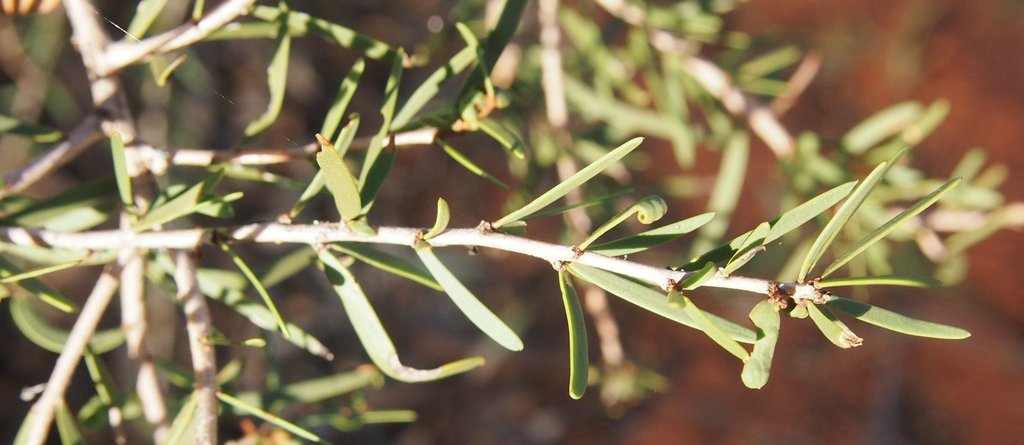
Acacia estrophiolata
Acacia estrophiolata, commonly known as ironwood, southern ironwood, desert ironwood or utjanypa, is a species of flowering plant in the family Fabaceae and is endemic to Central Australia. It is a graceful, glabrous tree with linear to very narrowly elliptic phyllodes, spherical heads of cream-coloured to pale yellow flowers, and firmly papery, flat pods.
From the article Acacia estrophiolata on Wikipedia (CC BY-SA), quoted section by section
Description
Acacia estrophiolata is a graceful, glabrous tree that typically grows to a height of 4–16 m (13–52 ft) and has pendulous branchlets when mature. Its phyllodes are linear to very narrowly elliptic, straight to slightly curved, 40–110 mm (1.6–4.3 in) long and 2–5 mm (0.079–0.197 in) wide, thinly leathery pale green and glabrous with 3 or 4 main veins and a gland 4–10 mm (0.16–0.39 in) above the base of the phyllode. Its flowers are borne in one or two spherical heads in axils on a peduncle 5–12 mm (0.20–0.47 in) long. The heads are 4–5 mm (0.16–0.20 in) in diameter with 30 to 35 densely clustered, cream-coloured to pale yellow flowers.
Range & habitat
This species of wattle commonly grows on sandy alluvial flats as scattered trees, but also in tall open shrubland and open woodland. It is found in the Central Ranges, Finke, Great Victoria Desert and Stony Plains bioregions of South Australia, southern parts of the Northern Territory and the Central Ranges, Gascoyne, Great Sandy Desert and Tanami bioregions of Western Australia.
Wikipedia: “Distribution and habitat”
At the table
Traditionally, Aboriginal Australians would use the gum from the tree as a sweet bushtucker treat. Its name in the Arrernte language of Central Australia is Ngkwarle athenge arlperle. It is still sometimes eaten today. The gum is snapped off the branches, either clear or red. It is then ground and mixed with a little water, then left to set again to a chewable gum, and eaten with a small stick.
Wikipedia: “Food”
In medicine
Parts of the tree are used topically to treat skin problems such as burns, cuts, scabies, sores and it is also used for treating major wounds. It is used as a lotion to treat eye problems.
Wikipedia: “Traditional medicine”
Where it lives
Recorded sightings
—
geo-referenced records in GBIF, from museums, herbaria and field observers.
Drag the globe to turn it. Dots are where records exist, not a range map; darker means more records.
In the stacks
Searching the stacks…
Every page naming Acacia estrophiolata in the Biodiversity Heritage Library →
This page is assembled live from iNaturalist, GBIF, Wikipedia, the Source Library and the Internet Archive. It is not yet part of the hand-edited codex. iNaturalist taxon 559968.