- Plants
- ›Vascular Plants
- ›flowering plants
- ›Dicots
- ›Sunflowers, Bellflowers, Fanflowers, and Allies
- ›Sunflowers, Daisies, Asters, and Allies
- ›Asteroideae
- ›paper daisies
- ›cudweeds, everlastings, and pussytoes
- ›Coronidium
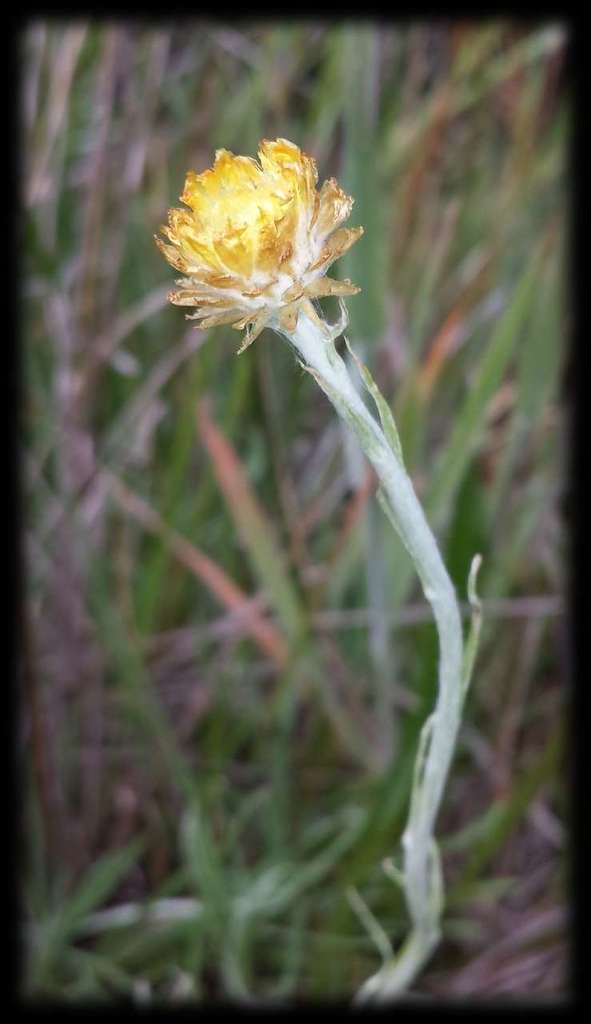
Pale Swamp Everlasting
Coronidium gunnianum
Coronidium gunnianum, commonly known as pale swamp everlasting, pale everlasting or Gunn's everlasting is a species of flowering plant in the family Asteraceae and is endemic to south-eastern Australia. It is an erect perennial, with linear to lance-shaped leaves with the narrower end towards the base, and solitary heads of pale yellow to brownish yellow daisy-like flowers.
From the article Coronidium gunnianum on Wikipedia (CC BY-SA), quoted section by section
Description
Coronidium gunnianum is an erect, rhizomatous perennial that typically grows to a height of 50 cm (20 in) with few branches, and stems covered in cottony hairs pressed against the surface. Its leaves are linear to lance-shaped with the narrower end towards the base, mostly 15–65 mm (0.59–2.56 in) long and 1–9 mm (0.039–0.354 in) wide, the upper surface glabrous or with cottony hairs, the lower surface obscured by cottony hairs pressed against the surface and many sessile glands. The heads of daisy-like flower are solitary, more or less spherical to depressed top-shaped, 10–25 mm (0.39–0.98 in) in diameter, with five to eight rows of pale yellow to brownish yellow involucral bracts. There are many florets, some outer ones female. Flowering mainly occurs from November to April, and the cypselas are 1.3–1.9 mm (0.051–0.075 in) long, glabrous, ridged and brown with 15 to 30 pappus bristles 3–4.5 mm (0.12–0.18 in) long.
Range & habitat
Pale swamp everlasting occurs on the coast and tablelands of New South Wales, the Australian Capital Territory, through most of Victoria apart from the north west and alpine and adjacent mountain areas, the Flinders Lofty Block and Kanmantoo bioregions of South Australia and in Tasmania where it is rare. It mainly grows in grasslands and Eucalyptus camaldulensis woodlands on soils that are prone to inundation, usually under 100 m (330 ft) above mean sea level.
== References ==
Wikipedia: “Distribution and habitat”
Where it lives
Recorded sightings
—
geo-referenced records in GBIF, from museums, herbaria and field observers.
Drag the globe to turn it. Dots are where records exist, not a range map; darker means more records.
In the stacks
Searching the stacks…
Every page naming Coronidium gunnianum in the Biodiversity Heritage Library →
This page is assembled live from iNaturalist, GBIF, Wikipedia, the Source Library and the Internet Archive. It is not yet part of the hand-edited codex. iNaturalist taxon 560705.