- Plants
- ›Vascular Plants
- ›flowering plants
- ›Dicots
- ›Mints, Plantains, Olives, and Allies
- ›Plantain Family
- ›Veroniceae
- ›Veronica
- ›Cochlidiosperma
- ›Veronica hederifolia
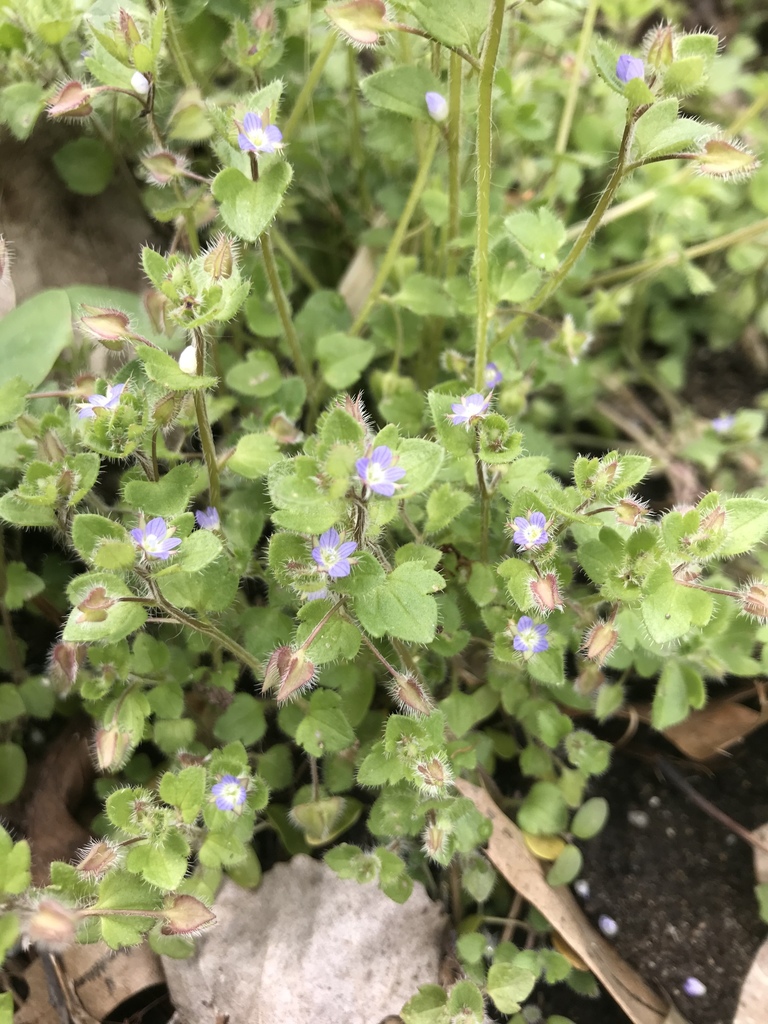
Ivy-leaved Speedwell
Veronica hederifolia
Veronica hederifolia (Ivy-leaved Speedwell) is a flowering plant belonging to the family Plantaginaceae. It is native to Eurasia and it is present in other places as an introduced species and a common weed. It is an annual herb growing from a taproot and producing a hairy, spreading stem up to about 60 centimetres (24 in) long. The stem is lined with rounded leaves with blades which are divided shallowly into three to five lobes and borne on...
From the article Veronica hederifolia on Wikipedia (CC BY-SA), quoted section by section
Description
It is an annual herb with procumbent to climbing stems up to 60 centimetres (24 in) long. The stems are green to purplish, round, with abundant spreading, wavy hairs 1 mm long (but forming a thick line along one side of the stem). The leaves are opposite, becoming alternate higher up the stem, with 4–15 mm long petioles and no stipules. The blades are divided shallowly into 5 lobes, like ivy, (sometimes 3–7 lobes or entire), darker above than below, up to 1.5 cm long, and are downy above and below with long hairs on the margins. The flowers are solitary in the leaf axils on pedicels up to 18 mm long. The calyx has four triangular lobes which expand after flowering. There are 4–5 pale lilac petals, 2 mm long, with darker veins. There are 2 stamens, with blue anthers, and one style. The fruits are glabrous, 2-celled (sometimes 1–3) capsules.
Range & habitat
It is thought to be native to southern Europe and widely naturalised outside that range, including in northern Europe as far as Scandinavia, in the United States, Japan, Australia, New Zealand, and scattered places elsewhere. In Britain, it is ubiquitous throughout the lowlands, becoming rare only in the mountains of Cumbria and the Highlands and Islands of Scotland. In Ireland it has a similarly south-easterly distribution, fading out in the west.
Wikipedia: “Distribution”
What it does
In Britain, it is mainly associated with inhabited areas, being common in towns and villages where it grows in gardens, hedges, road sides and on waste ground. It is also found, less commonly, in arable fields and more wild places. It is a lowland plant; its maximum recorded altitude was 380 m (1,250 ft) at Malham Moor in Yorkshire (although that was in 1888, so it might have been an atypical occurrence).
Wikipedia: “Ecology and habitat”
Where it lives
Recorded sightings
—
geo-referenced records in GBIF, from museums, herbaria and field observers.
Drag the globe to turn it. Dots are where records exist, not a range map; darker means more records.
In the stacks
Searching the stacks…
Every page naming Veronica hederifolia in the Biodiversity Heritage Library →
This page is assembled live from iNaturalist, GBIF, Wikipedia, the Source Library and the Internet Archive. It is not yet part of the hand-edited codex. iNaturalist taxon 56129.