- Plants
- ›Vascular Plants
- ›flowering plants
- ›monocots
- ›Agaves, Orchids, Irises, and Allies
- ›agave and allies
- ›Hyacinth subfamily
- ›star-of-Bethlehem tribe
- ›Ornithogalum
- ›Ornithogalum
- ›Ornithogalum
- ›Ornithogalum umbellatum
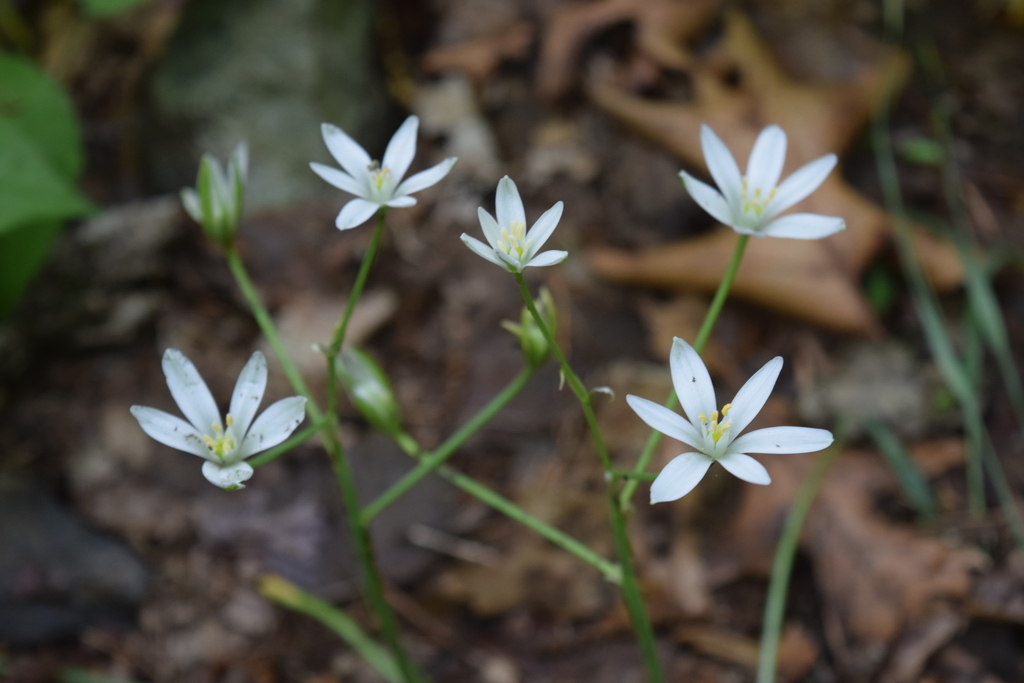
common star-of-Bethlehem
Ornithogalum umbellatum
Ornithogalum umbellatum, the garden star-of-Bethlehem, grass lily, nap-at-noon, or eleven-o'clock lady, is a perennial bulbous flowering plant in the asparagus family (Asparagaceae). O. umbellatum is a relatively short plant, occurring in tufts of basal linear leaves, producing conspicuous white flowers, in a stellate pattern, in mid to late spring. The flowers open late in the day (hence some of its common names), but when closed have a green stripe on the outside. It is native throughout southern and central Europe, and north-western Africa. O. umbellatum is often grown as a garden ornamental, but in North America and other areas it has escaped cultivation and can be found in many areas, where it may be considered an invasive weed. Parts of the plant are considered poisonous, but are used in some regional cuisines. Essences are also sold as patent remedies. O. umbellatum has been depicted in art by artists such as Leonardo da Vinci, and folklore has suggested it originally grew from fragments of the star of Bethlehem, hence its horticultural name.
From the article Ornithogalum umbellatum on Wikipedia (CC BY-SA), quoted section by section
Description
O. umbellatum is a perennial herbaceous bulbous plant (geophyte), dying back after flowering, to an underground storage bulb. The following year, it regrows from the often shallow rooted bulbs, which are ovoid with a membranous coat, 15–25 millimetres (1⁄2–1 inch) long and 18–32 mm (3⁄4–1+1⁄4 in) in diameter. The bulbs form multiple leaf-bearing bulbils that soon separate but remain close by. Initially the plant forms 6–10 basal leaves, that arise in tufts from the bulbs. The leaves are grooved (canaliculate), smooth (glabrous) and linear with a white to light green linear midrib on the upper surface, and grow up to 30 centimetres (12 in) long and 8 mm (1⁄4 in) broad. O. umbellatum is scapose, with a glabrous flower stem (scape) that emerges from the leaf tufts later and is about 10–30 cm (4–12 in) in height, tapering at its tip.
The inflorescence bears 6–20 flat star shaped flowers on ascending stems (pedicels), 3–3.5 cm (1+1⁄4–1+1⁄2 in), associated with membranaceous leaflets (bracts), 2.5–3 cm (1–1+1⁄4 in), in an open branching umbrella (umbel) shaped terminal cluster, described as a corymbose raceme. The petal-like perianth is radially symmetric (actinomorphic), which is 1.5–2 cm (1⁄2–3⁄4 in) in diameter, consists of six lanceolate tepals which are white with a green stripe on the underside (outside), 15 mm (1⁄2 in) in length and 5 mm (1⁄4 in) wide. …
Range & habitat
A native of most of Europe, North Africa and western Asia, O. umbellatum has been adopted as an ornamental garden plant from where it has escaped and naturalised widely in North America, where it is considered an aggressive noxious weed of lawns, gardens and no-till agricultural land, which can be difficult to eradicate. In Europe its range extends from Ireland and Portugal in the west, Italy in the south, north to parts of France and east to Turkey and the Levant. O. umbellatum prefers damp habitats, being found along rivers, streams, and lower, wet areas of pastures. It is tolerant to shade and soil type.
Wikipedia: “Distribution and habitat”
What it does
Ornithogalum umbellatum is thermoperiodic, requiring a cold winter to complete its life cycle. It first appears in early spring as tufts of leaves, prior to flowering (proteranthous), which occurs in late spring (May–June), the leaves fading prior to blooming. It reproduces by its bulbs, which form many offsetting bulbils that can be dispersed by water. Like many bulb plants from temperate regions, a period of exposure to cold is necessary before spring growth can begin. This protects the plant from growth during winter when intense cold may damage it. Warmer spring temperatures then initiate growth from the bulb. O. umbellatum spreads aggressively in clumps by means of these offsets.
Wikipedia: “Life cycle”
At the table
Despite the known toxicities, the plant has been described as edible for 2,000 years and incorporated into some traditional regional cuisines (e.g., Turkish) and traditional medicine (e.g., Indian). In Britain, the plant has long been the subject of herbals for its claimed culinary and medicinal properties. This includes drying and grinding the bulbs, or boiling them and baking the flowers into bread. Essences are sold as patent remedies and for aromatherapy, such as Bach flower remedies. Medical authorities advise against ingesting any part of the plant.
Wikipedia: “Uses”
Toxicity
The plant, especially the bulb and flowers, contains cardiac glycosides, specifically convallatoxin and convalloside which are toxic to humans and livestock. Symptoms of poisoning include nausea, salivation, vomiting, diarrhea, and shortness of breath, as well as pain, burning, and swelling of lips, tongue, and throat. Prolonged contact may lead to skin irritation.
How it is grown
Ornithogalum umbellatum requires considerable moisture during winter and spring, but can tolerate summer drought. It can be grown in a woodland garden as semi-shade is preferable. It is hardy to zone 5 UK, 4–9 USDA, and can become invasive. It is produced commercially as an ornamental garden plant. To control invasive tendencies, it is best to plant in a container or an edged area. O. umbellatum may be grown as an indoor plant.
Wikipedia: “Cultivation”
In human culture
The species epithet reflects the flower formation as an umbel. The plant's many common names include garden star-of-Bethlehem, sleepydick, nap-at-noon, grass lily, summer snowflake, snowdrop, starflower, bird's milk, chinkerichee, ten-o'clock lady, eleven-o'clock lady, Bath asparagus, and star of Hungary. The references to the time of day reflect the opening times of the flowers, opening late and closing at night or in cloudy conditions. The star names indicate the arrangement of the petals and bird's milk is a literal translation of ornithogalum. It has also been called dove's dung, equating it with a plant described in the bible. The name star-of-Bethlehem is shared by a number of species of Ornithogalum, due to the white stellate flowers, and the folklore relating the flower to the biblical star-of-Bethlehem (see In popular culture).
Wikipedia: “Etymology”
Where it lives
Recorded sightings
—
geo-referenced records in GBIF, from museums, herbaria and field observers.
Drag the globe to turn it. Dots are where records exist, not a range map; darker means more records.
In the stacks
Searching the stacks…
Every page naming Ornithogalum umbellatum in the Biodiversity Heritage Library →
This page is assembled live from iNaturalist, GBIF, Wikipedia, the Source Library and the Internet Archive. It is not yet part of the hand-edited codex. iNaturalist taxon 56137.