- Plants
- ›Vascular Plants
- ›flowering plants
- ›Dicots
- ›Sunflowers, Bellflowers, Fanflowers, and Allies
- ›Sunflowers, Daisies, Asters, and Allies
- ›Asteroideae
- ›tarweeds, silverswords, and allies
- ›Arnica
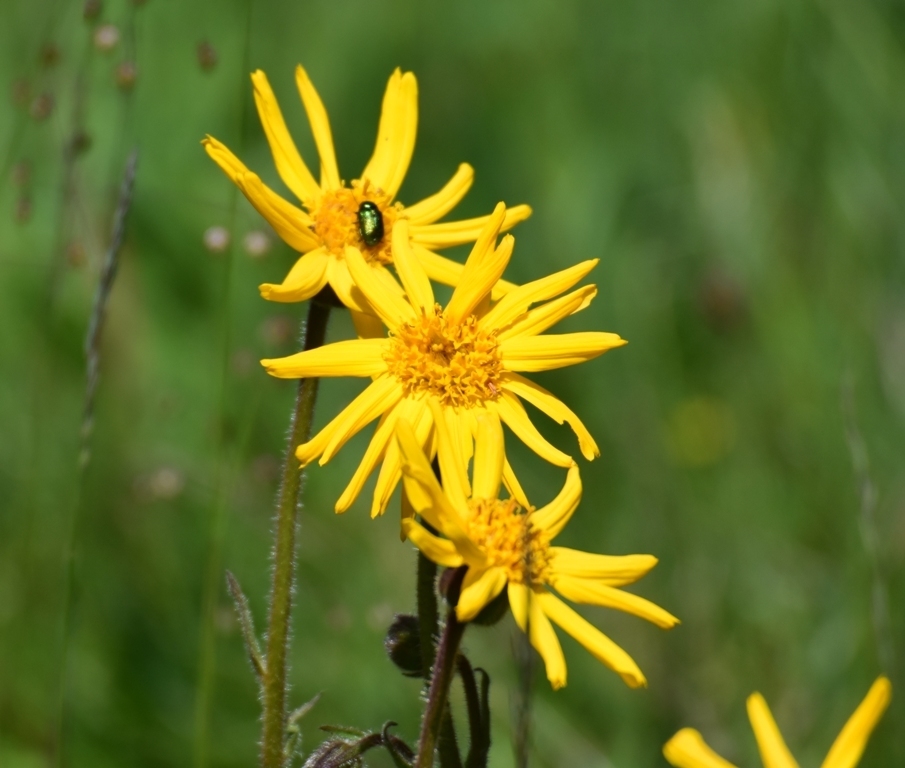
Wolf's bane
Arnica montana
Arnica montana, also known as leopard's bane, mountain tobacco and mountain arnica, is a moderately toxic European flowering plant in the daisy family Asteraceae that has a large yellow flower head. The names "wolf's bane" and "leopard's bane" are also used for another plant, Aconitum, which is extremely poisonous.
Arnica montana has been used as a herbal medicine, but there is insufficient clinical evidence for its therapeutic use. It is toxic when taken internally or applied to injured skin.
From the article Arnica montana on Wikipedia (CC BY-SA), quoted section by section
Description
Arnica montana is a flowering plant about 18–60 cm (7.1–23.6 in) tall aromatic fragrant, herbaceous perennial. Its basal green ovate leaves with rounded tips are bright coloured and level to the ground. In addition, they are somewhat downy on their upper surface, veined and aggregated in rosettes. By contrast, the upper leaves are opposed, spear-shaped and smaller which is an exception within the Asteraceae. The chromosome number is 2n=38. The flowering season is between May and August (Central Europe). The 2 in (5.1 cm) flower heads are composed of orange-yellow disc florets in the centre which are externally bordered by 10 to 15 yellow ray florets. The achenes have a one-piece rough pappus which opens in dry conditions. Arnica montana is a hemicryptophyte, which helps the plant to survive the extreme overwintering condition of its habitat. In addition, Arnica forms rhizomes, which grow in a two-year cycle: the rosette part grows at its front while its tail is slowly dying.
Range & habitat
Arnica montana is widespread across most of Europe. It is absent from the Celtic Isles and the Italian and Balkan peninsulas. In addition, it is considered extinct in Hungary and Lithuania. Arnica montana grows in nutrient-poor siliceous meadows or clay soils. It mostly grows on alpine meadows and up to nearly 3,000 m (9,800 ft). In more upland regions, it may also be found on nutrient-poor moors and heaths. Arnica does not grow on lime soil, indicating its use as a bioindicator of nutrient poor and acidic soils. It is rare overall, but may be locally abundant. It is becoming rarer, particularly in the north of its distribution, largely due to increasingly intensive agriculture and commercial wildcrafting (foraging). Nevertheless, it is cultivated on a large scale in Estonia.
Wikipedia: “Distribution and habitat”
In medicine
Arnica montana has been used as a herbal medicine. When used as a topical medication in a gel at 50% concentration, A. montana was found to have the same effectiveness (albeit with possibly worse side effects) as a 5% ibuprofen gel for treating the symptoms of hand osteoarthritis. A 2014 review found that A. montana was ineffective at concentrations of 10% or less for pain, swelling, and bruises. A 1998 review of homeopathic A. montana (all such preparations are so dilute that they contain none of the plant) found it is no more effective than a placebo.
Toxicity. The US Food and Drug Administration has classified Arnica montana as an unsafe herb because of its toxicity. It should not be taken orally or applied to broken skin where absorption can occur. Arnica irritates mucous membranes and may elicit stomach pain, diarrhea, and vomiting. It may produce contact dermatitis when applied to skin. Arnica montana contains the toxin helenalin, which can be poisonous if large amounts of the plant are eaten or small amounts of concentrated Arnica are used. Consumption of A. montana can produce severe gastroenteritis, internal bleeding of the digestive tract, raised liver enzymes (which can indicate inflammation of the liver), nervousness, accelerated heart rate, muscular weakness, and death if enough is ingested. Contact with the plant can also cause skin irritation. …
Wikipedia: “Use in herbal medicine”
How it is grown
Arnica montana is propagated from seed. Generally, 20% of seeds do not germinate. For large scale planting, it is recommended to raise plants first in a nursery and then to transplant them in the field. Seeds sprout in 14–20 days but germination rate depends highly on the seed quality. Planting density for Arnica montana is of 20 plants/m2 such that the maximum yield density will be achieved in the second flowering season. While Arnica montana has high exigencies of soil quality, analyses should be done before any fertilizer input. The flowers are harvested when fully developed and dried without their bract nor receptacles. The roots can be harvested in autumn and dried as well after being carefully washed. Arnica montana is sometimes grown in herb gardens.
Wikipedia: “Cultivation”
Where it lives
Recorded sightings
—
geo-referenced records in GBIF, from museums, herbaria and field observers.
Drag the globe to turn it. Dots are where records exist, not a range map; darker means more records.
In the stacks
Searching the stacks…
Every page naming Arnica montana in the Biodiversity Heritage Library →
This page is assembled live from iNaturalist, GBIF, Wikipedia, the Source Library and the Internet Archive. It is not yet part of the hand-edited codex. iNaturalist taxon 56229.