- Plants
- ›Vascular Plants
- ›flowering plants
- ›Dicots
- ›Mallows, Rock Roses, and Allies
- ›Mallow and Hibiscus Family
- ›Byttnerioideae
- ›Theobroma
Cacaui
Theobroma speciosum
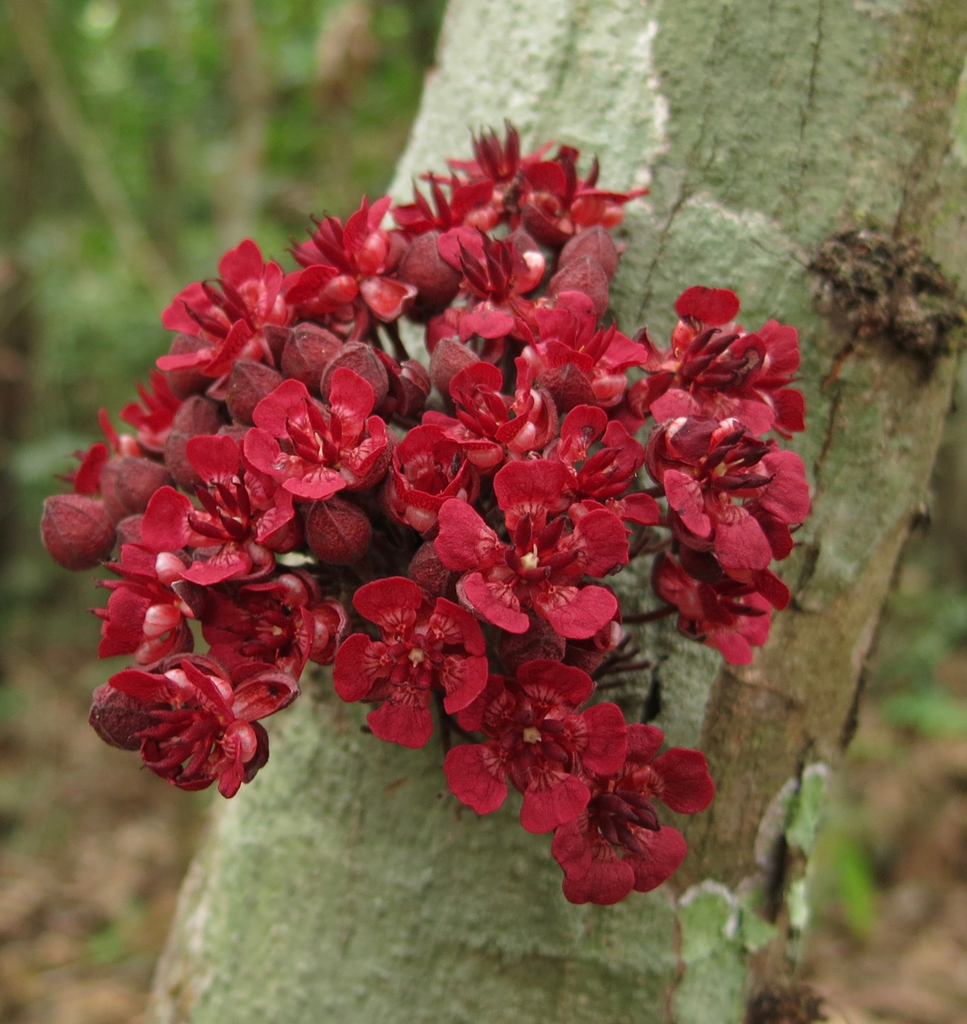
Theobroma speciosum is an evergreen tree species of flowering plant in the mallow family native to northern South America. It is the 35th most abundant species of tree in the Amazon rainforest.
From the article Theobroma speciosum on Wikipedia (CC BY-SA), quoted section by section
Description
Theobroma speciosum is an evergreen tree that grows up to 15 m (49 ft) tall. The trunk is straight, with plagiotropic (horizontally growing) side branches. The canopy is small. Its leaves are simple, and have a coriaceous (leather-like) surface with trichomes (hairs). Leaf arrangement is distichous (leaves alternate between one side of the stem and the other). Flowers are red, and grow on the trunk in dense clusters. Fruits are 10 cm (3.9 in) in length, and comprise approximately 20 seeds surrounded by a white flesh, which in turn is surrounded by a capsule.
Range & habitat
Theobroma speciosum is native to:
Bolivia Brazil, where it has been recorded as present in the following states: Acre Amapá Amazonas Maranhão Mato Grosso Pará Rondônia Peru Venezuela
Wikipedia: “Distribution”
What it does
The fruit of T. speciosum is a food source for primates and rodents. Its flowers are pollinated by flying insects.
Wikipedia: “Ecology”
At the table
The flesh of the fruit is eaten by the Ka'apor and Tacana peoples. The seeds are used to make chocolate, and could also be used to make cocoa butter substitutes. The flowers are edible, and contain high concentrations of antioxidants.
Wikipedia: “Food”
Where it lives
Recorded sightings
—
geo-referenced records in GBIF, from museums, herbaria and field observers.
Drag the globe to turn it. Dots are where records exist, not a range map; darker means more records.
In the stacks
Searching the stacks…
Every page naming Theobroma speciosum in the Biodiversity Heritage Library →
This page is assembled live from iNaturalist, GBIF, Wikipedia, the Source Library and the Internet Archive. It is not yet part of the hand-edited codex. iNaturalist taxon 563926.