- Plants
- ›Vascular Plants
- ›flowering plants
- ›Dicots
- ›Woodsorrels, Quandongs, and Allies
- ›quandong family
- ›Tetratheca
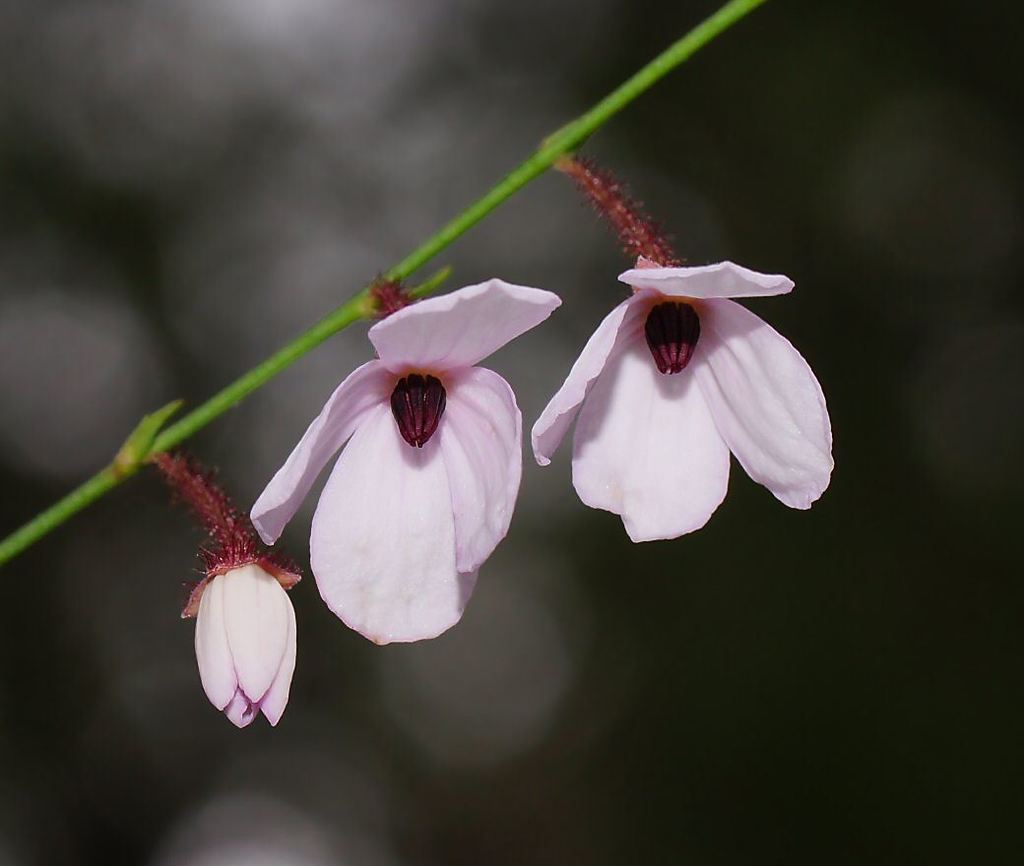
long pink-bells
Tetratheca stenocarpa
Tetratheca stenocarpa, commonly known as long pink-bells, is a small shrub in the family Elaeocarpaceae. It is endemic to Victoria in Australia.
From the article Tetratheca stenocarpa on Wikipedia (CC BY-SA), quoted section by section
Description
It is a prostrate or weeping small shrub which grows to between 1 and 1.5 metres high and 0.5 to 1 metre wide. The leaves are triangular to rounded with toothed edges. These are 5 to 12 millimetres long and wide and are reduced to scales on flowering stems and are often only seen on young growth. The pale to deep lilac-pink (rarely white) bell-shaped flowers appear between July and January in their native range. These occur in clusters of 1 to 3 on petioles with dense, gland-tipped hairs. It is similar in appearance to Tetratheca ciliata, but the latter has petioles with only a few gland-tipped hairs.
Range & habitat
The species has a restricted distribution, occurring in damp forests in hilly country to the east of Melbourne, on French Island and in a separate population in Gisborne. The species is classified as rare in Victoria. It adapts well to disturbed sites, and is often found on exposed road cuttings.
Wikipedia: “Distribution”
How it is grown
The species is free-flowering and is suitable for moist shady positions. It can be situated under established trees or at the top of retaining walls, or used in a cottage garden setting.
== References ==
Wikipedia: “Cultivation”
Where it lives
Recorded sightings
—
geo-referenced records in GBIF, from museums, herbaria and field observers.
Drag the globe to turn it. Dots are where records exist, not a range map; darker means more records.
In the stacks
Searching the stacks…
Every page naming Tetratheca stenocarpa in the Biodiversity Heritage Library →
This page is assembled live from iNaturalist, GBIF, Wikipedia, the Source Library and the Internet Archive. It is not yet part of the hand-edited codex. iNaturalist taxon 564106.