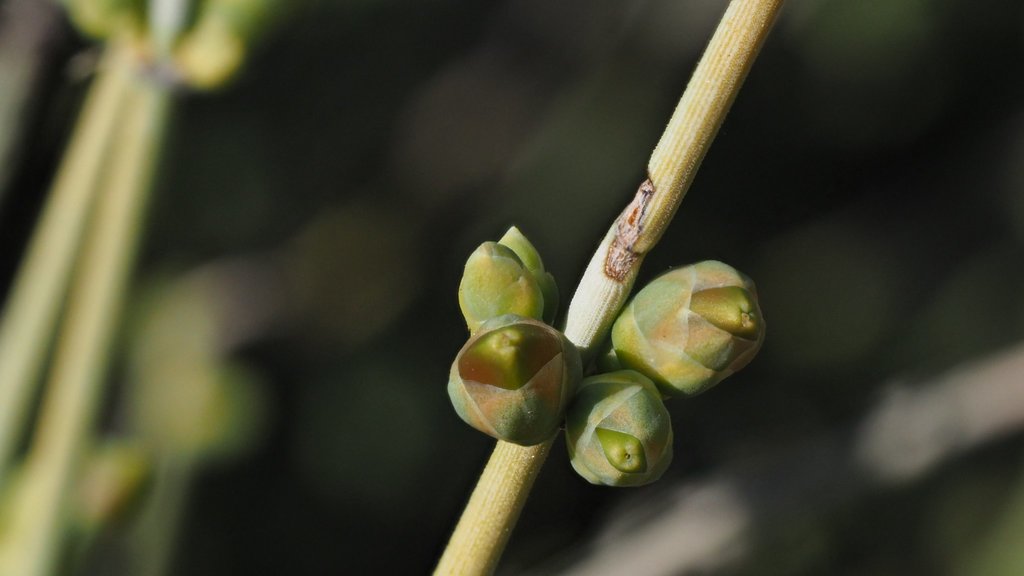
rough jointfir
Ephedra aspera
Ephedra aspera is a species of Ephedra known by the common names rough jointfir, boundary ephedra, and pitamoreal. It is native to the southwestern United States from California to Texas and parts of northern Mexico as far south as Zacatecas. It is a resident of varied woodland and scrub plant communities.
From the article Ephedra aspera on Wikipedia (CC BY-SA), quoted section by section
Description
Ephedra aspera is a highly branched shrub often exceeding 1 metre (3.3 ft) in height made up of many long yellow-gold twigs. Its small leaves are just a few millimeters long. Male plants bear pollen cones 4 to 7 millimeters long. Female plants may be darker to reddish in color, bearing seed cones which are slightly larger than those of the male plant and contain only one seed each. Shrubs are 0.5–1.5 m in length. Bark is gray, cracked and fissured. Branches are opposite or whorled, rigid, angle of divergence is about 30°. Twigs are pale to dark green, becoming yellow with age, not viscid, slightly to strongly scabrous, with numerous longitudinal grooves; internodes are 1–6 cm in length. Terminal buds conic, 1–2 mm, apex obtuse. Leaves opposite (rarely in whorls of 3), 1–3(–5) mm, connate to 1/2–7/8 their length; bases thickened, brown, shredding with age, ± persistent; apex obtuse. Pollen cones 2 (rarely 1 or whorled) at node, obovoid, 4–7 mm, sessile or rarely on short peduncles; bracts opposite, 6–10 pairs, yellow to red-brown, obovate, 3–4 × 2–3 mm, membranous; bracteoles slightly exceeding bracts; sporangiophores 4–5 mm, 1/2 exserted, with 4–6 sessile to short-stalked (less than 1 mm) microsporangia. …
Where it lives
Recorded sightings
—
geo-referenced records in GBIF, from museums, herbaria and field observers.
Drag the globe to turn it. Dots are where records exist, not a range map; darker means more records.
In the stacks
Searching the stacks…
Every page naming Ephedra aspera in the Biodiversity Heritage Library →
This page is assembled live from iNaturalist, GBIF, Wikipedia, the Source Library and the Internet Archive. It is not yet part of the hand-edited codex. iNaturalist taxon 565392.