- Plants
- ›Vascular Plants
- ›flowering plants
- ›monocots
- ›lilies, supplejacks, and allies
- ›lily family
- ›true lily subfamily
- ›true lilies and allies
- ›Lilium
- ›Lophophorum
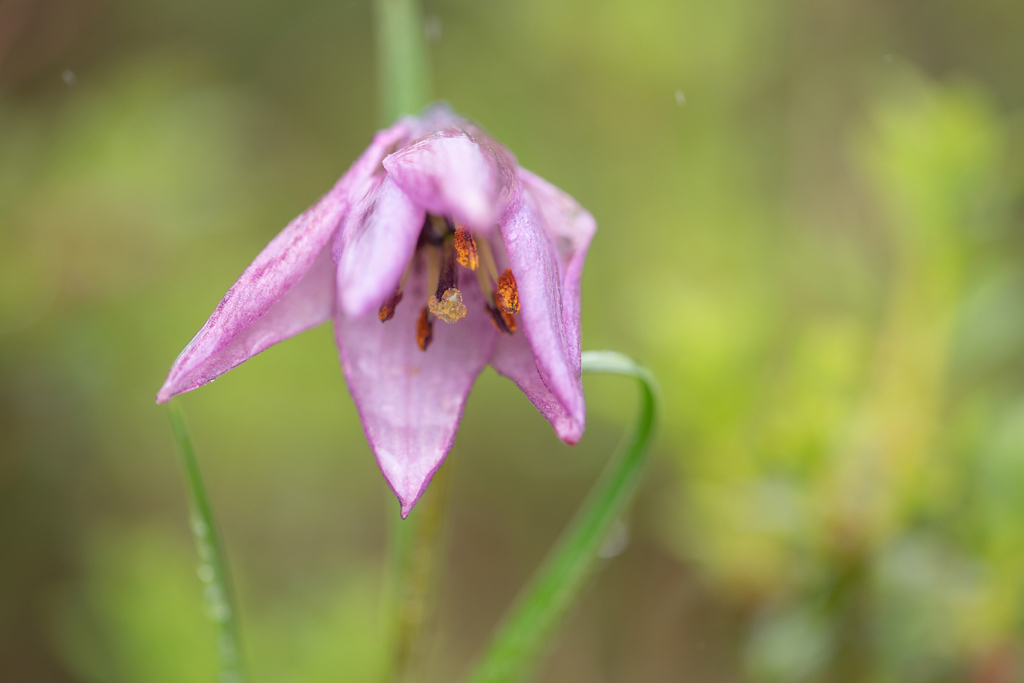
Lilium nanum
Lilium nanum is a species belonging to the lily family (Liliaceae). The species is widespread throughout the Himalayas and is one of the genus's smallest species. Lilium nanum was discovered in 1845 on a journey by Prince Waldemar of Prussia. The name was first described in 1860.
From the article Lilium nanum on Wikipedia (CC BY-SA), quoted section by section
Description
Lilium nanum is a perennial herbaceous plant that grows from 8 to 42 cm tall. The oblong-ovate-shaped bulbs have a height of 2 to 4 cm and a diameter of 1 to 2.3 cm. The white, narrowly lanceolate, and overlapping scales, which range from 9 to 22 cm, resemble roof tiles. They generally measure between 2 and 2.5 cm high and between 0.3 and 0.8 cm wide. The green stem is thin, erect, cylindrical, and hairless, and thickens from 0.15 to 0.3 cm. It is equally covered from the base to almost the end with 8 to 14 spirally arranged stem leaves that range in size from wide to narrow-linear and measure between 5 and 15.5 cm in length and 0.2 to 0.7 cm wide. They consist of three to seven diffuse veins, are glabrous, with a blunt to rounded tip, and are concave adaxially (facing the axis). Lower leaves are significantly smaller, possibly even to the size of membranous stipules.
In June, the plant develops a terminal, nodding, bell-shaped solitary flower. The pedicel is long and twisted, and it ranges in length from 0.5 to 5.5 cm. The flowers of the flavidum variety are mostly purple to violet with very little pale yellow. The six petals of the outer circle are about the same size and form as the inner circle's six petals, which are a little shorter and wider. Tiny papillae are scattered throughout its tip. …
Range & habitat
The species is native to the Himalayas. It occurs in Sikkim, Nepal, Bhutan, southwestern China (Sichuan, Tibet, and Yunnan), as well as northern Myanmar. It inhabits altitudes between 3500 m and 4500 m above sea level, but is also found above the tree line; Turrill cites findings at 5795 m. According to reports from Nepal, Tibet, Sikkim, and Bhutan, it appears to be widespread and flourishing in the monsoon season. In addition to open, grassy, and frequently rocky hillsides, it also lives in alpine thickets, pine woods, and forest edges. It also occasionally lives in shady, protected areas close to junipers, rhododendrons, and dwarf birch trees.
Wikipedia: “Distribution and habitat”
In human culture
Lilium nanum was collected in 1845 by Werner Hoffmeister, the friend, physician, and traveling companion of Prince Waldemar of Prussia during his journey through Asia, but the precise location and date of the gathering are unknown, as Hoffmeister died in the Battle of Ferozeshah on December 21–22, 1845. The botanical processing of the collected material was done by Johann Friedrich Klotzsch in Berlin. He wrote the initial description but died in 1860 before finishing the manuscript on the entire work. Christian August Friedrich Garcke completed this and published "Die botanischen Ergebnisse der Reise seiner König" in 1862. Klotzsch is the only author because the first description therein was all his own creation. The Latin word "nanus" (which means "dwarf") in the species epithet to the plant's unusually short height. The type specimen has not been preserved; it was last verifiably seen by John Gilbert Baker in 1875. It is remarkable that the first description with "Bloom...white" and "finely pubescent", are two characteristics that contradict the species' present knowledge. Starting in 1900, many species variants were redescribed with increasingly frequent specimens, including transfer to other genera. …
Wikipedia: “Botanical history”
Where it lives
Recorded sightings
—
geo-referenced records in GBIF, from museums, herbaria and field observers.
Drag the globe to turn it. Dots are where records exist, not a range map; darker means more records.
In the stacks
Searching the stacks…
Every page naming Lilium nanum in the Biodiversity Heritage Library →
This page is assembled live from iNaturalist, GBIF, Wikipedia, the Source Library and the Internet Archive. It is not yet part of the hand-edited codex. iNaturalist taxon 565758.