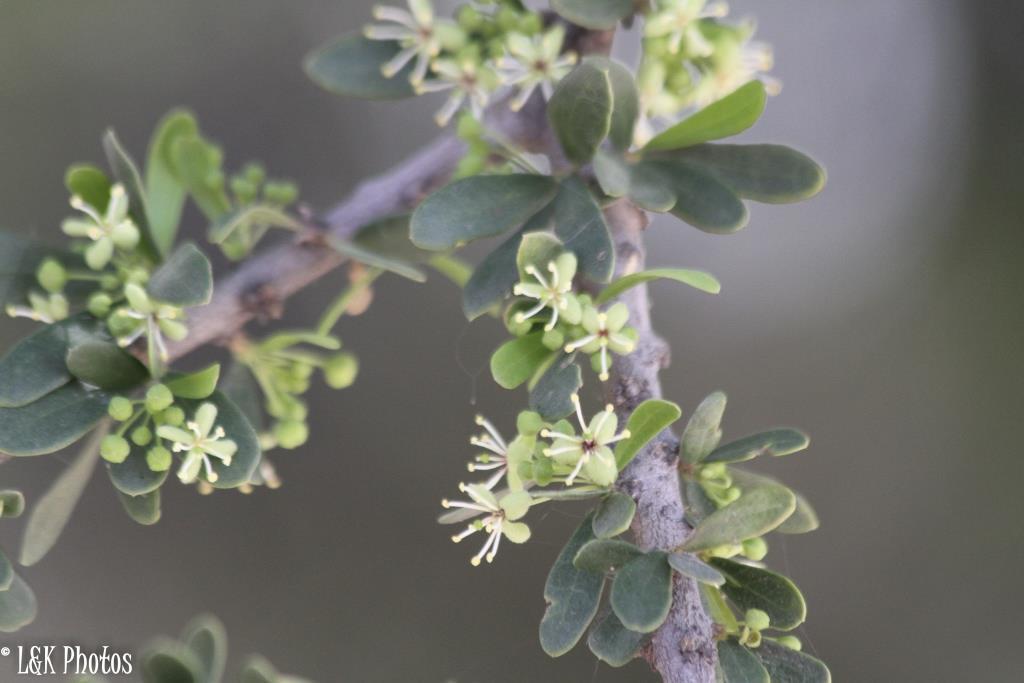
Stink Shepherdstree
Boscia foetida
Boscia foetida, commonly known as the stink shepherd's tree and the smelly shepherd's bush, is an evergreen shrub or tree that is native to the warmer and drier parts southern Africa. It is found in semi-desert and arid bushveld, and in the west it occurs commonly in areas which are otherwise sparsely wooded. It is known for the particularly unpleasant smell of its flowers which appear during early spring, to which its specific name foetida alludes. Its freshly cut wood likewise has an unpleasant smell, and has traditional medicinal and magical uses, for instance as a protection against lightning. In central Botswana the village of Mopipi is named after this species.
From the article Boscia foetida on Wikipedia (CC BY-SA), quoted section by section
Range & habitat
It occurs in Namibia up to the Kunene region, the Northern Cape, central Botswana to southern Zimbabwe and the Transvaal bushveld and lowveld, eastern Eswatini, KwaZulu-Natal southwards to the Tugela valley, and in southernmost Mozambique. It grows mainly on plains in semi-desert or arid bushveld. It is also present on hillsides, rocky outcrops, termite mounds or along dry river courses. It grows on rocky, stony or gravel substrates in the west, and is absent from sand except where a rocky substrate is present.
Wikipedia: “Range and habitat”
Where it lives
Recorded sightings
—
geo-referenced records in GBIF, from museums, herbaria and field observers.
Drag the globe to turn it. Dots are where records exist, not a range map; darker means more records.
In the stacks
Searching the stacks…
Every page naming Boscia foetida in the Biodiversity Heritage Library →
This page is assembled live from iNaturalist, GBIF, Wikipedia, the Source Library and the Internet Archive. It is not yet part of the hand-edited codex. iNaturalist taxon 566049.