- Plants
- ›Vascular Plants
- ›flowering plants
- ›monocots
- ›Spiderworts and Allies
- ›Spiderworts
- ›Commelinoideae
- ›Commelineae
- ›Dayflowers and relatives
- ›Aneilema
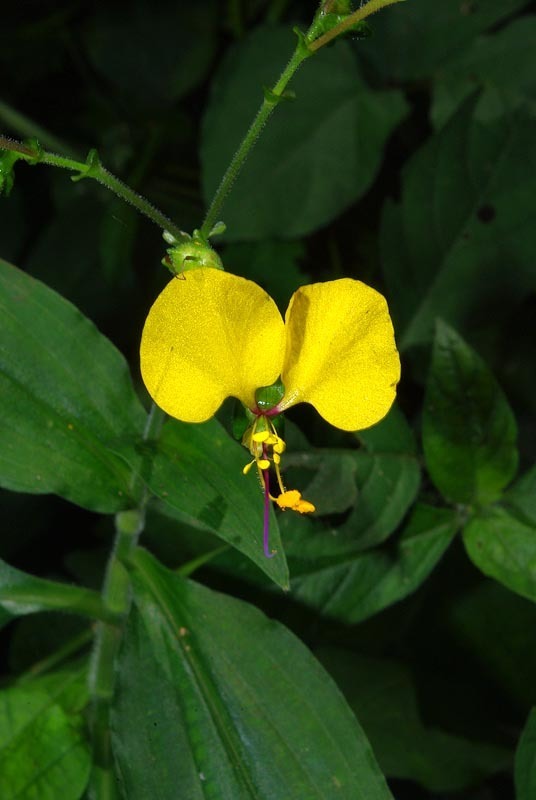
Clinging Aneilema
Aneilema aequinoctiale
Aneilema aequinoctiale is a flowering shrub native to much of sub-Saharan Africa. It is sometimes referred to by its English common name, clinging aneilema, and in Yoruba, a language of West Africa, it may be referred to as ẹfĩajija.
From the article Aneilema aequinoctiale on Wikipedia (CC BY-SA), quoted section by section
Description
A. aequinoctiale is a perennial shrub, sometimes considered a herb, that may be scrambling or erect in habit. It can grow up to two metres in height. The leaves and their leaf-sheaths, arranged distichously on the stem, are pale green and covered in fine, hooked hairs that give a "sticky" feeling. Leaf shapes may be ovate or lanceolate to elliptic. Roots of the plant are fibrous and thin. The inflorescences are usually terminal, and the cincinni may be whorled, opposite, or alternate. The petals of A. aequinoctiale are bright yellow and grow as a single pair, with a third petal either absent or small and withered. The flowers are short-lived, opening daily from approximately 07:00 to 10:00 during the flowering season, which is September through June. The flowers may be perfect, possessing both male and female reproductive organs, or may be staminate only. The capsules are generally oblong to obovate, and seeds are brown.
Wikipedia: “Description and habit”
Range & habitat
A. aequinoctiale prefers moist, partially shaded areas, and often grows on forest margins and by streams, though it can also be found growing in grassland, farmland, and roadside scrub. It is widespread in several regions of West and East Africa, though it is reported as being more widely cultivated and made use of in Nigeria, Uganda, Kenya, Zanzibar, and Zimbabwe. Ungulates may graze on the plant in grassland areas, such as Kenya, though its main uses in Africa are medicinal, culinary, and domestic. In the Ondo regions of Nigeria, infants may be bathed in a wash made from the roots of A. aequinoctiale. In other regions, the roots may be used as feed for livestock, and leaves may be cooked like spinach. The plant may be used to relieve colds in Zanzibar, though throughout Africa, the roots serve many other medicinal purposes, being used to treat skin disorders, diseases of the eye, constipation, leprosy, kwashiorkor, and amenorrhoea. Its application is also believed to help children with osteomalacia to walk. Considerable research has confirmed that chimpanzees self-medicate with A. aequinoctiale by swallowing the leaves whole. …
Wikipedia: “Natural habitat, cultivation, and uses”
Where it lives
Recorded sightings
—
geo-referenced records in GBIF, from museums, herbaria and field observers.
Drag the globe to turn it. Dots are where records exist, not a range map; darker means more records.
In the stacks
Searching the stacks…
Every page naming Aneilema aequinoctiale in the Biodiversity Heritage Library →
This page is assembled live from iNaturalist, GBIF, Wikipedia, the Source Library and the Internet Archive. It is not yet part of the hand-edited codex. iNaturalist taxon 566632.