- Plants
- ›Vascular Plants
- ›flowering plants
- ›Dicots
- ›Sunflowers, Bellflowers, Fanflowers, and Allies
- ›Sunflowers, Daisies, Asters, and Allies
- ›Asteroideae
- ›asters and allies
- ›Hinterhuberinae
- ›Mairia
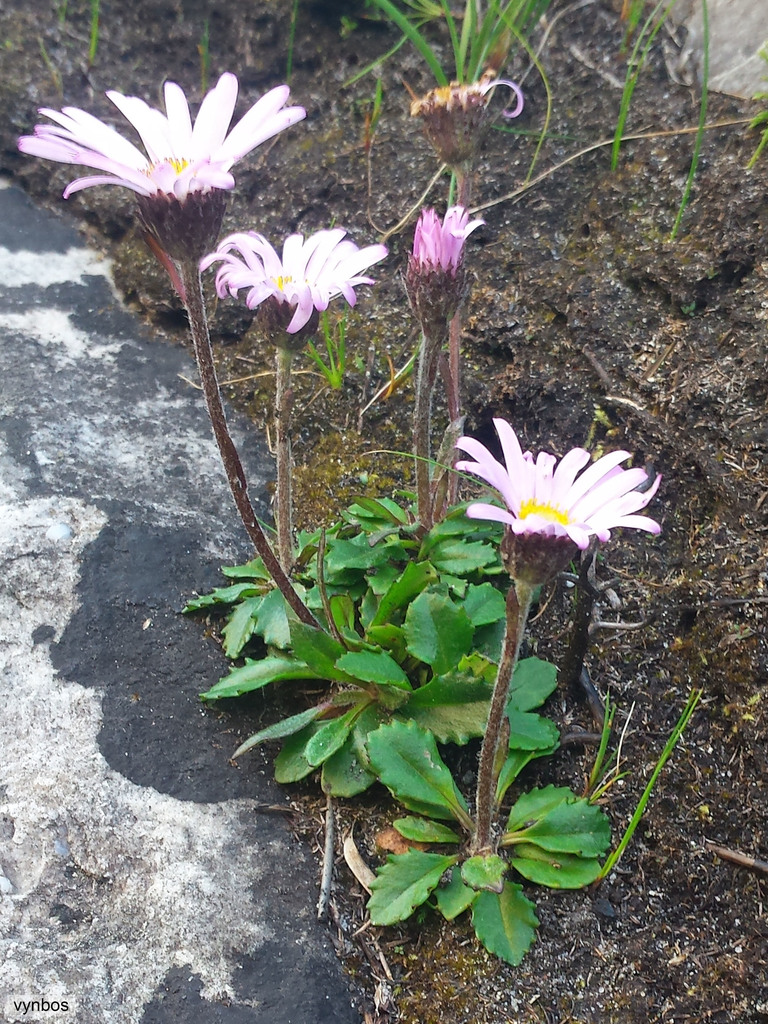
Scallop Fire-Aster
Mairia crenata
Mairia crenata is a perennial herbaceous plant of mostly 2–15 cm (1–6 in) high that is assigned to the family Asteraceae. It has a woody rootstock of up to 5 cm (2 in) long, from which brown, fleshy roots develop. The five to eighteen, hard and leathery, spoon-shaped leaves are in one to three rosettes, have a distinct main vein, blunt or pointy tip, often dark red or blackish margins with rounded teeth and a 1⁄2–2 cm (0.2–0.8 in) long stalk-like foot, often initially somewhat woolly hairy, on particularly the lower surface and the main vein, but this is easily rubbed off the shiny surfaces. Each rosette produces mostly one, sometimes up to four, mostly rusty or whitish woolly hairy, brown or dark red inflorescence stalks, usually 1+1⁄2–15 cm (2⁄3–6 in) long, each with two to eight, initially woolly, line-shaped to oval bracts, the lowest up to 3 cm (1.2 in), decreasing size further up, and carrying mostly one, rarely up to three flower heads. The flower heads have a bell-shaped involucre with about 40 bracts, sixteen to thirty three violet to white ray florets of about 1+1⁄4–1+7⁄8 cm long, and many yellow disc florets. The species flowers anywhere between February and December but only after a fire has destroyed the overhead biomass or serious disturbance. It is an endemic species that is restricted to the Eastern Cape and Western Cape provinces of South Africa.
From the article Mairia crenata on Wikipedia (CC BY-SA), quoted section by section
Description
Mairia crenata is a geophytic perennial herb of variable height and hairiness. It is mostly 2–15 cm (1–6 in) high, but at low altitude and particularly towards the east it may sometimes reach 40 cm (16 in). It has a woody rizome of up to 5 cm (2 in) long, from which bright to dark brown, thick and fleshy roots appear, and one to three leaf rosettes. The five to seventeen hard leathery leaves may be somewhat succulent, are narrowed into a leaf stalk of 1⁄2–2 cm (0.2–0.8 in) long or less narrowed and have a distinct midvein. The axils of the leaves are often woolly. Mostly under an initial covering of some woolly hairs the surface of the leaf blade is shiny, ellipse-shaped, inverted oval, spoon-shaped, or almost circular, 2–4+1⁄2 cm (0.8–1.8 in) long and 1⁄2–2+1⁄2 cm (0.2–1.0 in) wide. The leaf tip may both be pointy or blunt. The leaf margin is flat or slightly curves down, and has evenly distributed rounded teeth with blackish red tips, rarely it is almost entire.
Inflorescences. From each leaf rosette, one, or sometimes up to four, brown to dark red, robust inflorescence stalks rise up to 1+1⁄2–15 cm (0.6–6 in) sometimes up to 40 cm (16 in), mostly initially covered with white or rusty woolly hairs, broadening close to the flower heads. …
Range & habitat
M. crenata has the largest distribution of any species of Mairia. It has an isolated population on Table Mountain. From Du Toitskloof Pass and the Hottentots Holland Mountains in the west, it can be found along the length of the Riviersonderend Mountains, the Langeberg, the Outeniqua Mountains and Tsitsikamma Mountains all the way to the Kouga Mountains on the eastern end. It grows in fynbos vegetations on sandstone slopes.
Wikipedia: “Distribution, habitat and ecology”
Where it lives
Recorded sightings
—
geo-referenced records in GBIF, from museums, herbaria and field observers.
Drag the globe to turn it. Dots are where records exist, not a range map; darker means more records.
In the stacks
Searching the stacks…
Every page naming Mairia crenata in the Biodiversity Heritage Library →
This page is assembled live from iNaturalist, GBIF, Wikipedia, the Source Library and the Internet Archive. It is not yet part of the hand-edited codex. iNaturalist taxon 566735.