- Plants
- ›Vascular Plants
- ›flowering plants
- ›Dicots
- ›proteas, lotuses, planes, and allies
- ›Protea family
- ›Singlet Proteas
- ›Nutseed Proteoid Clade
- ›Cape Nutseed Proteoids
- ›Leucospermum
- ›Diastelloidea
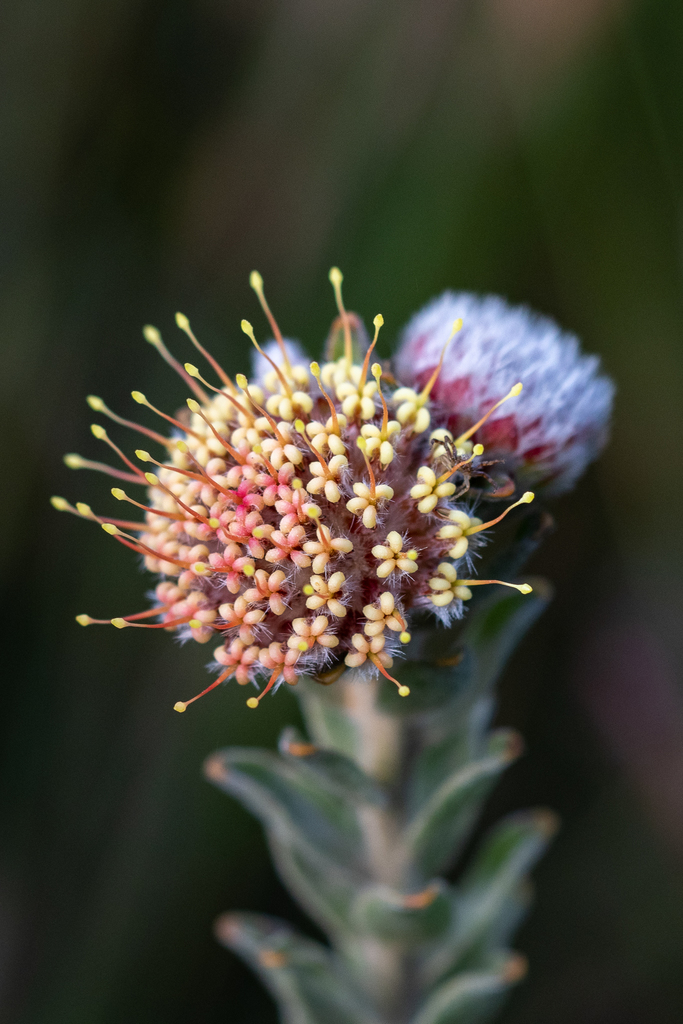
Oval-leaf Pincushion
Leucospermum truncatulum
Leucospermum truncatulum is a slender, upright, evergreen, hardly branching shrub of up to 2 m (6 ft) high, with felty inverted egg-shaped to oval, leaves with entire margins of 1–2½ cm (0.4–1.0 in) long and ½–1 cm (0.2–0.4 in) wide. It has small globe-shaped, at first yellow, later pinkish flower heads of 1½–2 cm (0.6-0.8 in) in diameter, without a stalk, usually crowded with two to eight together near the end of the stems. It is known as oval-leaf pincushion in English, and patrysbos or kleinkopspeldekussing in Afrikaans. It is an endemic species of the south of the Western Cape province of South Africa, and flowers between August and December.
From the article Leucospermum truncatulum on Wikipedia (CC BY-SA), quoted section by section
Description
The oval-leaf pincushion is a slender, stiffly upright and very sparsely branching evergreen shrublet mostly 1–1½ m, occasionally up to 2 m (6 ft) high, with a single basal stem. The flowering stems are slender, 3–4 mm (0.12–0.16 in) in diameter, densely set with soft hairs. The leaves are small for a Leucospermum species, rounded egg-shaped to oval with entire margins, 1–2½ cm (0.4–1.0 in) long and ½–1 cm (0.2–0.4 in) wide, densely overlapping, covered with fine silky hairs. The flower heads are globe-shaped, 1½–2 cm (0.6-0.8 in) in diameter, without a stalk, usually crowded with two to eight together near the end of the stems. The common base of the flowers in the same head is flat and 4–5 mm in diameter. The bracts subtending the flower head are arranged in three or four whorls, each broadly lance-shaped to oval, with a pointy or blunt tip, 5–7 mm (0.20–0.28 in) long and 2–5 mm (0.08–0.20 in) wide, papery in consistency and with a thin tuft of long straight hair at its tip, with a regular row of straight hairs along the margin but otherwise without hairs. The bracts subtending the individual flowers are lance-shaped with a pointy tip, about 6 mm (0.24 in) long and 2 mm (0.08 in) wide, densely covered in woolly hairs. The perianth is initially yellow in colour but changes to pinkish over time, is 8–10 mm (0.32–0.40 in) long. …
Range & habitat
The oval-leaf pincushion can be found from the eastern foothills of the Kogelberg Peak in the west, to the south along the Bot River, along the coast from Hermanus, almost reaching Cape Agulhas in the southeast of its range, north to Bredasdorp northwestwards via Caledon. Plants are mostly found in extensive stands. Across its range the average annual precipitation is between 650 and 1000 mm (25–40 in), most of which falls during the winter half year. The species prefers acidulous and nutrient-poor sands on east- and southward facing slopes from sea level to about 365 m (1200 ft) where grows in a dense sclerophyll vegetation further mainly consisting of other Proteaceae, Ericaceae and the grass-like Restionaceae. The oval-leaf pincushion is pollinated by insects, including bees and flies. When the fruits are ripe about two months after flowering, they fall to the ground. Here they are gathered by ants who are attracted to a pale fleshy ant loaf (or elaiosome) and carry them to their underground nests where the ant loaf is eaten, but the seeds remain safely stored. This seed dispersal strategy is known as myrmecochory. After above ground the plants are killed by the wildfires that naturally occur in the Fynbos every decade or two, chemicals from the charred vegetation which percolate with the rainwater, the seeds germinate and revive the population. …
Wikipedia: “Distribution, habitat and ecology”
Where it lives
Recorded sightings
—
geo-referenced records in GBIF, from museums, herbaria and field observers.
Drag the globe to turn it. Dots are where records exist, not a range map; darker means more records.
In the stacks
Searching the stacks…
Every page naming Leucospermum truncatulum in the Biodiversity Heritage Library →
This page is assembled live from iNaturalist, GBIF, Wikipedia, the Source Library and the Internet Archive. It is not yet part of the hand-edited codex. iNaturalist taxon 567143.