- Plants
- ›Vascular Plants
- ›flowering plants
- ›Dicots
- ›Mints, Plantains, Olives, and Allies
- ›Plantain Family
- ›Angelonieae
- ›Ourisia
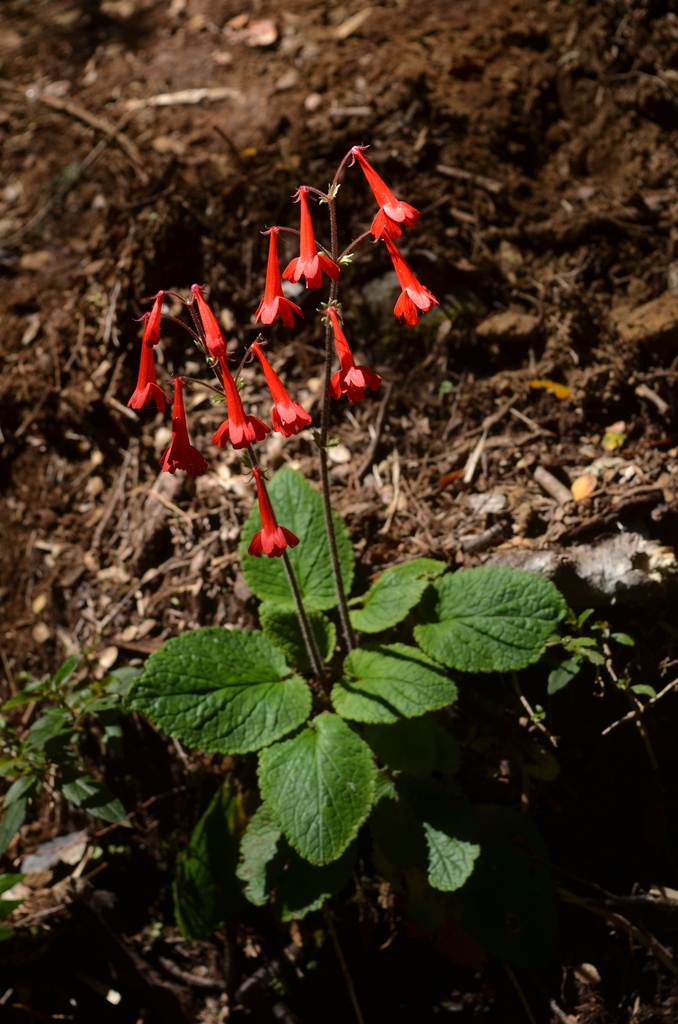
Ourisia coccinea
Ourisia coccinea is a species of flowering plant in the family Plantaginaceae that is endemic to mountainous habitats of the Andes of southern Chile and Argentina. Christiaan Hendrik Persoon described O. coccinea in 1806. Plants of this species of South American foxglove are perennial, hairy, rosette herbs with crenate leaves. There can be up to 30 flowers on a long, erect raceme, and each flower has a regular calyx, and a long, bilabiate, tubular-funnelform, red corolla with two exserted and two included stamens. The calyx is hairy with a mix of glandular and non-glandular hairs, and the corolla is usually hairless or with some glandular hairs on the outside. There are two allopatric subspecies that can be distinguished by the edges and hairs of the leaves, and by the hairs on the pedicel. It is often used as an ornamental plant.
From the article Ourisia coccinea on Wikipedia (CC BY-SA), quoted section by section
Description
Ourisia coccinea plants are perennial, erect, rosette herbs. The short stems are 2.8–8.9 mm wide, and glabrous (hairless) or rarely hairy with long, non-glandular hairs. Leaves are tightly clustered in a subrosette or rosette, petiolate, 16.6–92.1 mm long by 14.2–74.3 mm wide (length: width ratio 0.8–1.7:1). Leaf petioles are 2–14 cm long and densely hairy with long non-glandular hairs. Leaf blades are narrowly ovate, ovate, broadly ovate, or very broadly ovate, widest below the middle, usually with a rounded apex, cordate or truncate base, and crenate or doubly crenate edges that are also sometimes lobed. Both surfaces of the leaves are glabrous or sparsely hairy with non-glandular hairs, and the underside is also punctate. Inflorescences are erect, with hairy racemes up to 53 cm long, and with 3–8 flowering nodes and up to 29 total flowers per raceme. Each flowering node has 1–2 flowers and 2 petiolate to sessile bracts that are oblanceolate to obovate or lanceolate to very broadly ovate. The bracts are similar to the leaves but smaller, 3.6–24.1 mm long and 1.1–13.3 mm wide and petiolate (lower bracts only) or sessile. The flowers are borne on a pedicel that is up to 85.2 mm long and is sparsely to densely hairy with tiny to long (<0.1 mm to 0.7 mm) glandular hairs. …
Range & habitat
Ourisia coccinea is native to the Andes mountains of Chile and Argentina from approximately 31°S to 46°S latitude. In Chile it is found in the regions of Coquimbo, Santiago Metropolitan, O'Higgins, Maule, Ñuble, Biobío, Araucanía, Los Ríos, Los Lagos, and Aysén, and in Argentina it is found in the province of Neuquén. It is found from sea level to 2600 m elevation in rocky, wet habitats, including near running water, often in shady forests. It is the only species of Ourisia found on the island of Chiloé.
Wikipedia: “Distribution and habitat”
What it does
Although the flowers of O. coccinea fit the hummingbird pollination syndrome, suggesting ornithophily, and have abundant nectar, no hummingbirds were seen to visit this species during the course of one study on the island of Chiloé.
Wikipedia: “Pollination”
Where it lives
Recorded sightings
—
geo-referenced records in GBIF, from museums, herbaria and field observers.
Drag the globe to turn it. Dots are where records exist, not a range map; darker means more records.
In the stacks
Searching the stacks…
Every page naming Ourisia coccinea in the Biodiversity Heritage Library →
This page is assembled live from iNaturalist, GBIF, Wikipedia, the Source Library and the Internet Archive. It is not yet part of the hand-edited codex. iNaturalist taxon 567783.