- Plants
- ›Vascular Plants
- ›flowering plants
- ›Dicots
- ›proteas, lotuses, planes, and allies
- ›Protea family
- ›Singlet Proteas
- ›Smokebushes and Blueboys
- ›Conosperminae
- ›Synaphea
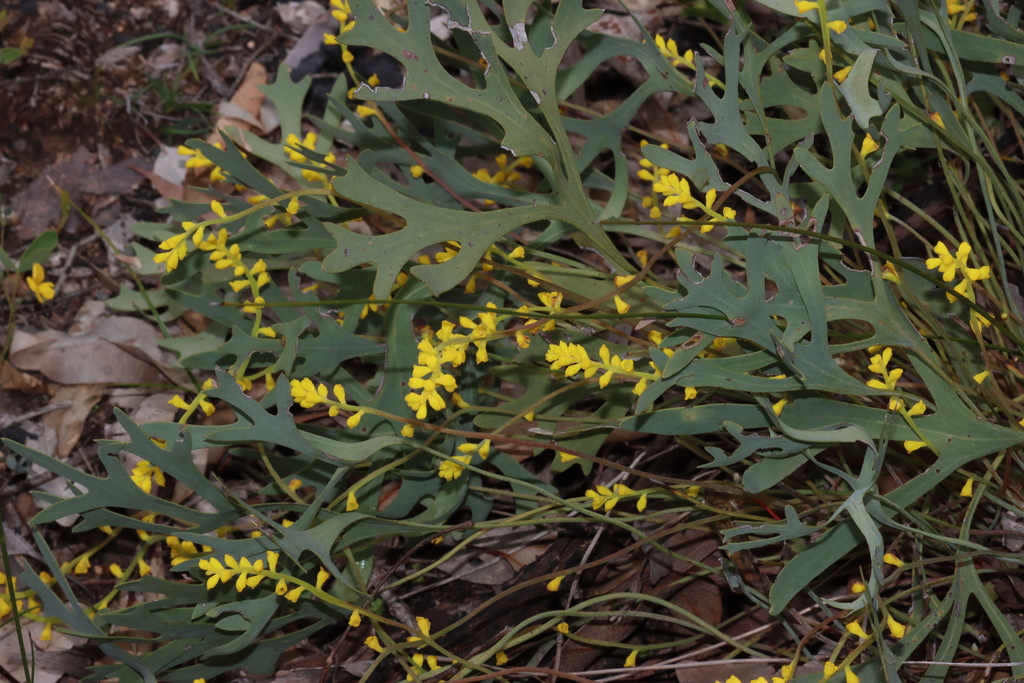
Synaphea petiolaris
Synaphea petiolaris is a species of flowering plant in the family Proteaceae and is endemic to the south west of Western Australia. It is a shrub with tufted stems, simple or deeply lobed to pinnatipartite leaves, and spikes of widely spaced yellow flowers.
From the article Synaphea petiolaris on Wikipedia (CC BY-SA), quoted section by section
Description
Synaphea petiolaris is a shrub that typically grows to a height of up to 60 cm (24 in) and has tufted stems up to 100 mm (3.9 in) long, sometimes covered with soft hairs pressed against the surface. Its leaves are usually deeply three-lobed to pinnatipartite, 60–200 mm (2.4–7.9 in) long on a petiole, the primary lobes simple or deeply lobed. The lobes are linear to lance-shaped, 5–8 mm (0.20–0.31 in) long. The flowers are yellow and widely spaced in spikes 30–150 mm (1.2–5.9 in) long on simple or branched peduncles 70–350 mm (2.8–13.8 in) long, with bracts 1.0–1.5 mm (0.039–0.059 in) long. The perianth is ascending, the opening more or less wide, sparsely hairy or glabrous. The upper tepal is 4.0–5.5 mm (0.16–0.22 in) long and 1.9–2.5 mm (0.075–0.098 in) wide and the lower tepal 3.5–4.0 mm (0.14–0.16 in) long. The stigma is broadly egg-shaped to oblong, deeply notched to horned, 0.8–1.3 mm (0.031–0.051 in) long and 0.9–1.1 mm (0.035–0.043 in) wide. The ovary is covered with soft hairs to almost glabrous. Flowering occurs from June to December or January, and the fruit is elliptic to egg-shaped on a prominent neck and beaked, 5–6 mm (0.20–0.24 in) long with spreading hairs or glabrous.
Range & habitat
Synaphea petiolaris is found around swamps and on sand plains, slopes and low-lying areas in the Esperance Plains, Jarrah Forest, Mallee, Swan Coastal Plain and Warren bioregions of south-western Western Australia.
Subspecies petiolaris often grows in low-lying areas in sand or sandy loam, sometimes over laterite or granite and is widespread from Walpole, east to Cape Arid National Park, inland to the Stirling Range and north to Wooroloo. Subspecies simplex grows in sandy soils on flats and winter-wet areas in open eucalypt woodland and is restricted to areas north-east of Busselton in the Jarrah Forest and Swan Coastal Plain bioregions. Subspecies triloba grows in sandy soils in swampy areas and clay flats from Walpole to Busselton in the Jarrah Forest, Swan Coastal Plain and Warren bioregions.
Wikipedia: “Distribution and habitat”
Where it lives
Recorded sightings
—
geo-referenced records in GBIF, from museums, herbaria and field observers.
Drag the globe to turn it. Dots are where records exist, not a range map; darker means more records.
In the stacks
Searching the stacks…
Every page naming Synaphea petiolaris in the Biodiversity Heritage Library →
This page is assembled live from iNaturalist, GBIF, Wikipedia, the Source Library and the Internet Archive. It is not yet part of the hand-edited codex. iNaturalist taxon 567938.