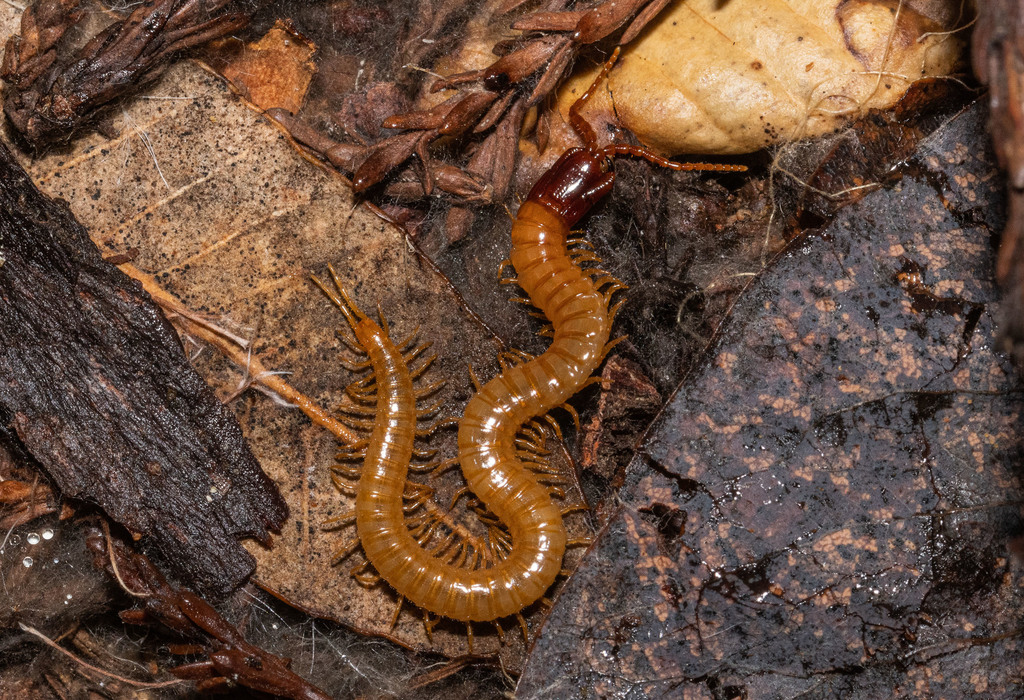
Dicellophilus limatus
Dicellophilus limatus is a species of soil centipede in the family Mecistocephalidae. This centipede is the type species for the genus Dicellophilus. This species features 45 pairs of legs, the maximum number observed in this genus, and can reach 60 mm or more in length. This species is found in California. This centipede is one of only four species in the family Mecistocephiladae found in North America.
From the article Dicellophilus limatus on Wikipedia (CC BY-SA), quoted section by section
Description
The species D. limatus features 45 leg pairs in each sex and can reach 60 mm or more in length and nearly 3 mm in width. The body ranges from yellow to orange-red, with the head and antennae ranging from dark red to chestnut brown. The tergites on the anterior half of the body often feature a narrow darker border on the posterior margin. Although no other species in the genus Dicellophilus features 45 leg pairs, the species D. limatus shares some distinctive traits with the other members of this genus. For example, as in all species in this genus, each of the posterior lateral sclerites of the labrum features longitudinal folds and a concave posterior margin fringed with bristles. Furthermore, as in all of these species, each of the ultimate legs features not only a ventral pore that is distinctly larger than all the other pores but also a tubercle at the distal end with a few small spines. The species D. limatus shares a more extensive set of distinctive traits with its close relatives, D. anomalus and D. pulcher. For example, in all three of these species, the terminal article of each of the antennae is elongate, with a length/width ratio ranging from 2.2 to 2.4. Furthermore, in all three species, the distal parts of the coxal projections from the first maxillae are evidently enlarged and subtriangular. The species D. …
Range & habitat
The natural distribution of the species D. limatus is limited to a narrow area along the Pacific Coast Ranges in central and southern California. In particular, this centipede is found around San Francisco Bay and near Los Angeles. This species has been recorded in Sonoma, Mill Valley, Sausalito, Berkeley, Stanford, and Claremont. Although this centipede has also been recorded elsewhere, on Nantucket island in Massachusetts, near Nashville, Tennessee, and at Chapman Field in Miami, Florida, authorities express some doubts about these records and find no persuasive evidence that this species actually lives outside of California.
== References ==
Wikipedia: “Distribution”
Where it lives
Recorded sightings
—
geo-referenced records in GBIF, from museums, herbaria and field observers.
Drag the globe to turn it. Dots are where records exist, not a range map; darker means more records.
In the stacks
Searching the stacks…
Every page naming Dicellophilus limatus in the Biodiversity Heritage Library →
This page is assembled live from iNaturalist, GBIF, Wikipedia, the Source Library and the Internet Archive. It is not yet part of the hand-edited codex. iNaturalist taxon 568162.