- Plants
- ›Vascular Plants
- ›flowering plants
- ›Dicots
- ›proteas, lotuses, planes, and allies
- ›Protea family
- ›Singlet Proteas
- ›Hairiseed Proteoid Clade
- ›Protea
- ›Lasiocephalae
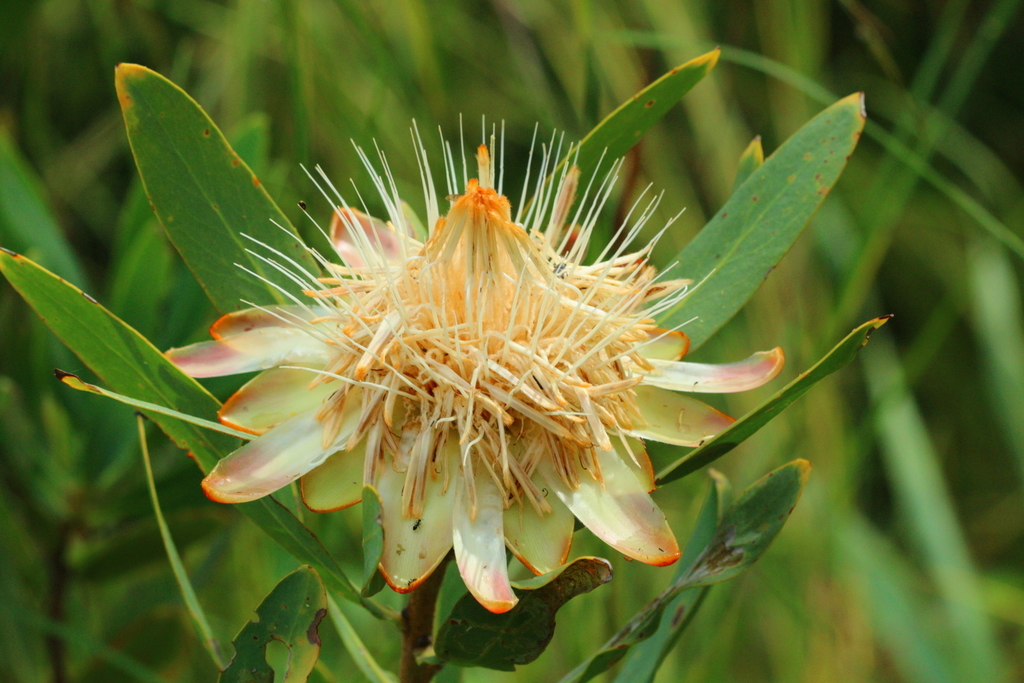
African sugarbush
Protea gaguedi
Protea gaguedi is similar to Protea welwitschii and has hairless mature leaves and solitary flower heads. It is widely distributed in Africa, from Ethiopia to KwaZulu-Natal in South Africa.
From the article Protea gaguedi on Wikipedia (CC BY-SA), quoted section by section
Description
This plant usually grows in the form of a small, erect to gnarled tree, reaching up to three metres in height. It has leaves which are oblong to elliptic, and often distinctly sickle-shaped. The leaves are glabrous (hairless) when mature, except for a few hairs near the base of the blade. The leaves are coloured light green to blue-green. The prominent midrib of the leaves is coloured somewhat yellowish. It usually has solitary flower heads, a specialised type of inflorescence. These flower heads are quite variable in form, but can grow up to 11 cm (4.3 in) in diameter. The flower heads are densely hairy and have a very strong scent. The outer involucral bracts range in colour from pink, to greenish-white, to white. The inner bracts are covered in silver hairs and are coloured pale green. The margins of the bracts may or may not have rusty-coloured hairs sprouting from them. The fruit is a hairy nutlet.
Similar species. It is similar to P. welwitschii, but this species has 60 mm (2.4 in) diameter flower heads which are usually clustered together in groups of three or four, and young leaves densely covered in hairs, with older leaves retaining pubescence at their base.
Range & habitat
It is widely distributed in Africa, from Eritrea in the north, to KwaZulu-Natal in South Africa. It does not occur in the Sahel of West Africa. Countries it occurs in include Sudan (including South Sudan), Eritrea, Ethiopia, Burundi, Rwanda, Uganda, Kenya, Tanzania, the Democratic Republic of Congo, Zambia, Angola, Botswana, Zimbabwe, Malawi, Mozambique, Namibia, eSwatini and South Africa. In South Africa it is a widespread species across the north of the country, and can be found in Gauteng, KwaZulu-Natal, Limpopo, Mpumalanga and North West Province.
Wikipedia: “Distribution”
In human culture
This tree is known by the common name of African protea. Other vernacular names for this species used in South Africa include African sugarbush, African white sugarbush, deciduous sugarbush or white sugarbush. In isiZulu and Ndebele it is known as isiqalaba, in the Northern Sotho language it is called segwapi, and in Venda tshizungu. In Shona it may be called mubonda, mumhonda, or musitsuru. In Afrikaans this species is known by the vernacular names of Afrika-witsuikerbos, grootsuikerbos, groot-suikerbos, suikerbos or witsuikerbos. In Pokot the species is called Sikninwö for single tree and Sikïnin in plural.
Wikipedia: “Common names and etymology”
Where it lives
Recorded sightings
—
geo-referenced records in GBIF, from museums, herbaria and field observers.
Drag the globe to turn it. Dots are where records exist, not a range map; darker means more records.
In the stacks
Searching the stacks…
Every page naming Protea gaguedi in the Biodiversity Heritage Library →
This page is assembled live from iNaturalist, GBIF, Wikipedia, the Source Library and the Internet Archive. It is not yet part of the hand-edited codex. iNaturalist taxon 568506.