- Plants
- ›Vascular Plants
- ›flowering plants
- ›Dicots
- ›Mints, Plantains, Olives, and Allies
- ›Plantain Family
- ›Veroniceae
- ›Veronica
- ›Pseudoveronica
- ›Labiatoides
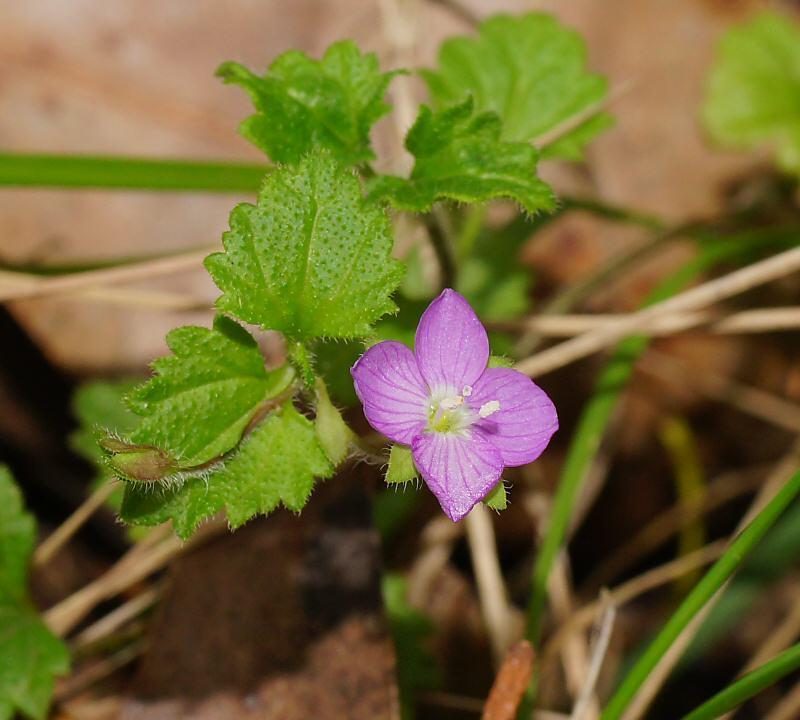
hairy speedwell
Veronica calycina
Veronica calycina, commonly known as hairy speedwell or cup speedwell, is a flowering plant in the family Plantaginaceae. It is a trailing perennial with dark green leaves, purple-blue flowers and is endemic to Australia.
From the article Veronica calycina on Wikipedia (CC BY-SA), quoted section by section
Description
Veronica calycina grows is a trailing, perennial herb, with stolons reaching 50 cm (20 in) long and rooting at leaf nodes. The flowering stems are up to 5–45 cm (2–17.5 in) long with soft stem hairs to 2 mm (0.079 in) long. The leaves are arranged in opposite pairs, usually hairy, ovate to broadly ovate, 0.7–3 cm (0.28–1.18 in) long and 0.5–2 cm (0–1 in) wide, apex either rounded or broadly pointed, base squared or slightly heart-shaped, margins with uneven, blunt teeth and a petiole 2–20 mm (0.079–0.787 in) long. The small racemes of pale blue-purple flowers are mostly in groups of up to 10 flowers, occasionally solitary, with four wide petals about 6 mm (0.24 in) long, and corolla 4–6 mm (0.16–0.24 in) long. The calyx lobes have small hairs mostly on the margins, 6.5–8.5 mm (0.26–0.33 in) long and 2.5–5 mm (0.098–0.197 in) wide when fruiting. Flowering occurs in spring and summer.
Range & habitat
Hairy speedwell is a widespread species, found in all states and territories apart from the Northern Territory. It grows in sheltered forest and shrubland on the coast, ranges and at higher altitudes in shady, moist locations.
== References ==
Wikipedia: “Distribution”
Where it lives
Recorded sightings
—
geo-referenced records in GBIF, from museums, herbaria and field observers.
Drag the globe to turn it. Dots are where records exist, not a range map; darker means more records.
In the stacks
Searching the stacks…
Every page naming Veronica calycina in the Biodiversity Heritage Library →
This page is assembled live from iNaturalist, GBIF, Wikipedia, the Source Library and the Internet Archive. It is not yet part of the hand-edited codex. iNaturalist taxon 568774.