- Plants
- ›Vascular Plants
- ›flowering plants
- ›Dicots
- ›proteas, lotuses, planes, and allies
- ›Protea family
- ›Singlet Proteas
- ›Featherbushes and Conesticks
- ›Petrophile
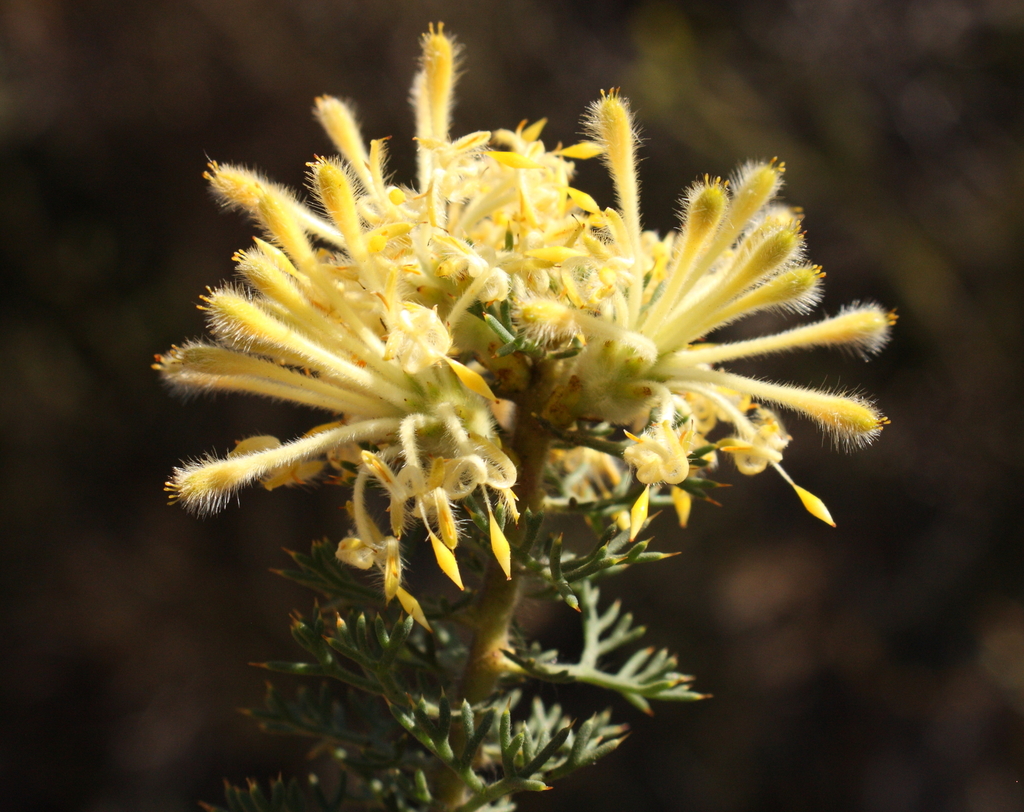
Petrophile serruriae
Petrophile serruriae is a species of flowering plant in the family Proteaceae and is endemic to southwestern Western Australia. It is a shrub with crowded, pinnate, needle-shaped, sharply-pointed leaves, and oval heads of silky-hairy yellow, greyish mauve to pink flowers.
From the article Petrophile serruriae on Wikipedia (CC BY-SA), quoted section by section
Description
Petrophile serruriae is an erect or spreading shrub that typically grows to a height of 0.2–1.5 m (7.9 in – 4 ft 11.1 in). It has silky-hairy branchlets and leaves but does not form a lignotuber. The leaves are bipinnate or tripinnate, 15–34 mm (0.59–1.34 in) long on a petiole 2–10 mm (0.079–0.394 in) long, with mostly twenty-seven to thirty-five needle-shaped, sharply-pointed lobes. The flowers are arranged on the ends of branchlets and in leaf axils with oval heads about 10 mm (0.39 in) in diameter, with a few deciduous involucral bracts at the base. The flowers are 13–16 mm (0.51–0.63 in) long, silky-hairy and yellow, greyish mauve to pink. Flowering mainly occurs from July to December and the fruit is a nut, fused with others in an oval to spherical head 10–12 mm (0.39–0.47 in) in diameter.
Range & habitat
Petrophile serruriae is common in coastal limestone and is widespread from near Geraldton to near Albany in the south-west of Western Australia.
Wikipedia: “Distribution and habitat”
Where it lives
Recorded sightings
—
geo-referenced records in GBIF, from museums, herbaria and field observers.
Drag the globe to turn it. Dots are where records exist, not a range map; darker means more records.
In the stacks
Searching the stacks…
Every page naming Petrophile serruriae in the Biodiversity Heritage Library →
This page is assembled live from iNaturalist, GBIF, Wikipedia, the Source Library and the Internet Archive. It is not yet part of the hand-edited codex. iNaturalist taxon 569578.