- Animals
- ›Arthropods
- ›Crustaceans
- ›Typical Crustaceans
- ›Malacostracans
- ›Decapods, Isopods, and allies
- ›Decapods and Krill
- ›Decapods
- ›Crabs, Lobsters, Shrimps, and Allies
- ›Crayfishes and Lobsters
- ›Parastacoidea
- ›Southern Hemisphere Crayfishes
- ›Gramastacus
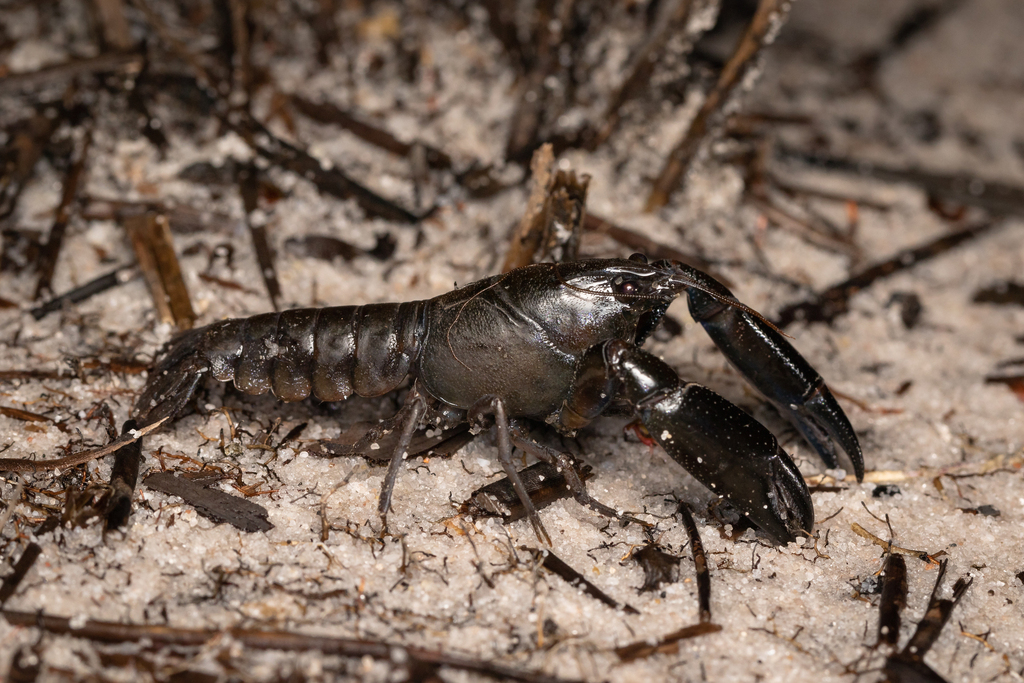
Gramastacus lacus
The eastern swamp crayfish (Gramastacus lacus) is a species of small freshwater crayfish from coastal New South Wales, Australia. It is distinguished from related species by large genital papilla on the males, large raised postorbital ridges, a laterally compressed carapace, and elongated chelae.
From the article Eastern swamp crayfish on Wikipedia (CC BY-SA), quoted section by section
Description
The species reaches a maximum weight of 7 grams (0.25 oz) and a length of 21.32 millimetres (0.839 in). The vast majority of specimens are smaller, with the average weight being around 4 grams (0.14 oz) to 5 grams (0.18 oz). The rostrum is long and narrow with a spine at the apex. The abdomen is smooth and unarmored, and thinly covered in stiff setae. The tailfan is U-shaped. The first cheliped is smooth and distinctly longer than the other legs. The species is sexually dimorphic, with males having significantly larger chelae than females while females have broader abdomens. Coloration varies among populations. The dorsal parts of the thorax and abdomen will often be light brown, green, tan, or steel blue and patterned with red or cream-colored spots. The cephalon is usually black or brown on the dorsal surface, with lighter toned blue highlights on the lateral edges. The body's ventral surface is cream-colored or transparent. The first chelae are black to dark blue, with bright blue coloration along the edges and red joints. Juveniles are uniformly light blue in color.
Range & habitat
Gramastacus lacus is found in a number of geographically isolated populations along the Central and Mid North Coast of New South Wales, Australia. It is native to coastal lowlands from Wamberal Lagoon to Wamberal Lagoon, usually 3 metres (9.8 ft) to 48 metres (157 ft) above sea level. Populations typically occur in ephemeral wetlands such as small creeks and swamps, in depths no greater than 1 metre (3.3 ft). Population density varies between 1 and 35 individuals per square meter depending on the environment.
Wikipedia: “Range and habitat”
What it does
Unlike its relative the western swamp crayfish (Gramastacus insolitus), the eastern swamp crayfish excavates burrows to survive during the dry season, when the water bodies it inhabits dry up. Burrows are typically between 450 millimetres (18 in) and 750 millimetres (30 in) deep, although some have been observed as deep as 1 metre (3.3 ft). Sometimes burrows will have a round chamber at the end or be capped with mud. Occasionally a juvenile will be found sharing a burrow with an adult. Gramastacus lacus often hides in the thick reeds and grass along the shore to avoid predators such as speckled longfin eels, carp gudgeons, giant water bugs, eastern long-necked turtles, and Australian water dragons, as well numerous species of birds. The only individuals to seek out deeper water are recently moulted ones, likely in an attempt to avoid being cannibalized. The crayfish will use its enlarged claws for defense while in the water, but when on land will usually elect to scuttle backward rapidly instead.
Wikipedia: “Behavior”
In human culture
The specific name is derived from Latin lacus, referring to the coastal lakes that the species is found in. Before it was formally described it was known by the common name "lake yabby".
Wikipedia: “Etymology”
Where it lives
Recorded sightings
—
geo-referenced records in GBIF, from museums, herbaria and field observers.
Drag the globe to turn it. Dots are where records exist, not a range map; darker means more records.
In the stacks
Searching the stacks…
Every page naming Gramastacus lacus in the Biodiversity Heritage Library →
This page is assembled live from iNaturalist, GBIF, Wikipedia, the Source Library and the Internet Archive. It is not yet part of the hand-edited codex. iNaturalist taxon 569723.