- Plants
- ›Vascular Plants
- ›flowering plants
- ›Dicots
- ›laurels, spicebushes, and allies
- ›spicebush family
- ›Idiospermum
Idiotfruit
Idiospermum australiense
Idiospermum is a monotypic genus (that is, a genus that contains only one species) in the family Calycanthaceae. The sole included species is Idiospermum australiense − commonly known as ribbonwood, dinosaur tree, or the misnomer idiotfruit − which is found only in two small areas of the tropical rainforests of northeastern Queensland, Australia. It has the largest seed embryo of any flowering plant, and is the only flowering plant with more than two cotyledons. It is a relic of the ancient forests of Gondwana, surviving in very localised refugia for 120 million years, and displaying features (of the flowers in particular) that are almost identical to fossil records from that time. As such it provides an important insight into the very early evolution of flowering plants.
From the article Idiospermum on Wikipedia (CC BY-SA), quoted section by section
Description
Idiospermum australiense has, in contrast to its weighty evolutionary significance and its extraordinarily unique fruit, a rather nondescript overall appearance. It is a broadleaf evergreen tree growing to around 25 m (82 ft) tall, with a maximum trunk diameter of around 60 cm (24 in). The leaves are simple (without lobes or divisions), opposite and glabrous (without hairs). They measure up to 24 cm (9.4 in) long by 10 cm (3.9 in) wide, with 7−10 pairs of lateral veins. They are held on petioles measuring 10 to 25 mm (0.4 to 1.0 in) long, and the leaf blades exhibit numerous 'oil dots' or pellucid glands (tiny, translucent spots) when held up against a strong light source.
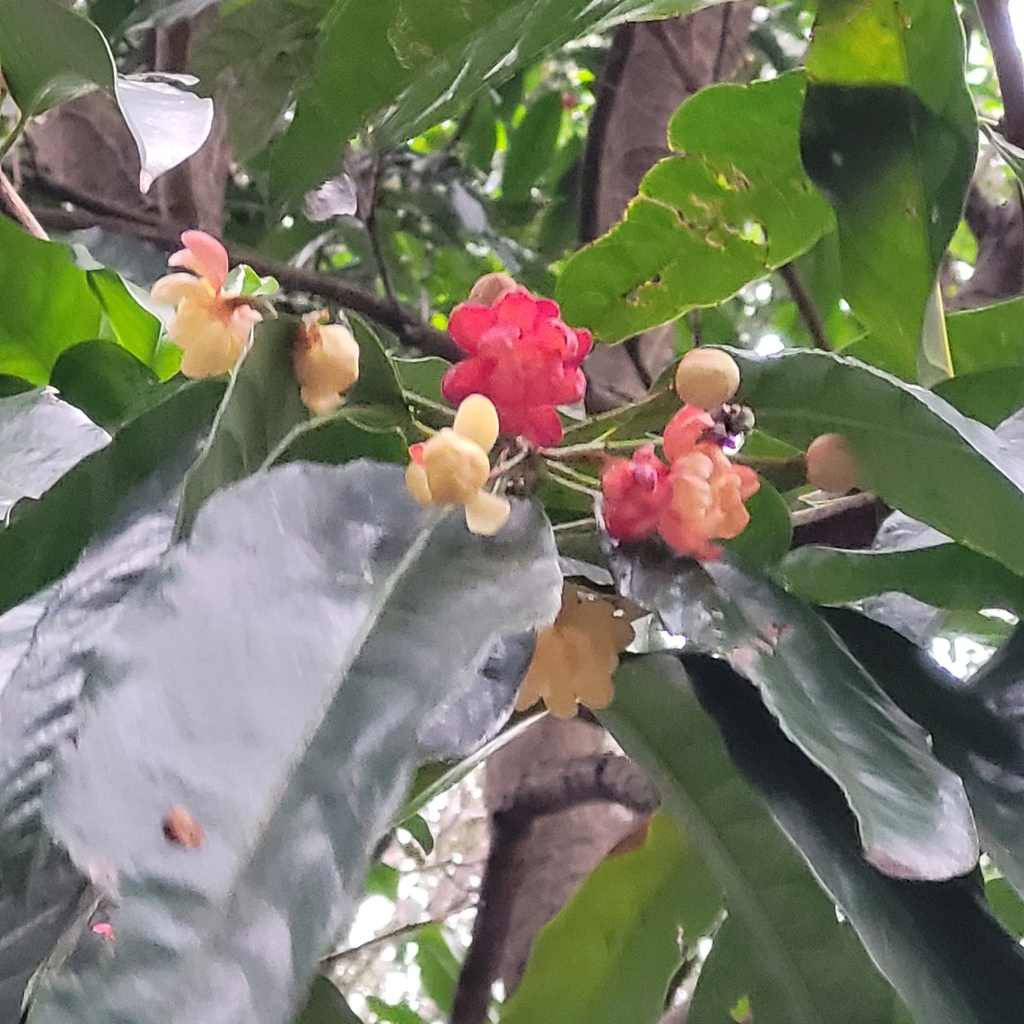
Flowers. The flowers may be solitary or in a panicle, produced either terminally or in the leaf axils. They are sessile (without a stem) and measure about 2 cm (0.79 in) wide when fully open. All floral organs − bracts, tepals, stamens, staminodes and carpels − are spirally arranged and there is no clear distinction between sepals and petals. The tepals are numerous with up to 52 per flower. The stamens number 13 to 15, and arch forward over the opening of the floral cup; the stigma lies well below the stamens and staminodes. …
Range & habitat
The area occupied by the populations of Idiospermum australiense is a total of just 22.5 km2 (8.7 sq mi) There are two main populations, the first (where Diels collected his samples), is approximately 50 km (31 mi) south of Cairns, in the vicinity of the Russell River and its tributaries. The other is approximately 120 km (75 mi) north of Cairns and around 10 km (6.2 mi) south of Cape Tribulation, in the areas of Cooper and Noah Creeks. Both areas are rainforested lowlands at the foot of high, rain-attracting mountains, with annual rainfalls of more than 3,000 mm (120 in), and alluvial soils. As the seeds of ribbonwood are only dispersed by gravity, the distribution of the species can only expand seawards.
Wikipedia: “Distribution and habitat”
What it does
Due to the enormous size of the seeds there are no animals that eat them and subsequently disperse them. Even the cassowary, well-known for its ability to swallow large fruit, does not eat these. They are also known to be extremely toxic to cattle (see Discovery, loss and re-discovery) and probably to other animals as well. A large variety of insects, mostly beetles and thrips, are attracted by the scent and colour of the flower, and they in turn attract predators such as spiders and ants. Only the beetles and thrips appear to take a role in pollination, which is completed only when an insect first visits a flower in the male phase and then carries pollen to a flower in the female phase.
Wikipedia: “Ecology”
In human culture
The name Idiospermum derives from the Ancient Greek words idios meaning "individuality" or "peculiarity", and spérma meaning "seed", and is a reference to the unique characteristics of the fruits. The common name "idiot fruit" is a mistranslation of this.
Wikipedia: “Etymology”
Where it lives
Recorded sightings
—
geo-referenced records in GBIF, from museums, herbaria and field observers.
Drag the globe to turn it. Dots are where records exist, not a range map; darker means more records.
In the stacks
Searching the stacks…
Every page naming Idiospermum australiense in the Biodiversity Heritage Library →
This page is assembled live from iNaturalist, GBIF, Wikipedia, the Source Library and the Internet Archive. It is not yet part of the hand-edited codex. iNaturalist taxon 570819.