- Plants
- ›Vascular Plants
- ›flowering plants
- ›Dicots
- ›myrtles, evening primroses, and allies
- ›myrtle family
- ›Myrtoideae
- ›Chamelaucieae
- ›Astarteinae
- ›Hypocalymma
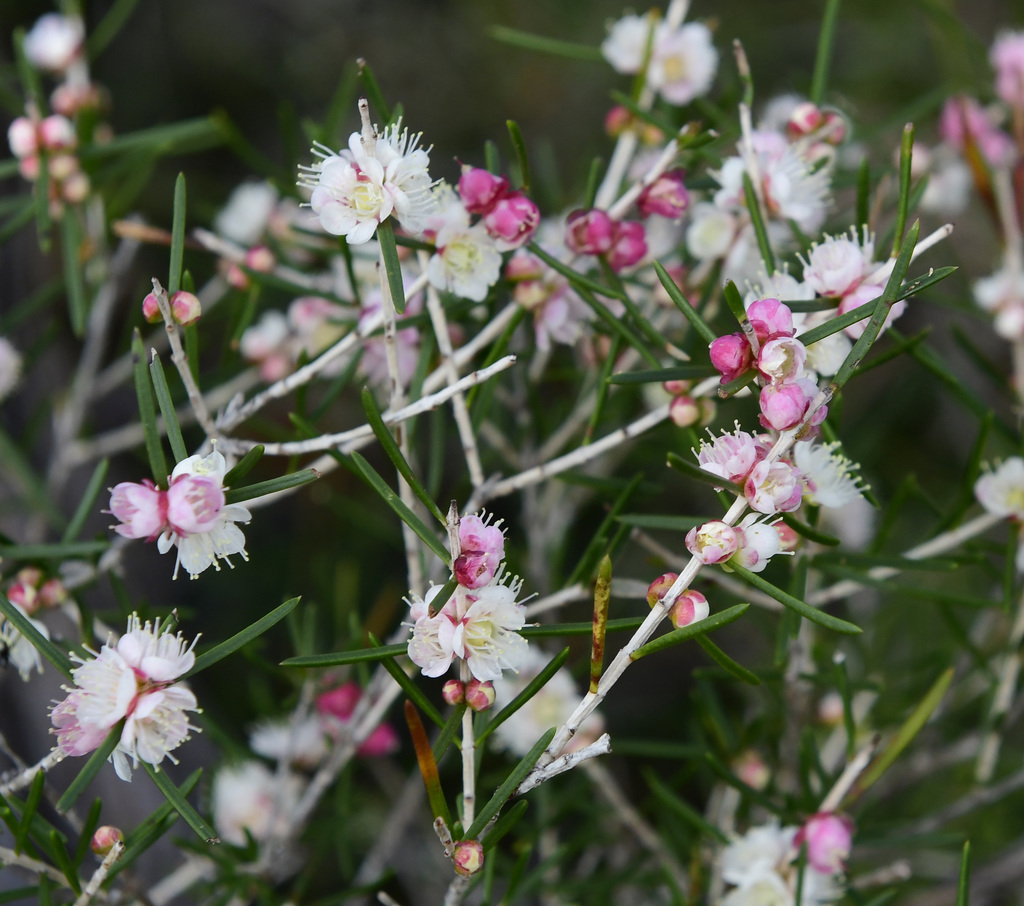
White Myrtle
Hypocalymma angustifolium
Hypocalymma angustifolium, commonly known as white myrtle, or pink-flowered myrtle, is a species of flowering in the myrtle family Myrtaceae, and is endemic to the south west region of Western Australia. The Noongar peoples know the plant as koodgeed or kudjidi. It is an erect, multi-stemmed shrub with narrowly linear leaves, white or pale pink flowers.
From the article Hypocalymma angustifolium on Wikipedia (CC BY-SA), quoted section by section
Description
Hypocalymma angustifolium is an erect, multistemmed shrub that typically grows to a height of up to 1.5 m (4 ft 11 in). Its leaves are linear, triangular in cross-section, channelled on the lower surface, and glabrous, mostly 15–30 mm (0.59–1.18 in) long and 0.8–1.2 mm (0.031–0.047 in) wide. The flowers are arranged singly or in pairs in leaf axils, and are sessile with short bracts and bracteoles at the base. The sepals are thin, membranous, about 1.5 mm (0.059 in) long. The petals are about 8 mm (0.31 in) across, white to cream coloured or occasionally pink, egg-shaped with the narrower end towards the base, 3.0–3.5 mm (0.12–0.14 in) long. There are usually 25 to 35 stamens with the filaments joined at the base, and about the same length as the petals. Flowering occurs from June to October and the fruit is a capsule 4–5 mm (0.16–0.20 in) in diameter.
Range & habitat
White myrtle is widespread between Eneabba and Ravensthorpe and inland to Manmanning and Wagin in the Avon Wheatbelt, Esperance Plains, Geraldton Sandplains, Jarrah Forest, Swan Coastal Plain and Warren bioregions. It grows in sandy soil, often in somewhat swampy places.
Wikipedia: “Distribution and habitat”
How it is grown
This species can be maintained as a well-rounded bush in cultivation and is suitable for growing in a container. It requires good drainage and prefers a position in partial shade, protected from heat and wind. It has a degree of frost-resistance. Flowering stems may be cut for floral arrangements
== References ==
Wikipedia: “Use in horticulture”
Where it lives
Recorded sightings
—
geo-referenced records in GBIF, from museums, herbaria and field observers.
Drag the globe to turn it. Dots are where records exist, not a range map; darker means more records.
In the stacks
Searching the stacks…
Every page naming Hypocalymma angustifolium in the Biodiversity Heritage Library →
This page is assembled live from iNaturalist, GBIF, Wikipedia, the Source Library and the Internet Archive. It is not yet part of the hand-edited codex. iNaturalist taxon 570828.