- Plants
- ›Vascular Plants
- ›flowering plants
- ›Dicots
- ›Mints, Plantains, Olives, and Allies
- ›Plantain Family
- ›Angelonieae
- ›Ourisia
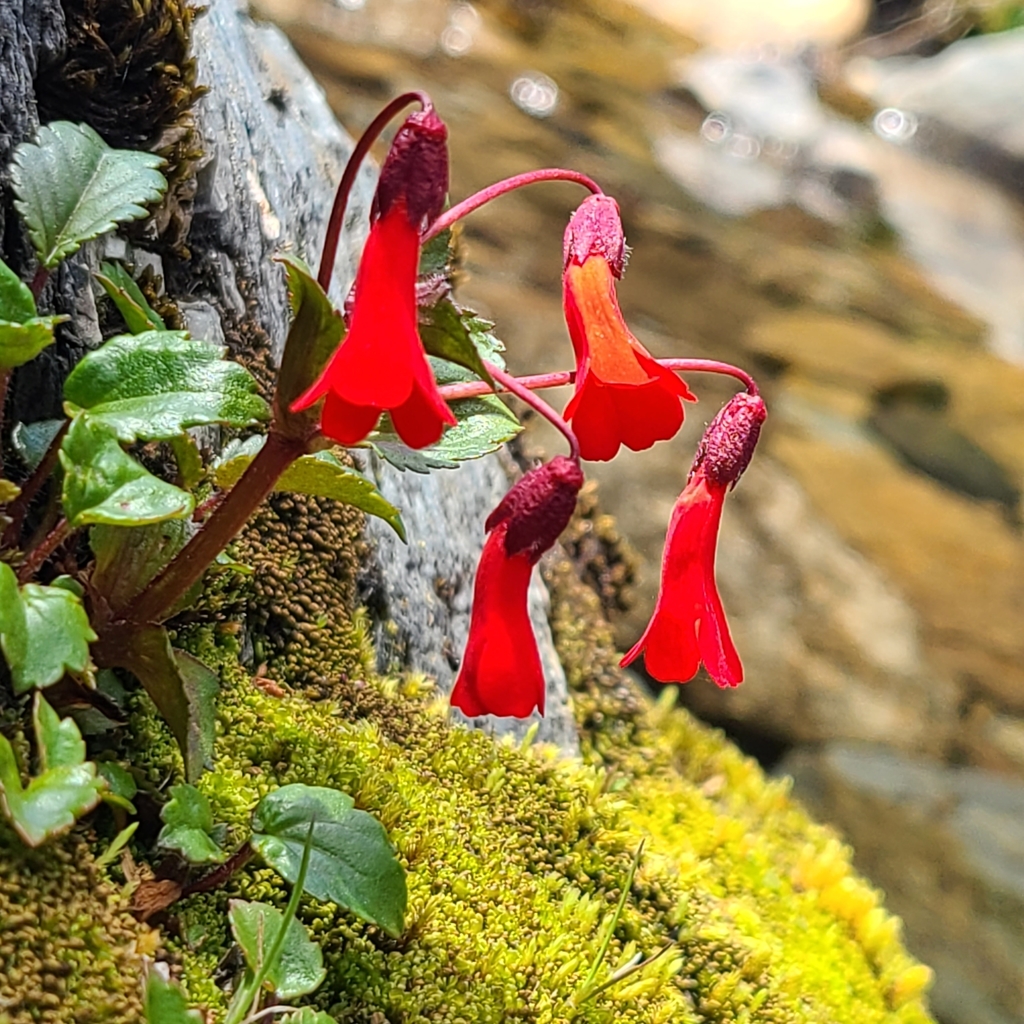
Ourisia ruellioides
Ourisia ruellioides is a species of flowering plant in the family Plantaginaceae that is endemic to mountainous habitats of the Andes of southern Argentina and Chile. Carl Linnaeus the Younger described Chelone ruelloides in 1782, and German botanist Otto Kuntze transferred it to the genus Ourisia in 1898. Plants of this species are large, showy plants with red, tubular almost regular corollas that are glabrous (hairless) inside the corolla tube, an irregular ciliate calyx with two calyx lobes deeply divided and three shallowly divided, and glabrous, serrate, ovate leaves. It is the most widespread and common species of Ourisia spanning 22 degrees of latitude and is the type species of the genus Ourisia.
From the article Ourisia ruellioides on Wikipedia (CC BY-SA), quoted section by section
Description
Ourisia ruellioides plants are perennial, ascending to erect herbs. The short stems are 1.9–4.3 mm wide, and glabrous (hairless) or hairy. Leaves are opposite, tightly clustered, petiolate, 6.2–116.1 mm long by 4.4–71.3 mm wide (length: width ratio 1.2–2.0:1). Leaf petioles are 6.3–250.0 mm long and usually glabrous or hairy with long non-glandular hairs. Leaf blades are usually narrowly ovate, ovate or broadly ovate, widest below the middle, usually with an acute apex, truncate or cordate base, and serrate edges. The both surfaces of the leaf are usually glabrous or with a few long non-glandular hairs, and the lower surface is also punctate. Inflorescences are erect racemes, up to 44 cm long. Each inflorescence has 1–6 flowering nodes with one or two flowers and 2 bracts in each node. The bracts are similar to the leaves but smaller, 2.3–3.5 mm long and 0.8–1.6 mm wide, and sessile. The flowers are borne on a pedicel that is up to 62.5 mm long and usually glabrous, or sometimes with a few short or long non-glandular or sessile glandular hairs. The calyx is 5.0–9.1 mm long, irregular, with 2 lobes divided to the base of the calyx and 3 lobes divided one-sixth to one-half the length of the calyx, and usually glabrous but ciliate. …
Range & habitat
Ourisia ruellioides is endemic to the Andes mountains of southern Argentina and Chile from 34°S to 56°S latitude. Spanning 22 degrees of latitude, it is the most widespread and common species of Ourisia. In Argentina it is found from Neuquén, Río Negro, Chubut, Santa Cruz and Tierra del Fuego, including several national parks, and the Chilean regions of O'Higgins, Maule, Ñuble, Biobío, Araucanía, Los Ríos, Los Lagos, Aysén and Magallanes. O. ruellioidies can be found from 0 to 2600 m above sea level in wet, rocky, shady habitats, including in Nothofagus forests, often in or near running water. It is one of three species of Ourisia to reach Tierra del Fuego (together with O. fuegiana and O. breviflora subsp. breviflora), where it is common in two of the four main vegetational zones, i.e. evergreen forest and deciduous forest, and found on several islands including Isla de los Estados.
Wikipedia: “Distribution and habitat”
Where it lives
Recorded sightings
—
geo-referenced records in GBIF, from museums, herbaria and field observers.
Drag the globe to turn it. Dots are where records exist, not a range map; darker means more records.
In the stacks
Searching the stacks…
Every page naming Ourisia ruellioides in the Biodiversity Heritage Library →
This page is assembled live from iNaturalist, GBIF, Wikipedia, the Source Library and the Internet Archive. It is not yet part of the hand-edited codex. iNaturalist taxon 570945.