- Plants
- ›Vascular Plants
- ›flowering plants
- ›Dicots
- ›pinks, cactuses, and allies
- ›Stone plants
- ›Brightfig Subfamily
- ›Brightfig Tribe
- ›Lithops
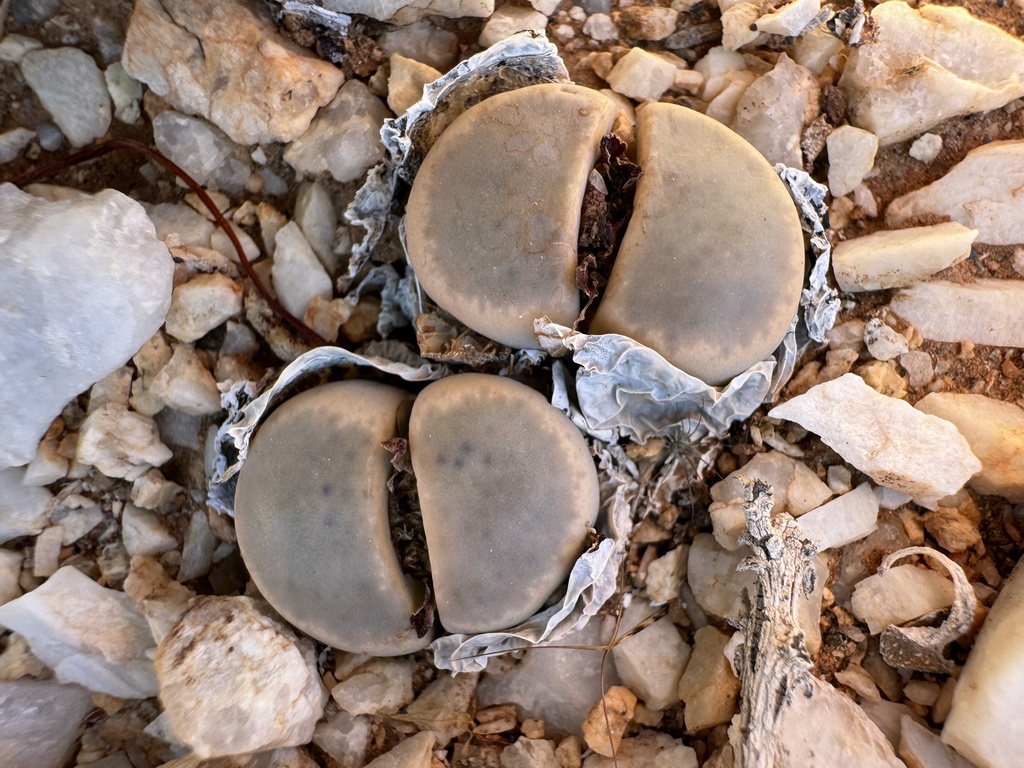
Lithops dinteri
Lithops dinteri is a species of the genus Lithops of the family Aizoaceae. It is a succulent plant native to Namibia and the Northern Cape Province of South Africa, where it grows in deserts which receive an average yearly rainfall of 464 mm.
The succulent plant is named after Mortiz Kurt Dinter, a German botanist of the late 19th and early 20th century. He was a collector of exotic succulents and his collection numbered around 8,400 pressed specimens.
From the article Lithops dinteri on Wikipedia (CC BY-SA), quoted section by section
Description
Lithops dinteri has leaves growing in pairs, and those pairs forming clumps of leaves. The leaves are thick, and hardly possess any stem. They have a small gap between them, out of which a yellow flower can blossom. The color of the sand or soil they grow in can determine the color of their lobes. Colors can range from red, to brown, to grey, and to cream. The leaves can also present red dots of the top, varying in number and size from plant to plant. The sides of the leaves are usually a purplish-green.
== References ==
Where it lives
Recorded sightings
—
geo-referenced records in GBIF, from museums, herbaria and field observers.
Drag the globe to turn it. Dots are where records exist, not a range map; darker means more records.
In the stacks
Searching the stacks…
Every page naming Lithops dinteri in the Biodiversity Heritage Library →
This page is assembled live from iNaturalist, GBIF, Wikipedia, the Source Library and the Internet Archive. It is not yet part of the hand-edited codex. iNaturalist taxon 571060.