- Plants
- ›Vascular Plants
- ›flowering plants
- ›Dicots
- ›proteas, lotuses, planes, and allies
- ›Protea family
- ›Singlet Proteas
- ›Hairiseed Proteoid Clade
- ›Protea
- ›Craterifolia
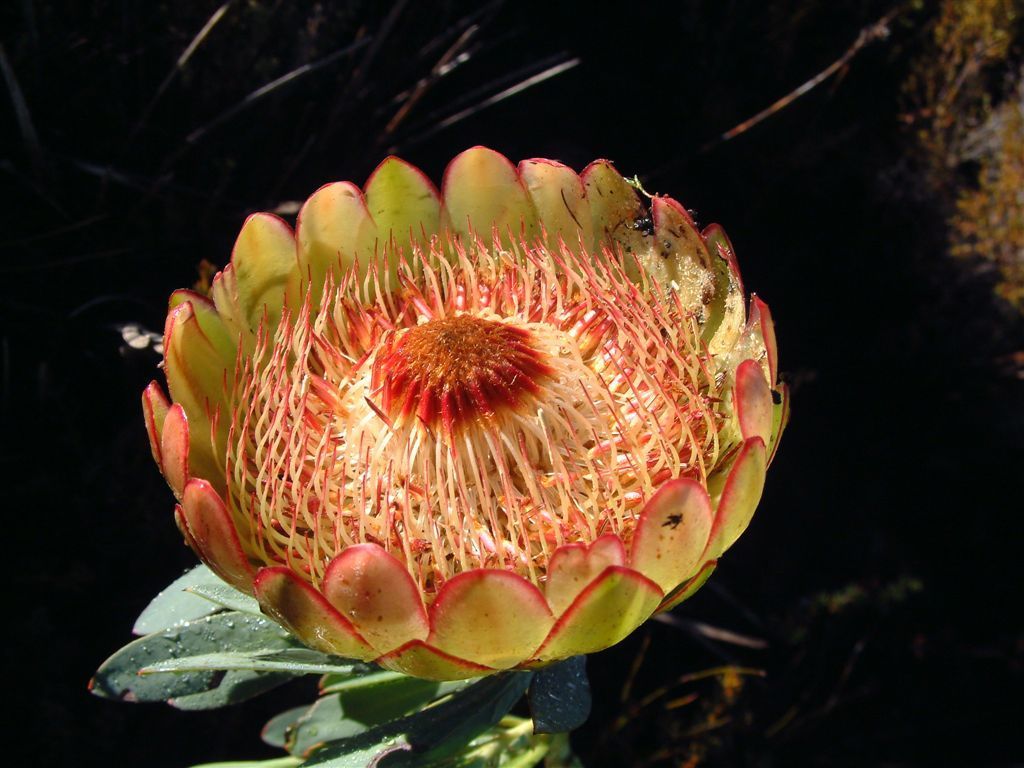
Scarlet Sugarbush
Protea effusa
Protea effusa, sometimes known as the scarlet sugarbush, is a flowering plant which belongs to the genus Protea. The plant is endemic to the Western Cape province of South Africa. In the Afrikaans language the vernacular name blosrooisuikerbos has been recorded for this plant.
From the article Protea effusa on Wikipedia (CC BY-SA), quoted section by section
Description
The branches are glabrous. The leaves are glaucous, distinctly veined, mucronate, end acutely and narrow towards the base. They are usually lanceolate in shape, and 1–2 inches (2.5–5.1 cm) in length. The flower heads are sessile on the stems, 2–3 inches (5.1–7.6 cm) long and 3 inches (7.6 cm) in diameter, and have the shape of a bowl. These appear on the plant in the winter months. The bracts may be greenish-yellow to deep red.
Variability. In cultivation in Australia, the plant can be very variable in appearance, with some forms growing as a ground-hugging, mat-forming, prostrate shrub, and others becoming an erect shrub growing up to 1.5 metres (4.9 ft) in height. The leaves can also be variable, with individual plants having differences in leaf width. The colour of the inflorescences may vary from greenish-bronze to a rich red. In the wild in South Africa, most populations are of the ground-hugging sort, but populations of taller, erect-growing plants exist at Gydo Pass and across the Gydoberg. These plants are suspected of being natural hybrids with Protea recondita, or perhaps a hybrid of P. recondita crossed with P. pendula, but require further study. Plants on the Matroosberg, the former P. …
Range & habitat
It occurs from the Koue Bokkeveld Mountains (such as the Waboomsberg) to the Du Toit Mountains and Naudesberg area of the Western Cape province. Within this area it occurs in the Franschhoek, the Gydoberg, Hex River and Groot Winterhoek mountains. It almost exclusively grows on mountain summits. Existing populations exhibit a fragmented spatial distribution and are small, over a quarter of the known populations consist of five plants or less. The reason behind such small populations is as yet mysterious. Of the known localities, only 13% bear more than a hundred plants.
Wikipedia: “Distribution”
What it does
This is a species found growing on rocky and exposed mountain ridges in an otherwise montane fynbos habitat at the tops of mountains, at altitudes of 1,200 to 1,800 metres. It is pollinated by rodents. Mature individuals are killed by wildfire, but the seeds can survive such an event, being stored in the fire-resistant dried old inflorescences. The seeds are released after fires, and dispersed by means of the wind.
Wikipedia: “Ecology”
How it is grown
Cultivation of this species is not always easy, the collection locality from which a particular batch of plants originates may play a large part in determining how it will grow. It prefers a cool and dry climate, being native to mountainous regions of the Cape Region. It is best grown in well-drained soils. The flower heads have successfully been used as cut flowers.
Wikipedia: “Horticulture”
Where it lives
Recorded sightings
—
geo-referenced records in GBIF, from museums, herbaria and field observers.
Drag the globe to turn it. Dots are where records exist, not a range map; darker means more records.
In the stacks
Searching the stacks…
Every page naming Protea effusa in the Biodiversity Heritage Library →
This page is assembled live from iNaturalist, GBIF, Wikipedia, the Source Library and the Internet Archive. It is not yet part of the hand-edited codex. iNaturalist taxon 571063.