- Plants
- ›Vascular Plants
- ›flowering plants
- ›Dicots
- ›pinks, cactuses, and allies
- ›Stone plants
- ›Brightfig Subfamily
- ›Brightfig Tribe
- ›Lithops
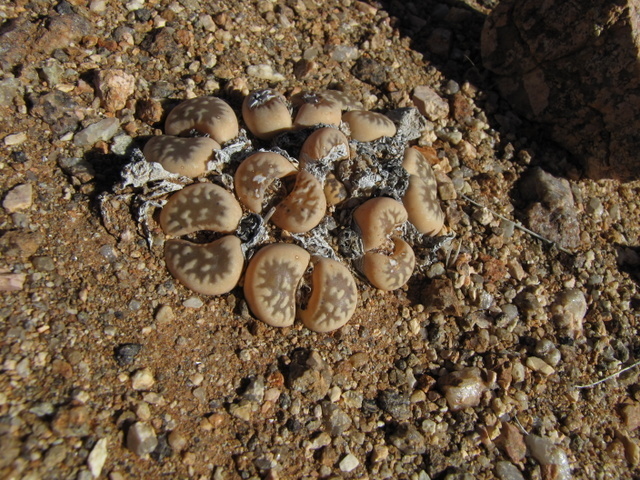
Lithops karasmontana
Lithops karasmontana (Karas Mountains living stone) is a species of flowering plant in the ice plant family Aizoaceae, native to Namibia and South Africa (the name refers to the Great Karas Mountains of Namibia).
From the article Lithops karasmontana on Wikipedia (CC BY-SA), quoted section by section
Description
It is a clump-forming succulent growing to 4 cm (2 in) high and spreading. The almost stemless leaves appear in pairs, and resemble two grey stones with brown mottling on the flat surfaces. White, narrow-rayed flowers 3–4 cm (1–2 in) in diameter, appear in autumn.
Lithops karasmontana resists attacks from herbivorous predators by mimicking the local stone formations, in this case quartzite. When not in flower it is extremely difficult to detect. L. karasmontana is generally treated as having two subspecies bella and eberlanzii, as well as ssp. karasmontana, although one modern paper raises the two subspecies to species level on the basis of seed morphology. Ssp. bella is distinguished by its relatively uniform appearance with beige colouring and darker windows. It often forms very large clumps with up to 60 heads. Ssp. eberlanzii is much more variable in appearance, with colours and markings similar to ssp. karasmontana, but it is generally smaller, softer, and more convex. Four varieties are also recognised: var. aiaisensis with creamy pinkish colouring, relative or complete lack of markings, and fairly smooth leaves; var. immaculata with almost unmarked beige leaves; var. lericheana with wide channels and greenish colouring; and var. tischeri with convex leaf tops and reddish colouring. Many older names are now sunk as synonyms in this highly variable species.
How it is grown
In temperate regions it must be grown in heat under glass, in conditions similar to those for cactuses. Like all Lithops, it requires extremely well-drained soil. Like all Lithops it also grows in annual cycles, as the leaf-pairs flower, and then each produces a new leaf-pair that replaces the old one (which shrivels away). The principal rule of watering is that Lithops should be kept dry from when they finish flowering, until the old leaf-pairs are fully replaced. It has gained the Royal Horticultural Society's Award of Garden Merit.
== References ==
Wikipedia: “Cultivation”
Where it lives
Recorded sightings
—
geo-referenced records in GBIF, from museums, herbaria and field observers.
Drag the globe to turn it. Dots are where records exist, not a range map; darker means more records.
In the stacks
Searching the stacks…
Every page naming Lithops karasmontana in the Biodiversity Heritage Library →
This page is assembled live from iNaturalist, GBIF, Wikipedia, the Source Library and the Internet Archive. It is not yet part of the hand-edited codex. iNaturalist taxon 571067.