- Plants
- ›Vascular Plants
- ›flowering plants
- ›Dicots
- ›honeysuckles, moschatels, and allies
- ›honeysuckle family
- ›Valerians and Allies
- ›Centranthus
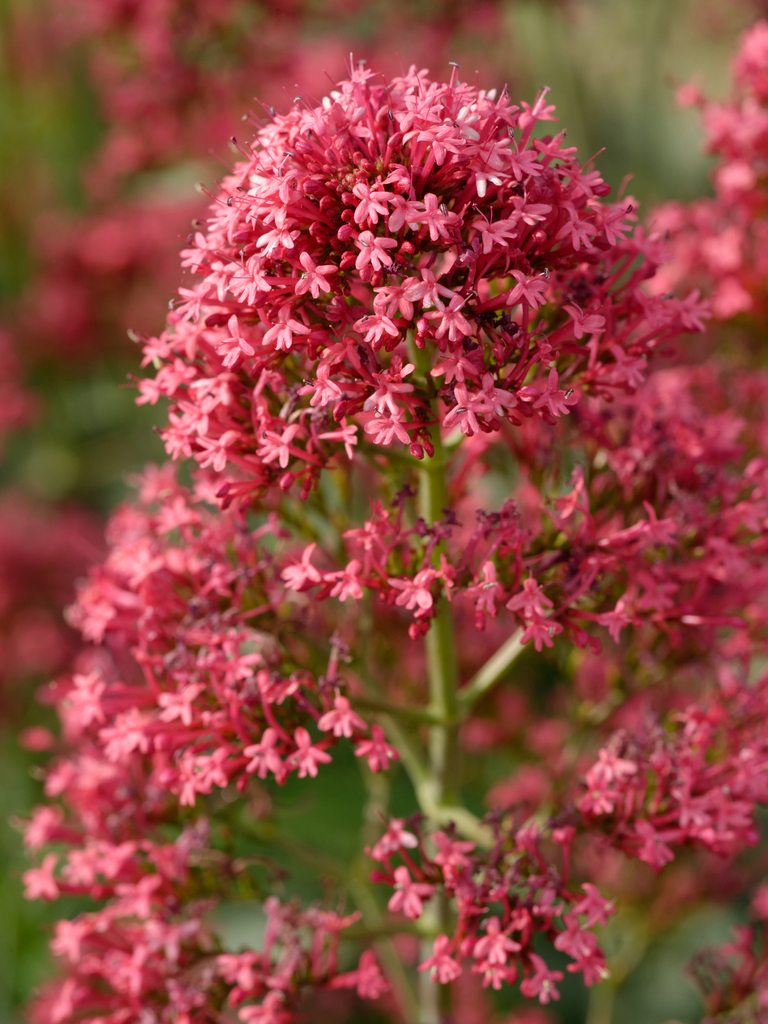
Red Valerian
Centranthus ruber
Valeriana rubra (synonym Centranthus ruber), the red valerian, spur valerian, kiss-me-quick, fox's brush, devil's beard or Jupiter's beard, is a popular garden plant grown for its ornamental flowers. It is not to be confused with the closely related Valeriana officinalis (the garden valerian).
From the article Valeriana rubra on Wikipedia (CC BY-SA), quoted section by section
Description
Valeriana rubra is a multi-stemmed perennial herbaceous plant up to 80 cm (31 in) tall with red, pink or white flowers. The leaves are generally 5–10 cm (2.0–3.9 in) long, the stem leaves being sessile and branch leaves sometimes having a petiole up to 5 cm long. The leaves grow in opposite pairs and are oval or lanceolate in shape. The inflorescences occur at the tips of the branches, in multiparous cymes with a hundred or more flowers. Each plant has either red, pink or white flowers. Valeriana rubra 'Albus' (about 10% of individuals) has white blooms. The cultivar 'coccineus' is especially long-blooming. The blooms have a strong and somewhat rank scent.
Range & habitat
Valeriana rubra is native of the Mediterranean region, ranging from Portugal and Spain to France, Italy, former Yugoslavia, Albania, Greece and European Turkey, and from Morocco to Algeria and Tunisia. It has been introduced into many other parts of the world as a garden escape. It is naturalised in France, Australia, Great Britain, Ireland, Isle of Man and the United States. In the US it can be found growing wild in such western states as Arizona, Utah, California, Hawaii, Washington, and Oregon, usually in disturbed, rocky places at elevations below 200 m. It is often seen by roadsides or in urban wasteland. It can tolerate very alkaline soil conditions. Because of its ability to tolerate alkaline conditions, Valeriana rubra can tolerate lime in mortar, and may frequently be seen growing on old walls in Italy, southern France and south-west UK.
Wikipedia: “Distribution”
What it does
They are pollinated by both bees and butterflies and the plant is noted for attracting insects. Flowering takes place in early summer and, in cool summer areas, continues sporadically throughout the summer and into fall. Red Valerian is used as a food plant by the larvae of some Lepidoptera species including angle shades. Fruits have feathery projections similar in appearance to the pappus of dandelion seeds that allow wind dispersal, and can self-seed freely and become invasive if not properly controlled.
Wikipedia: “Ecology”
Where it lives
Recorded sightings
—
geo-referenced records in GBIF, from museums, herbaria and field observers.
Drag the globe to turn it. Dots are where records exist, not a range map; darker means more records.
In the old herbals & bestiaries

Six Groups of the History of Plants
Rembert Dodoens · 1583 · p.369

Herbarium Portatile, Oder Behendes Kräuter- und Gewächs-Buch: Darinn nicht allein 1363. so wol Einheimische als Außländndische Kräuter mit Lateinisch und Deutscher Benennung abgebildet, sondern auch die meisten, so in der Medicin gebräuchlich, kürtzlich erkläret werden
Panckow, Thomas · 1656 · p.270
In the stacks
Searching the stacks…
Every page naming Centranthus ruber in the Biodiversity Heritage Library →
This page is assembled live from iNaturalist, GBIF, Wikipedia, the Source Library and the Internet Archive. It is not yet part of the hand-edited codex. iNaturalist taxon 57283.