- Plants
- ›Vascular Plants
- ›flowering plants
- ›Dicots
- ›Legumes, Milkworts, and Allies
- ›Legumes
- ›Faboideae
- ›Peas, Vetches, and Allies
- ›Vicia
- ›Cracca
- ›Cracca
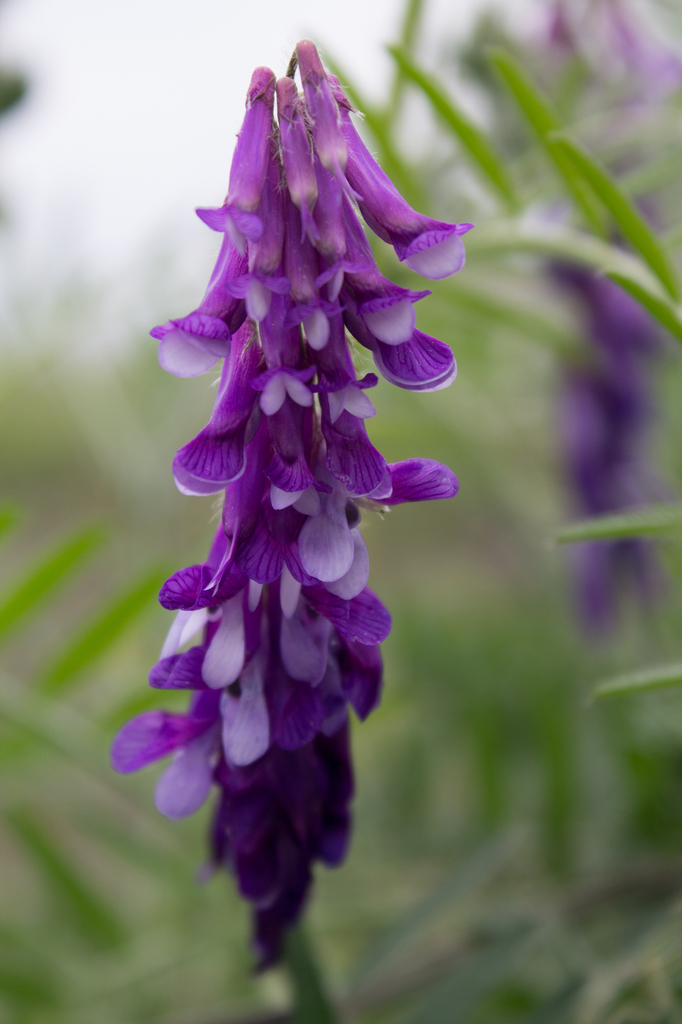
hairy vetch
Vicia villosa
Vicia villosa, known as the hairy vetch, fodder vetch or winter vetch, is a plant native to some of Europe and western Asia. It is a legume, grown as a forage crop, fodder crop, cover crop, and green manure. Although non-native, it occurs in all US states and is considered invasive by some states, such as Alaska, Florida, Georgia, Kansas, Michigan, Minnesota, Nebraska, Oregon, and Washington state — as well as in Japan and some parts of Europe where it is not native. It is also found in most Canadian provinces.
Hairy vetch is very similar to tufted vetch (Vicia cracca), the most noticeable difference being that tufted vetch has a smooth stem.
From the article Vicia villosa on Wikipedia (CC BY-SA), quoted section by section
How it is grown
Hairy vetch is widely used by organic growers in the United States as a winter cover crop and in no-till farming, as it is both winter hardy and can fix as much as 200 lb/acre of atmospheric nitrogen. Disadvantages of hairy vetch in production agriculture are related to the crop having a portion of hard seed and its tendency to shatter seed early in the season, leading to it remaining in the field as a weed later in the season. This can be a particular problem in wheat production.
Wikipedia: “Cultivation”
Where it lives
Recorded sightings
—
geo-referenced records in GBIF, from museums, herbaria and field observers.
Drag the globe to turn it. Dots are where records exist, not a range map; darker means more records.
In the stacks
Searching the stacks…
Every page naming Vicia villosa in the Biodiversity Heritage Library →
This page is assembled live from iNaturalist, GBIF, Wikipedia, the Source Library and the Internet Archive. It is not yet part of the hand-edited codex. iNaturalist taxon 57317.