- Plants
- ›Vascular Plants
- ›flowering plants
- ›Dicots
- ›Mints, Plantains, Olives, and Allies
- ›Mint Family
- ›Ajugoideae
- ›Teucrium
- ›Teucrium core clade
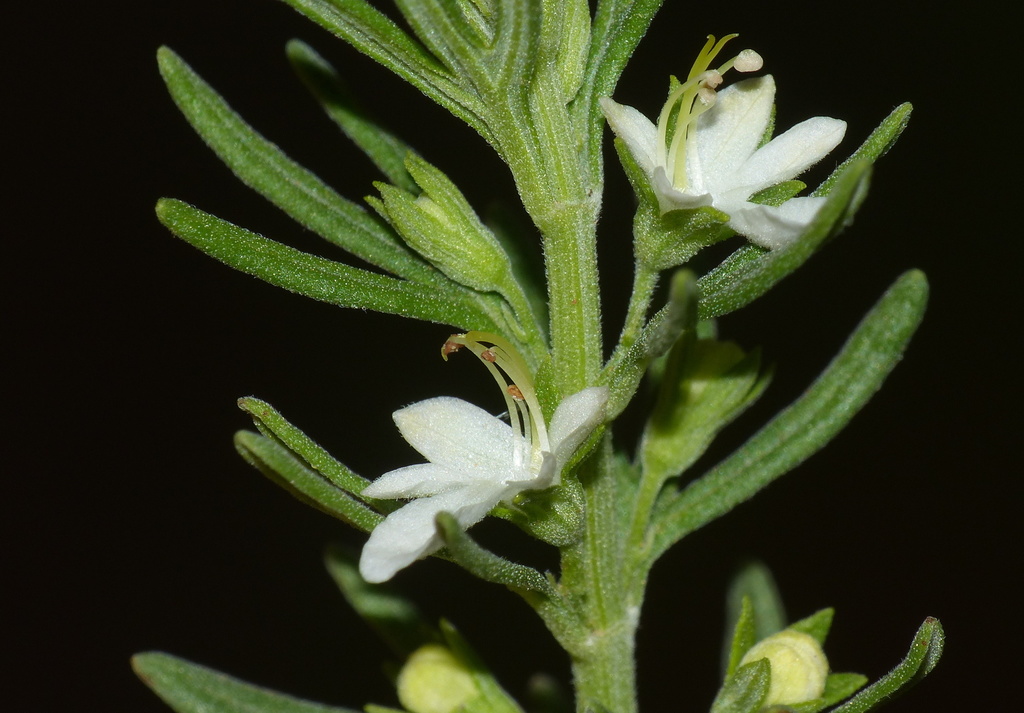
African Woodsage
Teucrium africanum
Teucrium africanum, commonly called the Cape or African woodsage, is a species of flowering plant in the family Lamiaceae. It is endemic to South Africa.
From the article Teucrium africanum on Wikipedia (CC BY-SA), quoted section by section
Description
This species is a small, greyish, bushy shrublet growing 10–30 cm (3.9–11.8 in) tall. The stems are simple or branched near the base and are covered in fine, glandular hairs, giving the plant a softly felted appearance. The leaves are sessile, grey-green, and 8–30 mm (0.31–1.18 in) long, usually divided into three narrow lobes; these lobes are linear to narrowly oblong, 5–25 mm (0.20–0.98 in) long and 1–3 mm (0.039–0.118 in) wide, with smooth, slightly rolled margins and a light covering of hairs. The flowers are borne in a leafy, terminal panicle. They are white, with a greyish calyx 3–4 mm (0.12–0.16 in) long and a small corolla 5–6 mm (0.20–0.24 in) long. The stamens project well beyond the flower, extending by about 6–7 mm (0.24–0.28 in).
Identification. Teucrium africanum overlaps with Teucrium trifidum in the Eastern Cape, from about Makhanda to Komani. It is markedly shorter than the latter, however, and it usually has solitary flowers rather than clusters of three to seven.
Range & habitat
This species is found in arid conditions from Bredasdorp in the Western Cape through the Klein Karoo to near Makhanda and inland to Middelburg and Graaff-Reinet.
Wikipedia: “Distribution and habitat”
Where it lives
Recorded sightings
—
geo-referenced records in GBIF, from museums, herbaria and field observers.
Drag the globe to turn it. Dots are where records exist, not a range map; darker means more records.
In the stacks
Searching the stacks…
Every page naming Teucrium africanum in the Biodiversity Heritage Library →
This page is assembled live from iNaturalist, GBIF, Wikipedia, the Source Library and the Internet Archive. It is not yet part of the hand-edited codex. iNaturalist taxon 57434.