- Plants
- ›Vascular Plants
- ›flowering plants
- ›Dicots
- ›Roses, Elms, Figs, and Allies
- ›rose family
- ›brambles, roses, strawberries, and allies
- ›avens tribe
- ›Geum
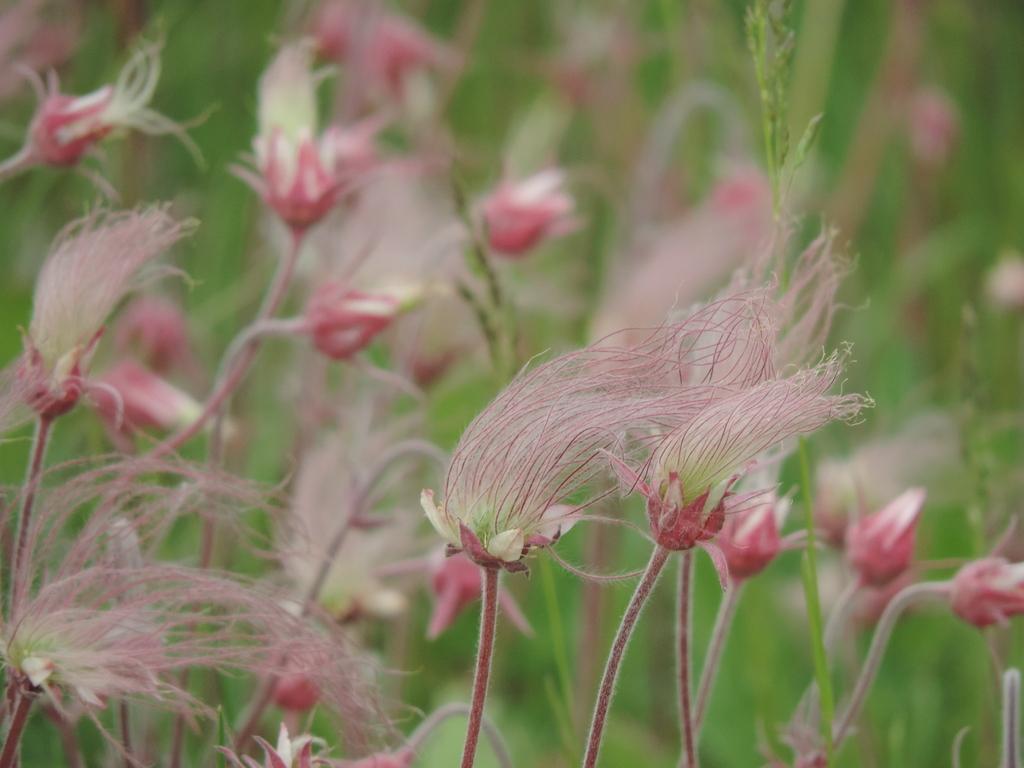
prairie smoke
Geum triflorum
Geum triflorum, commonly known as prairie smoke, old man's whiskers, or three-flowered avens, is a spring-blooming perennial herbaceous plant of the Rosaceae family. It is a hemiboreal continental climate species that is widespread in colder and drier environments of western North America, although it does occur in isolated populations as far east as New York and Ontario. It is particularly known for the long feathery plumes on the seed heads that have inspired many of the regional common names and aid in wind dispersal of its seeds.
From the article Geum triflorum on Wikipedia (CC BY-SA), quoted section by section
Description
Geum triflorum is a perennial herb with short, spreading rhizomes, which form colonies of stemless rosettes. The roots are fiberous and have a sassafras-like flavor. The leaves grow from a caudex and are 4–30 cm (1.6–12 in) long. They are divided into leaflets with deep divisions that makes the leaves resemble the leaves of a fern. The leaflets are arranged pinnately along a common leaf stem with smaller leaflets mixed in with 7–18 larger ones and single larger leaflet at the end of the leaf. The leaves are covered with extremely small downy hairs. Early in the spring, the leaves often lie flat to the ground and are in poor condition, but they soon become more upright in response to the warmer days and lack of snow cover. In the heat of a dry summer, the leaves also will lie down closer to the earth. The plants resume growth in the fall as other plants are starting to go dormant, developing a mound of deep grey-green leaves. The leaves are evergreen in areas without severe cold or there is protective snow cover, though they often turn purple, orange, or reddish. The flowers of G. triflorum appear from mid-spring to early summer. The flowering stalks stand well above the leaves on red-purple-maroon stems 10–45 cm (3.9–18 in) in height. …
Range & habitat
G. triflorum is widely distributed in North America, but only common in the Upper Midwest and mountainous west. In Canada, it is common from British Columbia to Manitoba. It also grows in parts of the Yukon Territory and Northwest Territory. It is a common prairie species in Minnesota, Wisconsin, and North Dakota. Contiguous with this it is reported in nine of the north-eastern counties in Illinois and eight counties in north-eastern South Dakota. It is recorded in PLANTS as growing in Iowa without a specific location. It is common throughout the prairies of Montana and Wyoming and into the mountains of Idaho, Colorado, Utah, and Nevada. It is present in the adjoining Black Hills in South Dakota, the eastern portions of Washington state, Oregon, and the north east mountainous portion of California. Populations are also found in the mountains of northern New Mexico and Arizona. In the eastern United States and Ontario populations are much rarer and isolated. It grows in six counties of the lower peninsula of Michigan and just Chippewa County in the upper peninsula. In New York state it is only recorded in PLANTS as growing in Jefferson County and Oswego County, which are adjacent to Lake Ontario. The New York Flora Atlas only records vouchered specimens from Jefferson County, New York.
Wikipedia: “Distribution”
What it does
The flowers produce both nectar and pollen. They are frequently visited by bumblebees, which are able to force their way into the mostly closed flowers and reach the nectar. They also buzz-pollinate to dislodge pollen from the stamens and gather it to feed their young. As it blooms early in the season and in large amounts in suitable habitats it is suggested that it is one of the plants that is critical to the success of queen bumblebees in establishing their first brood. Smaller bees such as sweat bees from the genus Lasioglossum feed on pollen grains from the opening of the flower. Bumblebees are the only effective cross-pollinators as G. trifloum are dependent on buzz pollination like plants such as tomatoes. Various insects become nectar robbers by chewing holes in the top of the flower, near the stem, to reach the nectar. It is not a major source of forage for most native herbivores including mule deer, elk, pronghorn, and game birds, but is foraged by white tailed deer. It is similarly not generally eaten by cattle, horses, or domestic sheep and has a low amount of protein.
Wikipedia: “Ecology”
At the table
Prairie smoke is planted in gardens as an ornamental for its interesting seed heads and for the persistent foliage in the winter. It is popular for native gardens, rock gardens, and with gardeners that wish to have an informal natural look. It is also suitable for use as part of green roof plantings because of its tolerance of periods of drought. Plants are winter hardy in USDA zones 3–7 and do not have any serious disease or pest problems. It is planted in either the spring or fall from cultivated plants or by seed. The size is dependent on the richness of the soil. Very lean soils without organic matter will grow compact plants, and in rich soils, the plants will become large and competitive. It is not tolerant of deep shade and can be displaced by taller species which grow over it and deprive it of light. Some Indigenous peoples of the Northwest Plateau have used three-flowered avens to treat tuberculosis. As recorded by Walter McClintock and later John C. Hellson, people of the Blackfeet Nation made an infusion of the roots to treat sore throats, canker sores in the mouth, and application to wounds and the infusion was also mixed with grease to create a salve used for the treatment of rashes, blisters, sores, and wounds. Infusions of the whole plant were used to treat severe coughs. The roots of G. …
Wikipedia: “Uses”
Where it lives
Recorded sightings
—
geo-referenced records in GBIF, from museums, herbaria and field observers.
Drag the globe to turn it. Dots are where records exist, not a range map; darker means more records.
In the stacks
Searching the stacks…
Every page naming Geum triflorum in the Biodiversity Heritage Library →
This page is assembled live from iNaturalist, GBIF, Wikipedia, the Source Library and the Internet Archive. It is not yet part of the hand-edited codex. iNaturalist taxon 57460.