- Plants
- ›Vascular Plants
- ›flowering plants
- ›Dicots
- ›Sunflowers, Bellflowers, Fanflowers, and Allies
- ›Sunflowers, Daisies, Asters, and Allies
- ›Thistles and Allies
- ›Cardueae
- ›Thistles and Burdocks
- ›Cynara
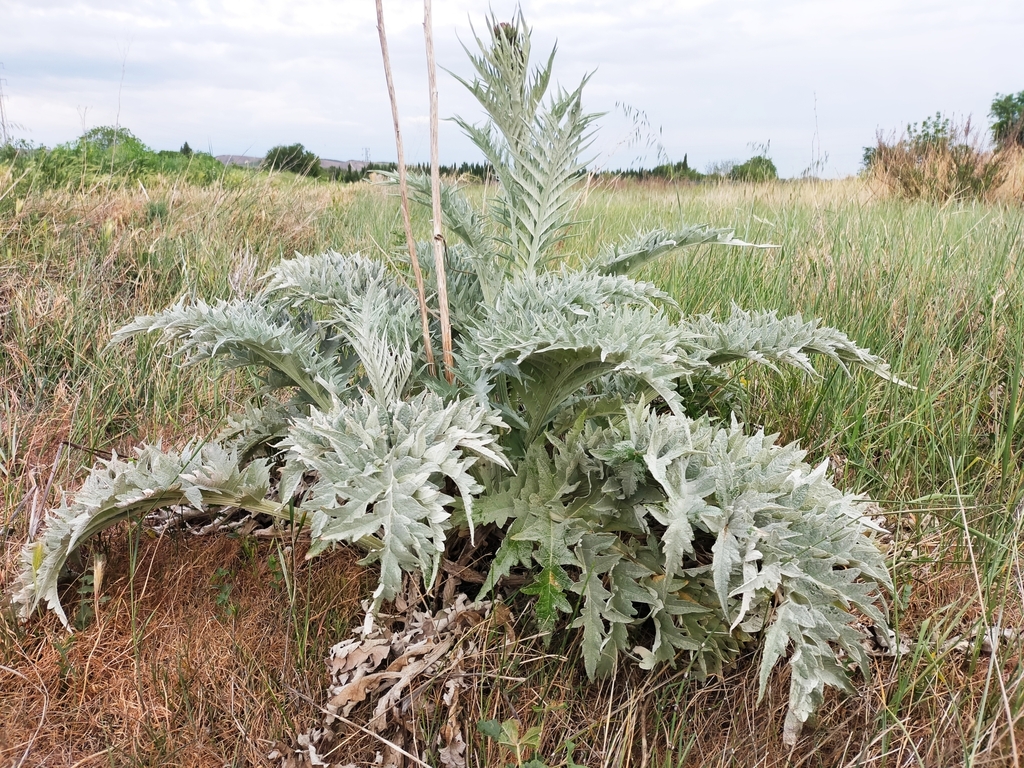
Artichoke Thistle
Cynara cardunculus
The cardoon (Cynara cardunculus ), also called the artichoke thistle, is a thistle in the family Asteraceae. It is a naturally occurring species that also has many cultivated forms, including the globe artichoke. It is native to the Mediterranean region, where it was domesticated in ancient times and still occurs as a wild plant.
From the article Cardoon on Wikipedia (CC BY-SA), quoted section by section
Description
The wild cardoon is a stout herbaceous perennial plant growing 0.8 to 1.5 m (31 to 59 in) tall, with deeply lobed and heavily spined green to grey-green tomentose (hairy or downy) leaves up to 50 cm (20 in) long, with yellow spines up to 3.5 cm long. The flowers are violet-purple, produced in a large, globose, massively spined capitulum up to 6 cm (2 in) in diameter. It is adapted to dry climates, native across a circum-Mediterranea area from Morocco and Portugal east to Libya and Greece and north to Croatia and Southern France; it may also be native on Cyprus, the Canary Islands and Madeira. In France, the frost-tender cardoon only occurs wild in the Mediterranean south (Gard, Hérault, Aude, Pyrénées-Orientales, Corsica). It has become an invasive weed in the Pampas of Argentina, and is also considered a weed in Australia and California. The "giant thistle of the Pampas" reported by Charles Darwin has been identified as cardoon.
At the table
Raw cardoon is 94% water, 4% carbohydrates, 1% protein, and has negligible fat. A 100-gram reference amount provides 71 kilojoules (17 kilocalories) of food energy and moderate amounts (10–19% of the Daily Value) of folate, magnesium, manganese, and sodium.
Wikipedia: “Nutrition”
How it is grown
There are two main cultivar groups in the Cynara cardunculus complex, both derived from the wild cardoon (C. cardunculus var. sylvestris (Lam.) Fiori): the cultivated cardoon (Cynara cardunculus Cardoon Group, syn. C. cardunculus var. altilis DC), selected for edible leaf stems, and the artichoke (Cynara cardunculus Scolymus Group, sometimes distinguished as Cynara scolymus or C. cardunculus var. scolymus (L.) Fiori), selected for larger edible flower buds. They differ from the wild plant in being larger (up to 2 m tall), much less spiny, and with thicker leaf stems and larger flowers, all characteristics selected by humans for greater crop yield and easier harvest and processing. Wild and cultivated cardoons and artichokes are very similar genetically, and are fully interfertile, but have only very limited ability to form hybrids with other species in the genus Cynara. The earliest description of the cardoon may come from the fourth-century BC Greek writer Theophrastus, under the name κάκτος (Latin: cactus), although the exact identity of this plant is uncertain. The cardoon was popular in Greek, Roman, and Persian cuisine, and remained popular in medieval and early modern Europe. …
Wikipedia: “Cultivation”
Where it lives
Recorded sightings
—
geo-referenced records in GBIF, from museums, herbaria and field observers.
Drag the globe to turn it. Dots are where records exist, not a range map; darker means more records.
In the stacks
Searching the stacks…
Every page naming Cynara cardunculus in the Biodiversity Heritage Library →
This page is assembled live from iNaturalist, GBIF, Wikipedia, the Source Library and the Internet Archive. It is not yet part of the hand-edited codex. iNaturalist taxon 57563.