- Animals
- ›Arthropods
- ›Hexapods
- ›Insects
- ›Winged and Once-winged Insects
- ›Ants, Bees, Wasps, and Sawflies
- ›Narrow-waisted Wasps, Ants, and Bees
- ›Ants, Bees, and Stinging Wasps
- ›Bees and Apoid Wasps
- ›Bees
- ›Sweat Bees
- ›Nomiine bees
- ›Nomia
- ›Acunomia
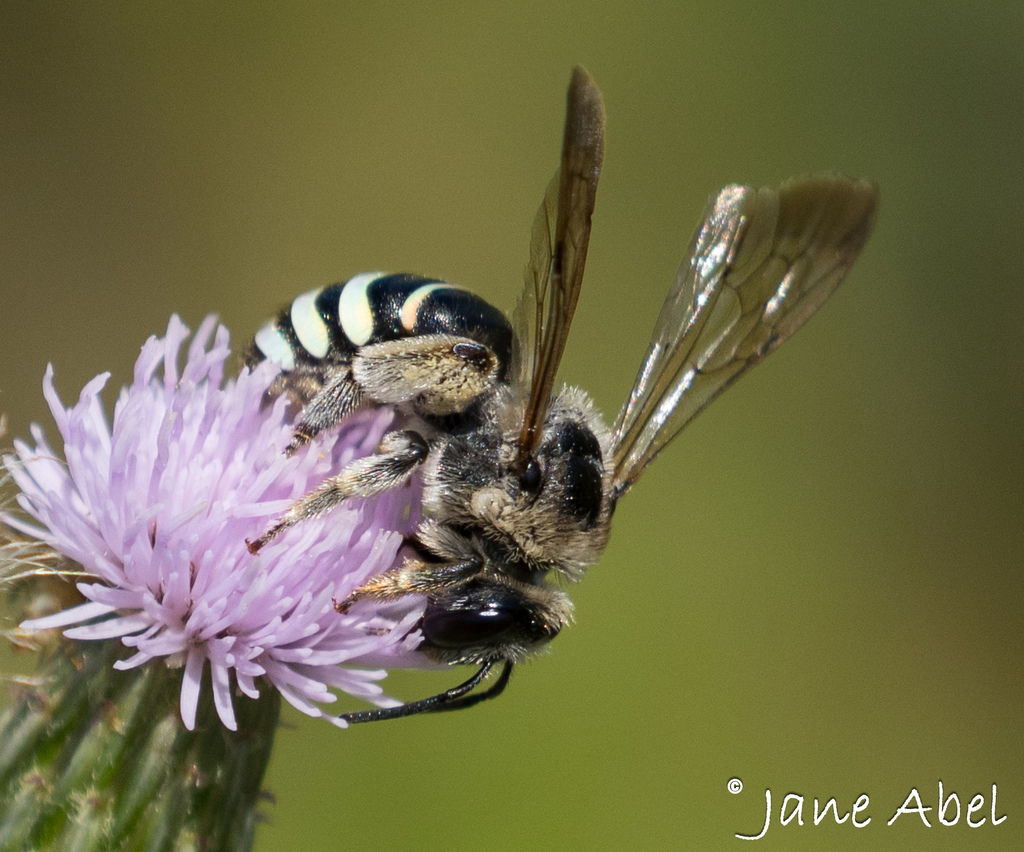
Alkali Nomia
Nomia melanderi
The alkali bee, Nomia melanderi, is a ground-nesting bee native to deserts and semi-arid desert basins of the western United States. It was described by Theodore Dru Alison Cockerell in 1906. While solitary, these bees nest near each other and can form extremely dense aggregations in areas with favorable conditions.
This bee nests in salt-saturated, or alkaline, soil. Like some other bees such as Megachile rotundata, alkali bees are an effective pollinator of alfalfa. The bee uses a specialized technique of opening alfalfa flowers for pollination by applying pressure to snap open the keel of the flower. Because of this and the fact that they prefer pollen to nectar, fly in a wide range of conditions, and perform well regardless of how well the field is watered, alkali bees are preferred to honeybees for alfalfa pollination but have been increasingly supplanted by M. rotundata in recent years. Due to the unusual nesting habits of this bee, farmers have developed methods to accommodate them with salty mud-fields where they can burrow and lay their eggs. Farmers started doing this after realizing that plowing up natural flats like these decreased the yield of alfalfa dramatically.
From the article Alkali bee on Wikipedia (CC BY-SA), quoted section by section
Description
The alkali bee is about two-thirds the size of a honeybee with black and metallic banding on the abdomen. Females have, but infrequently use, stingers and the males have white faces. Males and females in the northern part of the range are larger than their counterparts to the south. This is theorized to allow larval bees to survive for longer without food and may also be related to a slightly longer day in the summer, allowing for increased brood provisioning.
Wikipedia: “Appearance”
Range & habitat
The alkali bee lives in arid climates, primarily desert basins in the western United States from central Washington to southern California and east to western Colorado. They prefer to nest in moist, silty soils that have good drainage, a salty surface, and don't have vegetative groundcover. The hydrology of the soils appears to be the controlling factor for where nests are made. As soil makeup affects water retention and capillary action, soils with some clay and sand but mostly silt are preferred.
Wikipedia: “Distribution and habitat”
What it does
While solitary, alkali bees frequently nest in high densities. Females lay 1 to 2 eggs a day, and spend most of the day building the cell for the egg. Immediately after emergence a female begins to excavate the main burrow which usually entails digging for about 12 hours. The dirt is removed and using the mandibles and foretarsi, formed into pellets which are then deposited around the entrance to the burrow. The burrows are usually about 15–20 cm in depth, but in laboratory conditions with looser soil, much deeper burrows have been created. In addition to the main vertical burrow, smaller passageways are dug horizontally. From these shorter tunnels, small vertical holes called cells are created for oviposition. Cell creation usually begins the night after the main burrow is excavated. First, the "mine burrow" is dug and then a soil lining applied to the sides which reduces the size of the cell. Lastly a clear, lipid-rich secretion from the Dufour's gland (in the abdomen) is applied to the interior of the cell to waterproof it. After the cell is constructed, the female bee begins the process of provisioning. She brings back pollen and mixes it with nectar to form a ball which is then placed in the bottom of the cell. Any debris that makes its way into the cell during this period is meticulously removed. Once the pollen ball is completed, oviposition occurs. …
Wikipedia: “Nesting behavior”
Listen
Looking for field recordings…
Where it lives
Recorded sightings
—
geo-referenced records in GBIF, from museums, herbaria and field observers.
Drag the globe to turn it. Dots are where records exist, not a range map; darker means more records.
In the stacks
Searching the stacks…
Every page naming Nomia melanderi in the Biodiversity Heritage Library →
This page is assembled live from iNaturalist, GBIF, Wikipedia, the Source Library and the Internet Archive. It is not yet part of the hand-edited codex. iNaturalist taxon 57675.