- Plants
- ›Vascular Plants
- ›flowering plants
- ›Dicots
- ›borages
- ›borage family
- ›Boraginoideae
- ›Lithospermeae
- ›Echium
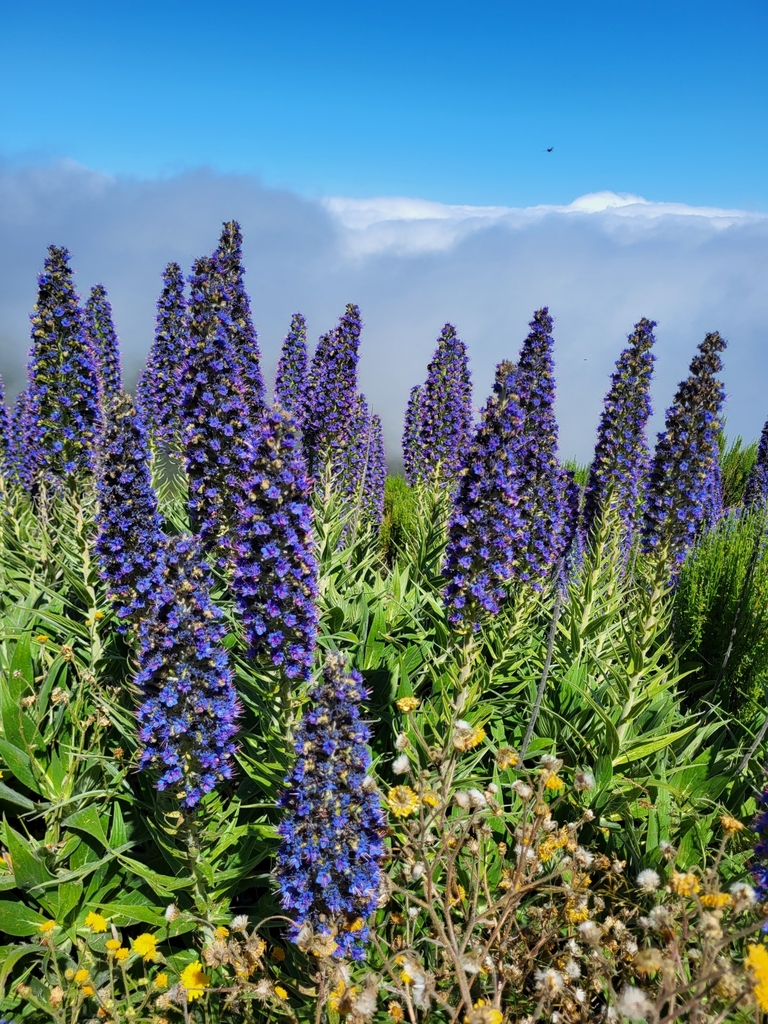
Pride of Madeira
Echium candicans
Echium candicans, the Pride of Madeira, is a species of flowering plant in the family Boraginaceae, and genus Echium, native to the island of Madeira. It is a large herbaceous perennial subshrub, growing to 1.5–2.5 m (4 ft 11 in – 8 ft 2 in).
In the first year after germination, the plant produces a broad rosette of leaves. In the second and subsequent years, more or less woody flowering stalks are produced clothed in rough leaves. The Latin specific epithet candicans means "shining white", referring to one colour form of this species.
From the article Echium candicans on Wikipedia (CC BY-SA), quoted section by section
Description
It grows as a 1 to 2 meter high shrub, usually with a candelabra-like growth habit. The inflorescences are not on the terminal shoot, but terminally on side shoots. The bark is whitish and peels off the shoots like paper. The short-stalked leaves are lanceolate to ovate-lanceolate and long pointed at the end, they reach a maximum length of about 25 cm (9.8 in) and a width of 2 to 4 cm (0.8 to 1.6 in). The lower leaves are more than five times as long as the upper ones. The adaxial side of the leaf blade (facing the shoot) is dark green, the axial side is slightly lighter green in color with prominent veins, all parts are protruding dense and soft, relatively long, velvety hairy.
Many flowers and bracts are in a dense, narrow, elongated inflorescence, which reach 10 to 25 cm (3.9 to 9.8 in), maximum 47 cm (19 in) in length. The hermaphrodite, sessile flowers are fivefold with a double perianth and are weakly zygomorphic, unlike the flowers of most other genera in the Boraginaceae. They are colored blue or purple, and would appear from spring to summer. The calyx is 4 to 5 millimeters long, green in color without darker veins and hairy, with lanceolate, pointed calyx lobes. The corolla is blue to violet, often with a white stripe on each apex, the flower tube is 9 to 11 millimeters long, the apex is rounded or truncated at the end. The stamens are pink, the anthers whitish. …
Range & habitat
The species is autochthonous only to Madeira and is absent from the other islands in the archipelago. It grows relatively frequently there at an altitude of about 800 to 1,200 meters (2,600 to 3,900 ft) in the central part of the island, at the upper end of the altitude range of the laurel forest and in open, heather-like vegetation.
Wikipedia: “Distribution”
How it is grown
E. candicans is cultivated in the horticulture trade and widely available throughout the world as an ornamental plant for traditional and drought-tolerant, water-conserving gardens. It is particularly suitable for coastal planting. With a temperature requirement of no less than 5–7 °C (41–45 °F), it needs some winter protection in frost-prone areas. It has gained the Royal Horticultural Society's Award of Garden Merit. In California, it is considered an invasive species. It is removed from native plant communities as part of habitat restoration efforts in coastal parks such as the Golden Gate National Recreation Area. In New Zealand, it is a common garden escapee onto roadside verges and shingle banks throughout the drier parts of both the North and the South Islands. In the state of Victoria, Australia, it is considered to be a high weed risk and an alert has been posted by the Department of Primary Industries.
Wikipedia: “Cultivation”
Where it lives
Recorded sightings
—
geo-referenced records in GBIF, from museums, herbaria and field observers.
Drag the globe to turn it. Dots are where records exist, not a range map; darker means more records.
In the stacks
Searching the stacks…
Every page naming Echium candicans in the Biodiversity Heritage Library →
This page is assembled live from iNaturalist, GBIF, Wikipedia, the Source Library and the Internet Archive. It is not yet part of the hand-edited codex. iNaturalist taxon 57723.