- Animals
- ›Chordates
- ›Vertebrates
- ›Ray-finned Fishes
- ›Spiny-rayed fishes
- ›Blennies, Damselfishes and Allies
- ›Damselfishes
- ›Typical Damselfishes and Anemonefishes
- ›Amphiprion
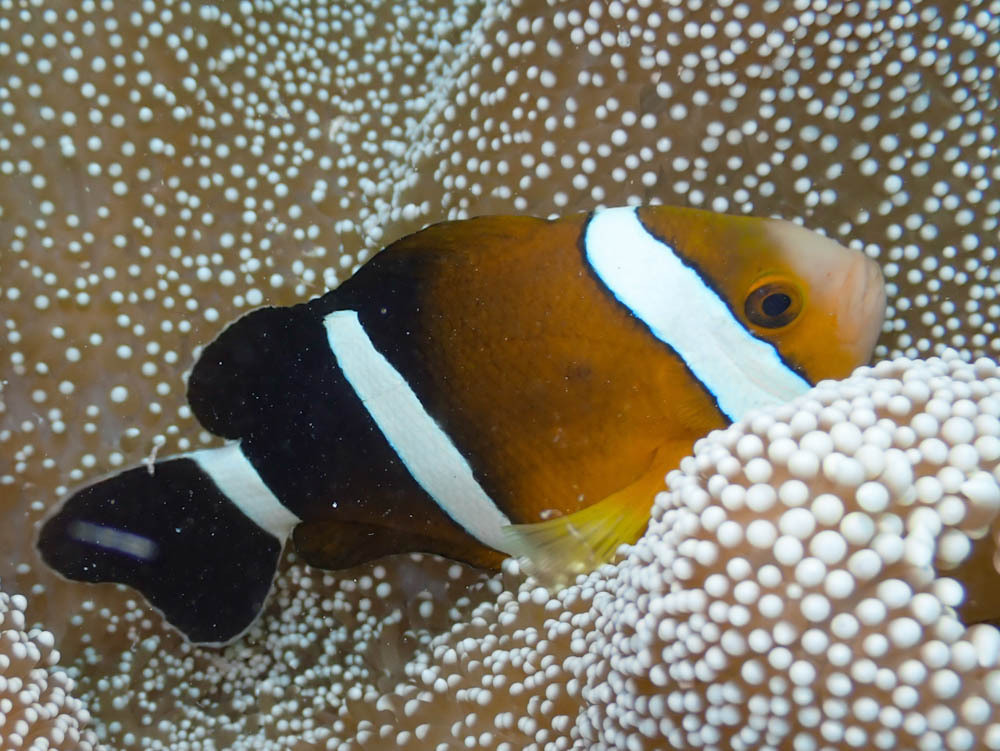
Three-band Anemonefish
Amphiprion tricinctus
The three-band anemonefish (Amphiprion tricinctus) is a species of anemonefish endemic to the Marshall Islands in the western part of the Pacific Ocean. Like all anemonefishes, it forms a symbiotic mutualism with sea anemones and is unaffected by the stinging tentacles of its host. It is a sequential hermaphrodite with a strict size-based dominance hierarchy; the female is largest, the breeding male is second largest, and the male nonbreeders get progressively smaller as the hierarchy descends. They exhibit protandry, meaning the breeding male changes to female if the sole breeding female dies, with the largest nonbreeder becoming the breeding male. The fish's natural diet includes zooplankton.
From the article Three-band anemonefish on Wikipedia (CC BY-SA), quoted section by section
Description
The body of A. tricinctus is yellow-orange at the snout, belly, and pelvic and anal fins, tending to dark brown or black at the tail. As the common name suggests, as an adult it has three white bands or bars. They can grow to be about 13 cm (5.1 in) long
Color variations. As A. tricinctus is endemic to the Marshall Islands, no geographic variation is seen, bute variations to the proportions of orange and black occur, from predominately orange through to predominantly black and the occasional aberrant coloration. Fish living with the host anemone Stichodactyla mertensii, Mertens' carpet sea anemone, are frequently black except for the snout and bars.
Similar species. Two other species have three body bars and a dark tail, A. chrysogaster and A. fuscocaudatus, but the species are geographically separated. Three other species of anemonefish are found in the Marshall Islands, A. chrysopterus, A. melanopus, and A. perideraion. These are easily distinguished from A. tricinctus as A. chrysopterus has two body bars and a whitish caudal fin, A. melanopus only has a head bar, and A. perideraion has a distinctive white stripe on the dorsal ridge. Genetic analysis has shown that A. tricinctus is closely related to A. clarkii and this clade is significantly different from the other species traditionally considered part of the A. clarkii complex.
Range & habitat
A. tricinctus is endemic to the Marshall Islands in the western part of the Pacific Ocean and is found in lagoons and pinnacle and seaward reefs. Whilst it is most commonly found at depths of 3 to 40 m (9.8 to 131.2 ft), it is occasionally found hosted by solitary specimens of Entacmaea quadricolor on seaward reef slopes in excess of 40 m (130 ft) deep.
Host anemones. The relationship between anemonefish and their host sea anemones is not random and instead is highly nested in structure. A. tricinctus is highly generalised, being hosted by eight of the 9 host anemones found in the Marshall Islands. A. tricinctus is generally said to be associated with these species of anemone:
Entacmaea quadricolor bubble-tip anemone Heteractis aurora beaded sea anemone (mostly juvenile) Heteractis crispa sebae anemone Stichodactyla haddoni Stichodactyla mertensii Mertens' carpet sea anemone Many locations in the Marshall Islands have not been scientifically surveyed, and A. tricinctus has been reported to be hosted by these species of anemone:
Heteractis magnifica magnificent sea anemone (rarely) Heteractis malu delicate sea anemone (rarely) Macrodactyla doreensis long-tentacle anemone
Wikipedia: “Distribution and habitat”
Where it lives
Recorded sightings
—
geo-referenced records in GBIF, from museums, herbaria and field observers.
Drag the globe to turn it. Dots are where records exist, not a range map; darker means more records.
In the stacks
Searching the stacks…
Every page naming Amphiprion tricinctus in the Biodiversity Heritage Library →
This page is assembled live from iNaturalist, GBIF, Wikipedia, the Source Library and the Internet Archive. It is not yet part of the hand-edited codex. iNaturalist taxon 57756.