- Plants
- ›Vascular Plants
- ›flowering plants
- ›Dicots
- ›proteas, lotuses, planes, and allies
- ›Protea family
- ›Paired Proteas
- ›Banksieae
- ›Banksiinae
- ›Banksia
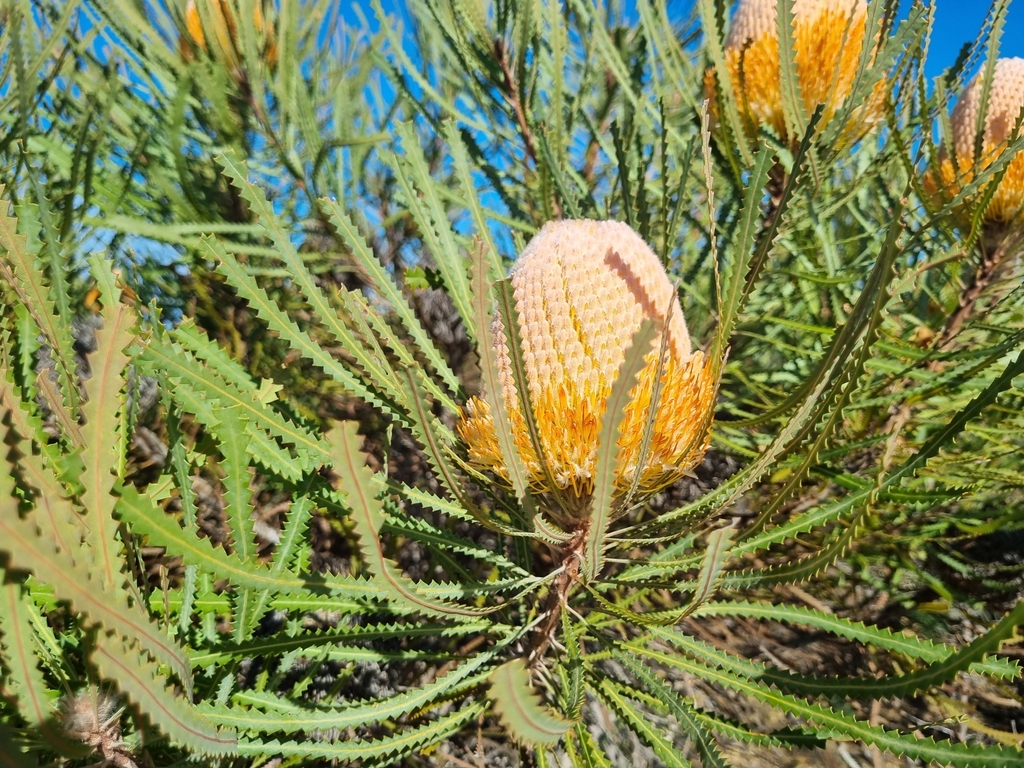
Hooker's Banksia
Banksia hookeriana
Banksia hookeriana, commonly known as Hooker's banksia, is a species of shrub of the genus Banksia in the family Proteaceae. It is native to the southwest of Western Australia and can reach up to 4 m (13 ft) high and 3 m (9.8 ft) wide. This species has long narrow serrated leaves and large, bright flower spikes, initially white before opening to a bright orange that appear over the cooler months. The flowers are pollinated by honeyeaters. The ageing flower spikes develop woody seed pods known as follicles. B. hookeriana is serotinous—large numbers of seeds are stored in the plant canopy for years until the plants are burnt by bushfire.
From the article Banksia hookeriana on Wikipedia (CC BY-SA), quoted section by section
Description
Banksia hookeriana grows as a bushy shrub to around 3 metres (10 ft) in diameter, and 3–4 metres (10–13 ft) high. It has smooth bark. New growth appears in spring and summer. Anywhere up to several hairy 15–25 centimetres (6–10 in)-long branchlets arise from just below nodes on larger branches. The leaves themselves are scattered along the branchlets but more crowded toward the tips. They are 6–16 centimetres (2+1⁄4–6+1⁄4 in) long and 0.5–1.2 centimetres (1⁄4–1⁄2 in) wide, and slightly concave in shape. The leaf margins have 20–45 triangular lobes long each side. The v-shaped lobes are 1–3 mm high by 1–6 mm wide. The flower spikes, known as inflorescences, arise at the ends of branchlets, appearing from late April to October, with a peak over July and August. They are 9–10 centimetres (3+1⁄2–4 in) wide and 7–12 centimetres (2+3⁄4–4+3⁄4 in) high. Each flower spike contains around 1000 individual small flowers. The flowers remain on the ageing spikes, which go on develop up to 20 woody seed pods (follicles) each.
Range & habitat
It occurs on sandplain shrubland between Arrowsmith and Eneabba and specifically on the Gingin scarp and Dandaragan plateau in Western Australia, found on flat or gently sloping land. It grows on deep white or yellow sand, and tends to be the dominant species. Commonly grows with Banksia attenuata, B. elegans and Eucalyptus todtiana.
Wikipedia: “Distribution and habitat”
What it does
Like many plants in Australia's southwest, Banksia hookeriana is adapted to an environment in which bushfire events are relatively frequent. Most Banksia species can be placed in one of two broad groups according to their response to fire: reseeders are killed by fire, but fire also triggers the release of their canopy seed bank, thus promoting recruitment of the next generation; resprouters survive fire, resprouting from a lignotuber or, more rarely, epicormic buds protected by thick bark. Banksia hookeriana is a reseeder—killed by bushfire and regenerating by seed. It is also serotinous, in that it holds its seeds in seed pods of old spikes in the plant canopy. As plants take 5 years to begin producing seeds and gradually accumulate more seeds over the coming decades, fire intervals around 15 to 18 years give the best chance of seedling recruitment, while intervals of less than 11 years result in reduced seedlings and ultimately possible extinction. Changing climate conditions and more frequent fire intervals have impacted on the species' reproductive rate. Plants can live up to 40 years old, though are generally killed by fire long before this. Plants growing on road verges are up to 30% taller with larger canopies and many more old flower spikes, hence storing over four times as many seeds. This is due to increased water and nutrients from runoff off the road. B. …
Wikipedia: “Ecology”
How it is grown
Banksia hookeriana is highly regarded in the cut flower industry, and has markets both in and outside Australia. Cut flowers have a vase life of ten days. A fast-growing plant in cultivation, B. hookeriana flowers 3–4 years from seed. It requires good drainage. It can be grown in Mediterranean climates such as Victoria and South Australia, but does not tolerate climates with summer humidity. Seeds do not require any treatment, and take 23 to 49 days to germinate.
Wikipedia: “Cultivation”
Where it lives
Recorded sightings
—
geo-referenced records in GBIF, from museums, herbaria and field observers.
Drag the globe to turn it. Dots are where records exist, not a range map; darker means more records.
In the stacks
Searching the stacks…
Every page naming Banksia hookeriana in the Biodiversity Heritage Library →
This page is assembled live from iNaturalist, GBIF, Wikipedia, the Source Library and the Internet Archive. It is not yet part of the hand-edited codex. iNaturalist taxon 578192.