- Plants
- ›Vascular Plants
- ›flowering plants
- ›Dicots
- ›Waterlilies, Fanworts, and Allies
- ›Waterlily Family
- ›Nuphar
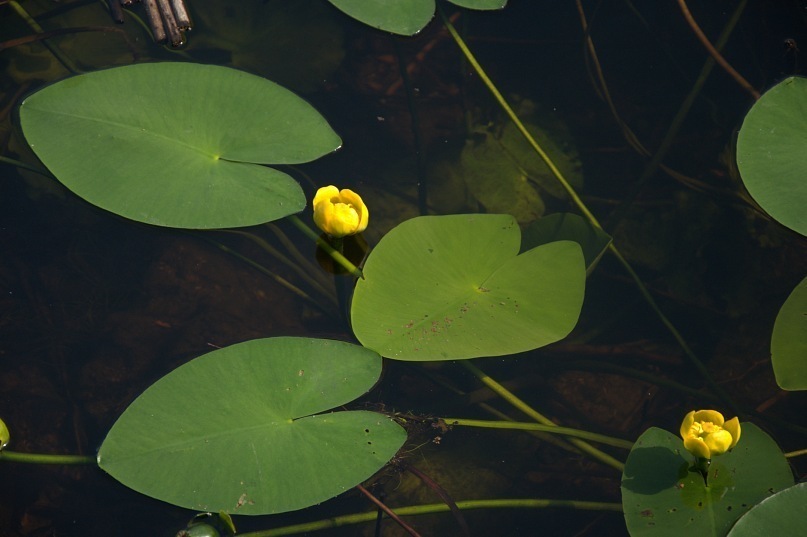
yellow water-lily
Nuphar lutea
Nuphar lutea, the yellow water-lily, is an aquatic plant of the family Nymphaeaceae, native to northern temperate and some subtropical regions of Europe, northwest Africa, and western Asia. This species was used as a food source and in medicinal practices from prehistoric times with potential research and medical applications going forward.
From the article Nuphar lutea on Wikipedia (CC BY-SA), quoted section by section
Range & habitat
Habitat for Nuphar lutea ranges widely from moving to stagnant waters of "shallow lakes, ponds, swamps, river and stream margins, canals, ditches, and tidal reaches of freshwater streams"; alkaline to acidic waters; and sea level to mountainous lakes up to 3,000 metres in altitude. The species is less tolerant of water pollution than water-lilies in the genus Nymphaea. This aquatic plant grows in shallow water and wetlands, with its roots in the sediment and its leaves floating on the water surface; it can grow in water up to 5 metres deep. It is usually found in shallower water than the white water-lily, and often in beaver ponds. Since the flooded soils are deficient in oxygen, aerenchyma in the leaves and rhizome transport oxygen from the atmosphere to the rhizome roots. Often there is mass flow from the young leaves into the rhizome, and out through the older leaves. This "ventilation mechanism" has become the subject of research because of this species' substantial benefit to the surrounding ecosystem by "exhaling" methane gas from lake sediments.
Wikipedia: “Habitat”
In human culture
The specific epithet lutea, from the Latin luteus, means deep yellow or golden yellow.
Wikipedia: “Etymology”
Where it lives
Recorded sightings
—
geo-referenced records in GBIF, from museums, herbaria and field observers.
Drag the globe to turn it. Dots are where records exist, not a range map; darker means more records.
In the old herbals & bestiaries

Junghans, Philipp Caspar: Philippi Caspari Ivnghans, Medicinae Doctoris, Medicinae Et Botanices Professor. Pvblic. Ordinar., Horti Regii Botanici Directoris Et Societatis Halensis Nat. Cvrios. Membri, Icones Plantarvm Officinalivm Ad Vitam Impressae. Centvria I.
Junghans, Philipp Caspar · 1792 · p.9

Notable Commentaries on the History of Plants
Leonhart Fuchs · 1542 · p.570

Notable Commentaries on the History of Plants
Leonhart Fuchs · 1549 · p.568

On the Names of Plants
Hieronymus Bock (Tragus) · 1552 · p.769

Compendium of Materia Medica
李時珍 · 1596 · p.90
In the stacks
Searching the stacks…
Every page naming Nuphar lutea in the Biodiversity Heritage Library →
This page is assembled live from iNaturalist, GBIF, Wikipedia, the Source Library and the Internet Archive. It is not yet part of the hand-edited codex. iNaturalist taxon 57850.