- Plants
- ›Vascular Plants
- ›flowering plants
- ›Dicots
- ›saxifrages, stonecrops, and allies
- ›stonecrop family
- ›Pig's Ears, Flaming Katies, Butterbushes, and Allies
- ›Adromischus
- ›Adromischus
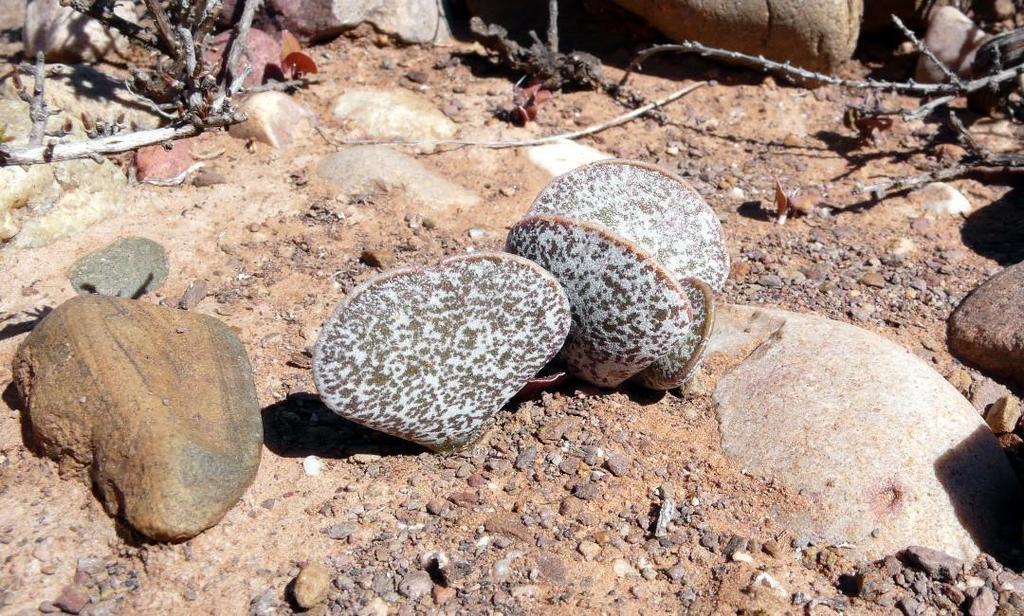
Adromischus bicolor
Adromischus bicolor is a perennial, succulent plant in the family Crassulaceae. The species name bicolor refers to the light, grey-green leaves spotted with purple to purple-green spots. It is endemic to the Succulent Karoo of western South Africa, as well as the Eastern Cape, South Africa.
From the article Adromischus bicolor on Wikipedia (CC BY-SA), quoted section by section
Description
Adromischus bicolor is a small, clumping plant with a compact habit reaching 4 cm tall and 9 cm wide. Its many small, grey-brown, succulent branches reach a diameter of 3 mm. The grey-green leaves with purple spots are obovate, sometimes obtriangular. One to two inflorescences begin to appear in the middle of summer, reaching up to 25 cm tall. The tubular flowers begin yellow-green at the base and gradated to a tinge of red. The 2 mm long petals are white and triangular.
Range & habitat
Adromischus bicolor occurs in exposed rock crevices in eastern and western regions of South Africa. There are less than five known populations. Some variation in leaf shape occurs depending on the locality, and it is unclear if both groups are of the same species. It is the only species of the Adromischus section to grow endemically in the eastern Cape. It is one of thousands of species of succulent plants to occur in the Succulent Karoo.
Wikipedia: “Distribution and habitat”
How it is grown
Adromischus bicolor is a slow-growing plant. Indoors, it will take as much sun as it can get in order to make the purple pigments pop. If growing outdoors, some shade may be required during the hottest months. Water only when soil dries completely. It can tolerate short periods of frost if the soil is completely dry, otherwise it can rot. Adromischus require a period of cold temperatures, around 10 °C, in order to flower. Propagation is easily done by leaf.
== References ==
Wikipedia: “Cultivation”
Where it lives
Recorded sightings
—
geo-referenced records in GBIF, from museums, herbaria and field observers.
Drag the globe to turn it. Dots are where records exist, not a range map; darker means more records.
In the stacks
Searching the stacks…
Every page naming Adromischus bicolor in the Biodiversity Heritage Library →
This page is assembled live from iNaturalist, GBIF, Wikipedia, the Source Library and the Internet Archive. It is not yet part of the hand-edited codex. iNaturalist taxon 579108.