- Plants
- ›Vascular Plants
- ›flowering plants
- ›Dicots
- ›Mints, Plantains, Olives, and Allies
- ›Mint Family
- ›Nepetoideae
- ›Ocimeae
- ›Plectranthinae
- ›Aeollanthus
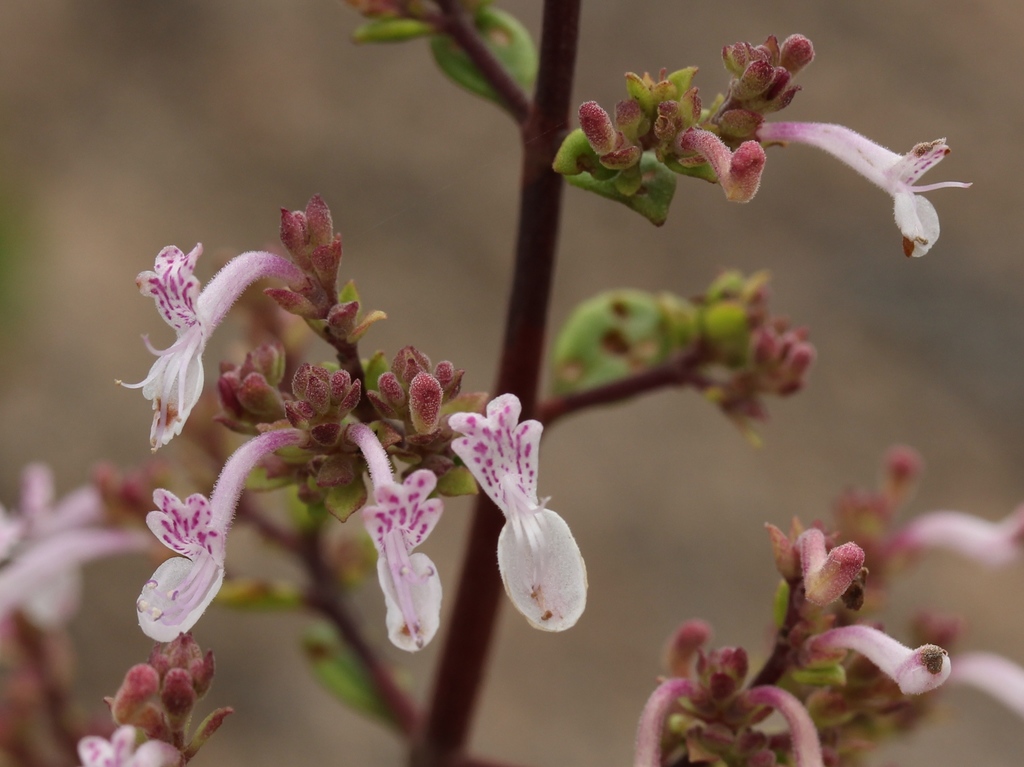
Littleleaf Rocksage
Aeollanthus parvifolius
Aeollanthus parvifolius is a drought-tolerant, succulent, perennial shrublet belonging to the Lamiaceae family, commonly known as rock sage (English) or klipsalie (Afrikaans).
From the article Aeollanthus parvifolius on Wikipedia (CC BY-SA), quoted section by section
Description
Aeollanthus parvifolius a multi-stemmed, aromatic, fast-growing plant that can reach up to 0.8 meters in height, with succulent, spreading opposite leaves that are egg-shaped to rounded, measuring 15–55 mm in length and 8–25 mm in width, and featuring 2 to 3 pairs of shallow teeth along the margin. Flowers appear from late summer to autumn, are two-lipped and tubular, measuring up to 12 mm in length, and range in color from white to light pink, often with mauve or reddish-purple markings on the upper lip. The flowers are borne on lax panicles or much-branched inflorescences, with stalks reaching up to 200 mm in length. The fruit consists of small nutlets (usually four per calyx), which remain enclosed in a persistent, enlarging calyx that breaks cleanly at maturity to release the seeds. Aeollanthus parvifolius is easily propagated from soft tip cuttings, which root rapidly in sand within 1 to 3 weeks, or from older herbaceous material that takes 2 to 4 weeks.
Range & habitat
This species is native to southern Africa, with a wide distribution from the northern Eastern Cape through Mpumalanga and Limpopo provinces, extending into Swaziland and southern Mozambique. It typically grows in montane and cliff-dwelling habitats, including grassland, savanna, and Afro-temperate vegetation, often found in rock crevices with varying aspects.
Wikipedia: “Distribution”
Where it lives
Recorded sightings
—
geo-referenced records in GBIF, from museums, herbaria and field observers.
Drag the globe to turn it. Dots are where records exist, not a range map; darker means more records.
In the stacks
Searching the stacks…
Every page naming Aeollanthus parvifolius in the Biodiversity Heritage Library →
This page is assembled live from iNaturalist, GBIF, Wikipedia, the Source Library and the Internet Archive. It is not yet part of the hand-edited codex. iNaturalist taxon 579136.