- Plants
- ›Vascular Plants
- ›flowering plants
- ›Dicots
- ›Sunflowers, Bellflowers, Fanflowers, and Allies
- ›Sunflowers, Daisies, Asters, and Allies
- ›Asteroideae
- ›Sunflowers and Allies
- ›Cockleburs, Ragweeds, and Wild Quinines
- ›Xanthium
- ›Xanthium
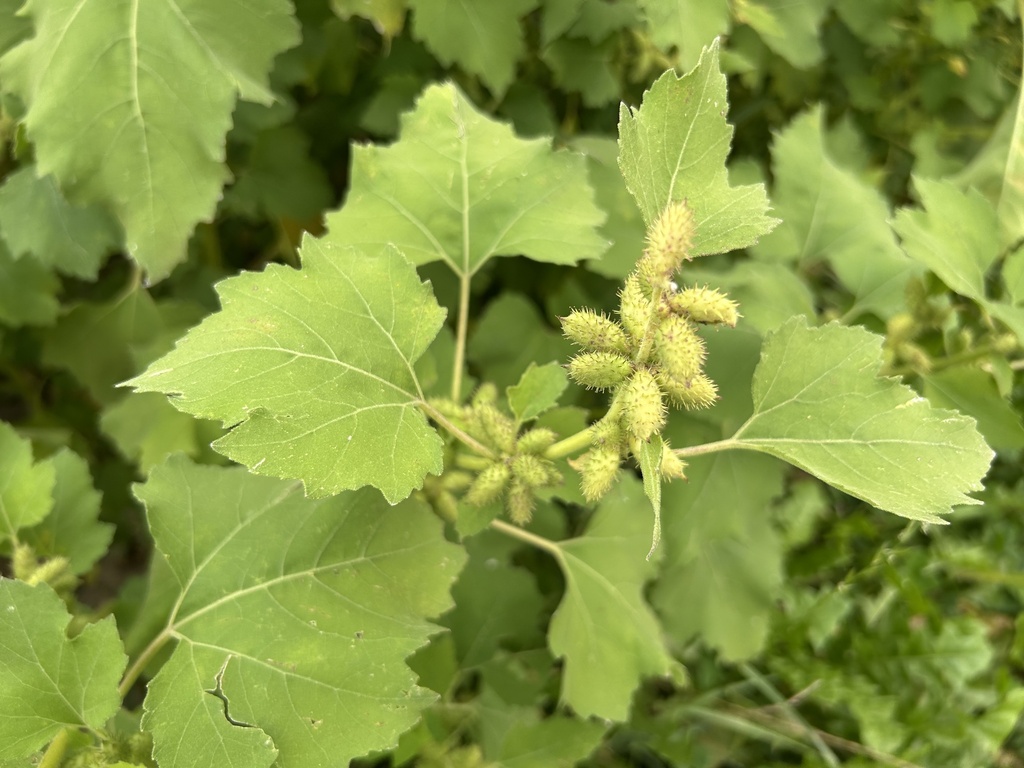
rough cocklebur
Xanthium strumarium
Xanthium strumarium (rough cocklebur, Noogoora burr, clotbur, common cocklebur, large cocklebur, woolgarie bur, Siberian cocklebur) is a species of annual plants in the flowering plant family Asteraceae. Some sources claim it originates in southern Europe and Asia, but has been extensively naturalized elsewhere. Others, such as the Flora of China and Flora of North America, state it originates in the Americas but was an early introduction to Eurasia.
From the article Xanthium strumarium on Wikipedia (CC BY-SA), quoted section by section
In medicine
The plant may have some medicinal properties and has been used in traditional medicine in South Asia and traditional Chinese medicine. In Telugu, this plant is called Marula Matangi. However, while small quantities of parts of the mature plants may be consumed, the seeds and seedlings should not be eaten in large quantities because they contain significant concentrations of the extremely toxic chemical carboxyatractyloside. The mature plant also contains at least four other toxins.
Animals have also been known to die after eating the plants. A patient consuming a traditional Chinese medicine containing cocklebur called Cang Er Zi Wan (苍耳子丸) developed muscle spasms. It was responsible for at least 19 deaths and 76 illnesses in Sylhet District, Bangladesh, 2007. People ate large amounts of the plants, locally called ghagra shak, because they were starving during a monsoon flood and no other plants were available. The symptoms included vomiting and altered mental states, followed by unconsciousness.
Wikipedia: “Toxic or medicinal phytochemistry”
Where it lives
Recorded sightings
—
geo-referenced records in GBIF, from museums, herbaria and field observers.
Drag the globe to turn it. Dots are where records exist, not a range map; darker means more records.
In the stacks
Searching the stacks…
Every page naming Xanthium strumarium in the Biodiversity Heritage Library →
This page is assembled live from iNaturalist, GBIF, Wikipedia, the Source Library and the Internet Archive. It is not yet part of the hand-edited codex. iNaturalist taxon 57920.