- Plants
- ›Vascular Plants
- ›flowering plants
- ›monocots
- ›Agaves, Orchids, Irises, and Allies
- ›Aloe family
- ›Aloes and allies
- ›Aloiampelos
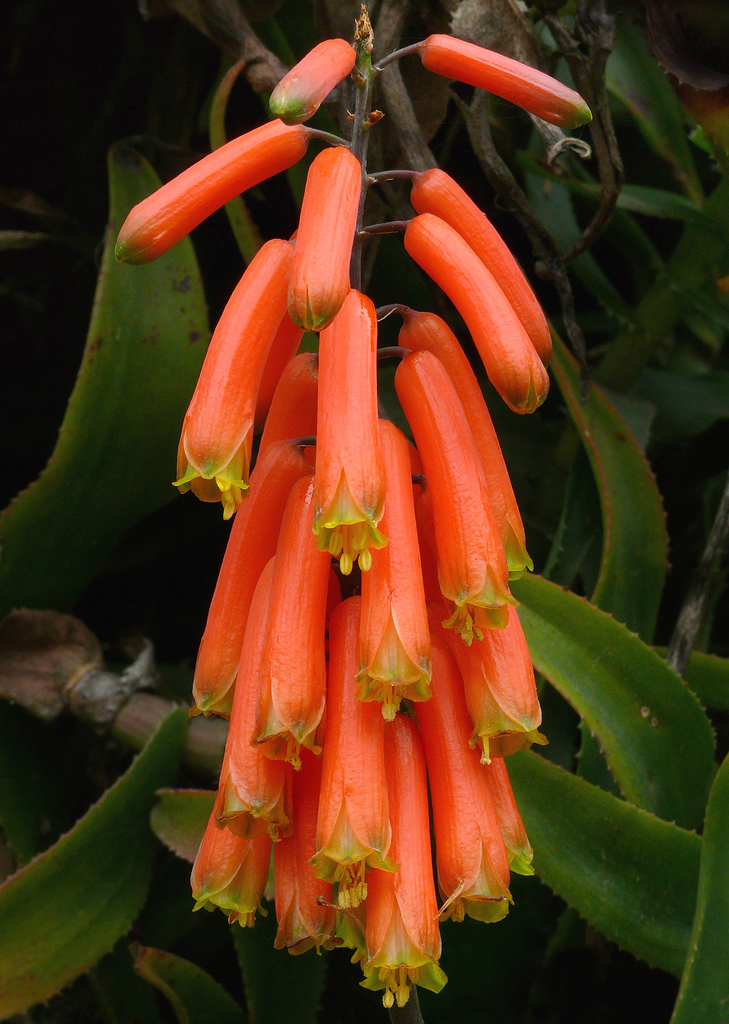
Common Climbing Aloe
Aloiampelos ciliaris
Aloiampelos ciliaris (formerly Aloe ciliaris), the common climbing-aloe, is a thin-leaved and generally rapidly-growing succulent plant from Southern Africa.
From the article Aloiampelos ciliaris on Wikipedia (CC BY-SA), quoted section by section
Description
The common climbing-aloe can be differentiated from other Aloiampelos species by the way that the soft, white, hair-like teeth ("cilia"=ciliaris) that appear along the leaf margins, extending fully around the stem at the base of the leaf. The fleshy green leaves are strongly recurved, helping to anchor the tall stems in dense thickets and assist the plant in climbing. The leaf sheaths are conspicuously-striped green and white, though some plants are more green. In most cases, A. ciliaris will grow quickly, producing long, thin, potentially straggly shoots that create a "messy" look, and the plant may require trellising or selective thinning/pruning to maintain if organic support is not available (such as a hillside, pole, tree, rocks, etc). In nature, or without support, the plant tends to form an ever-widening "mound" and assumes a lateral growth habit. From about November through April, A. ciliaris produces bright orange-red inflorescences; flowering is indicative of sufficient photosynthesis taking place, which may present a challenge for some gardeners as this species can experience sunburn during the hottest periods of the day. Although succulent plants are largely adaptable, A. …
Wikipedia: “Appearance, growth and flowering”
Range & habitat
Aloiampelos ciliaris is naturally widespread in the coastal and chaparral-like vegetation of the Eastern Cape, flowing into the Western Cape border's fynbos habitat. At the bases of dry river canyons and valleys, where they grow in thorny thickets, their long stems develop rapidly upwards and out, searching for the light at the top of the canyon. Their recurved leaves act as hooks, allowing the plants to anchor themselves in the thick vegetation or vertically along rocky hillsides, cliff faces, and canyon walls. A. ciliaris as a species seems to have developed from a smaller and rarer, more delicate plant now classified as a subspecies, Aloiampelos ciliaris ssp. tidmarshi, and appears to have spread across the region relatively recently. This ancestral subspecies remains restricted to the Albany thickets of the Eastern Cape, from Addo Elephant National Park in the west, east through Makhanda to East London. Along the coast, it is also known from Kenton-on-Sea and Port Alfred, and various areas in-between. While Aloiampelos ciliaris was once only found in the dry vegetation of the Eastern Cape, from the Baviaanskloof mountains to as far as the Ciskei, this adaptable species has been globally introduced via the plant market, and currently occurs in many regions beyond South Africa, such as coastal Morocco and Eastern Africa. …
Wikipedia: “Distribution”
Where it lives
Recorded sightings
—
geo-referenced records in GBIF, from museums, herbaria and field observers.
Drag the globe to turn it. Dots are where records exist, not a range map; darker means more records.
In the stacks
Searching the stacks…
Every page naming Aloiampelos ciliaris in the Biodiversity Heritage Library →
This page is assembled live from iNaturalist, GBIF, Wikipedia, the Source Library and the Internet Archive. It is not yet part of the hand-edited codex. iNaturalist taxon 579676.