- Plants
- ›Vascular Plants
- ›flowering plants
- ›monocots
- ›Agaves, Orchids, Irises, and Allies
- ›Aloe family
- ›Aloes and allies
- ›Aloiampelos
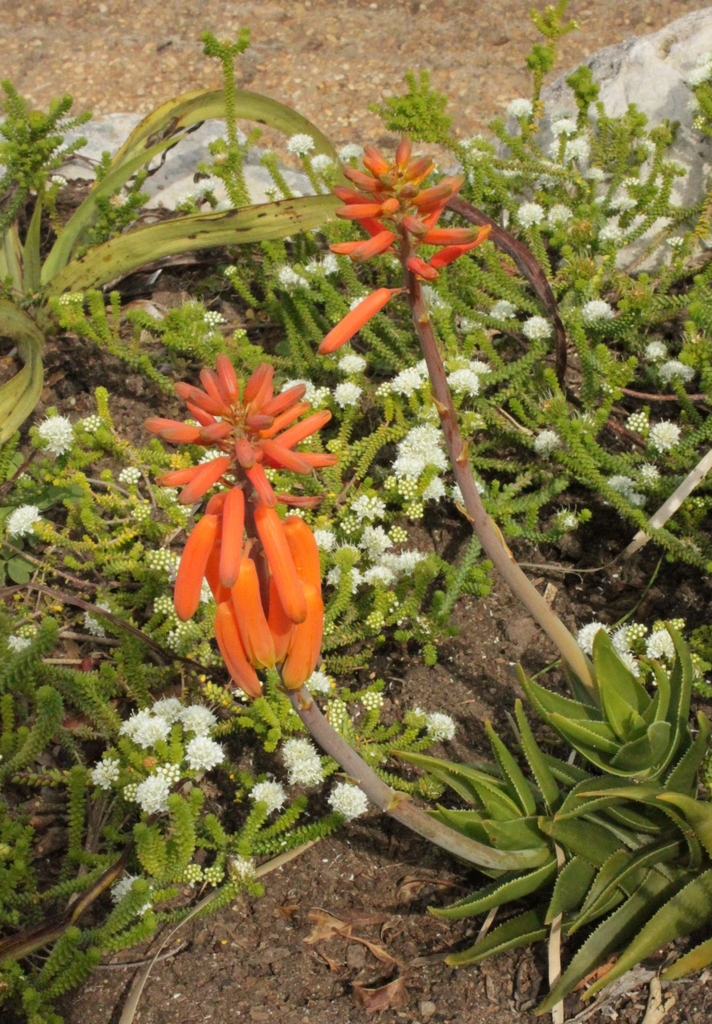
Koudeberg Aloe
Aloiampelos juddii
Aloiampelos juddii, formerly Aloe juddii, the Koudeberg aloe, is a newly discovered species that is native to a few rocky outcrops and a farm ("Farm 215"), near to Cape Agulhas in the Western Cape, South Africa.
From the article Aloiampelos juddii on Wikipedia (CC BY-SA), quoted section by section
Description
It is one of the few members of the tribe Aloeae that are indigenous to the fynbos vegetation type and it is closely related to the similarly rare Aloiampelos commixta of Table Mountain. Like this species, it is a slender, multi-stemmed succulent plant, with semi-erect stems that often sprawl along the ground and over rocks. In October and November it produces brilliant displays of bright red flowers, that are usually swiftly eaten by the tiny "Klipspringer" antelope that live in the area. It was named after the artist Eric Judd, who discovered it in 2004, and is known in Afrikaans as the "Baardskeerdersbosvuurpylaalwyn".
Range & habitat
Aloiampelos juddii has a small and restricted distribution. It occurs on rocky, south-east facing slopes, in sands derived from Table Mountain Sandstone (Nardouw subgroup). These are coarse, white sands, which are mineral-poor and acidic. The plants grow in this cool sand in the shelter of the quartzite boulders which shelter them from the winds and the heat. It is an area of predominantly winter rainfall. This plant has yet to be classified according to the IUCN Red List but is nevertheless rare and restricted to a very small natural range.
Wikipedia: “Distribution and habitat”
Where it lives
Recorded sightings
—
geo-referenced records in GBIF, from museums, herbaria and field observers.
Drag the globe to turn it. Dots are where records exist, not a range map; darker means more records.
In the stacks
Searching the stacks…
Every page naming Aloiampelos juddii in the Biodiversity Heritage Library →
This page is assembled live from iNaturalist, GBIF, Wikipedia, the Source Library and the Internet Archive. It is not yet part of the hand-edited codex. iNaturalist taxon 579680.