- Plants
- ›Vascular Plants
- ›flowering plants
- ›monocots
- ›Agaves, Orchids, Irises, and Allies
- ›Aloe family
- ›Aloes and allies
- ›Aloiampelos
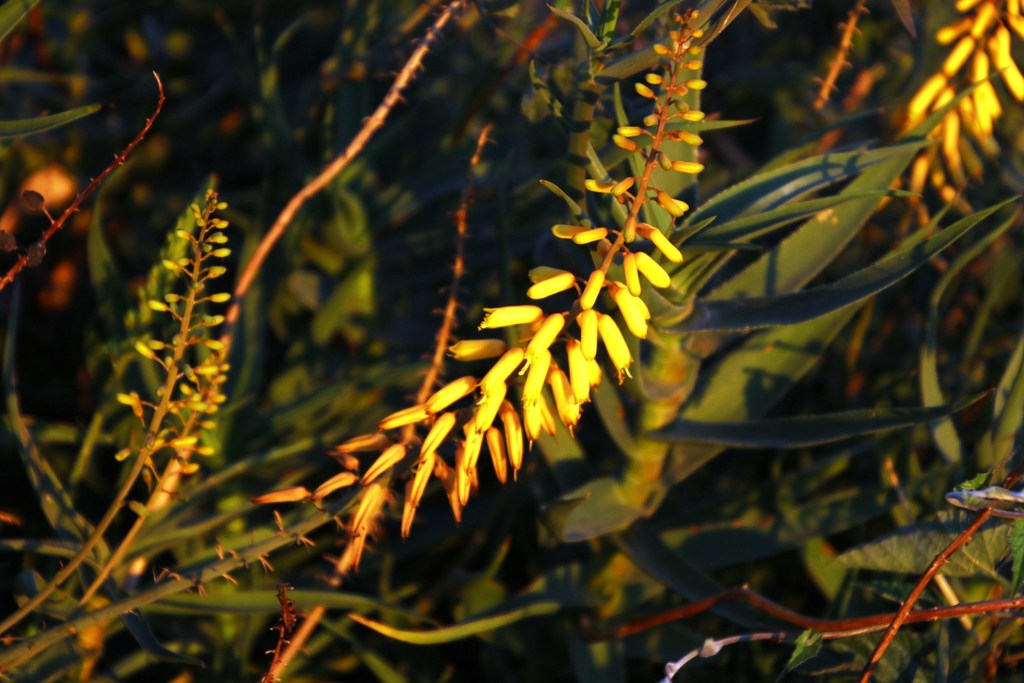
Fence Aloe
Aloiampelos tenuior
Aloiampelos tenuior, formerly Aloe tenuior, the fence aloe, is a bushy, multi-branched succulent plant from the grasslands and thickets of the Eastern Cape, Kwazulu Natal and Mpumalanga, South Africa. Its preferred habitat is sandy soils in open country, unlike many of its relatives that favour thicket vegetation.
It is one of the most profusely flowering of all aloes and their relatives.
From the article Aloiampelos tenuior on Wikipedia (CC BY-SA), quoted section by section
Description
Locally, this plant is known as iKhalene in Xhosa, inTelezi in Fengu, and simply the fence aloe in English. The specific epithet tenuior means "very slender", and refers to the plant's stems. A medium-sized, bushy plant that forms clumps up to 3 m tall, with leaves tufted at the ends of branches. The leaves have a distinctive greyish-green colour and the leaf margins have tiny white teeth. These leaves are a traditional remedy for tapeworm. An unusually large, woody rootstock usually forms on the ground at the base of the plant. Like all species in the genus, flowers are borne on slender racemes and are usually bright yellow (although there are red-flowered forms, sometimes called var. rubriflora). Aloiampelos tenuior flowers throughout the year, but especially in winter, and the small flowers appear on thin, un-branched racemes.
Where it lives
Recorded sightings
—
geo-referenced records in GBIF, from museums, herbaria and field observers.
Drag the globe to turn it. Dots are where records exist, not a range map; darker means more records.
In the stacks
Searching the stacks…
Every page naming Aloiampelos tenuior in the Biodiversity Heritage Library →
This page is assembled live from iNaturalist, GBIF, Wikipedia, the Source Library and the Internet Archive. It is not yet part of the hand-edited codex. iNaturalist taxon 579681.