- Plants
- ›Vascular Plants
- ›flowering plants
- ›monocots
- ›Agaves, Orchids, Irises, and Allies
- ›Aloe family
- ›Aloes and allies
- ›Astroloba
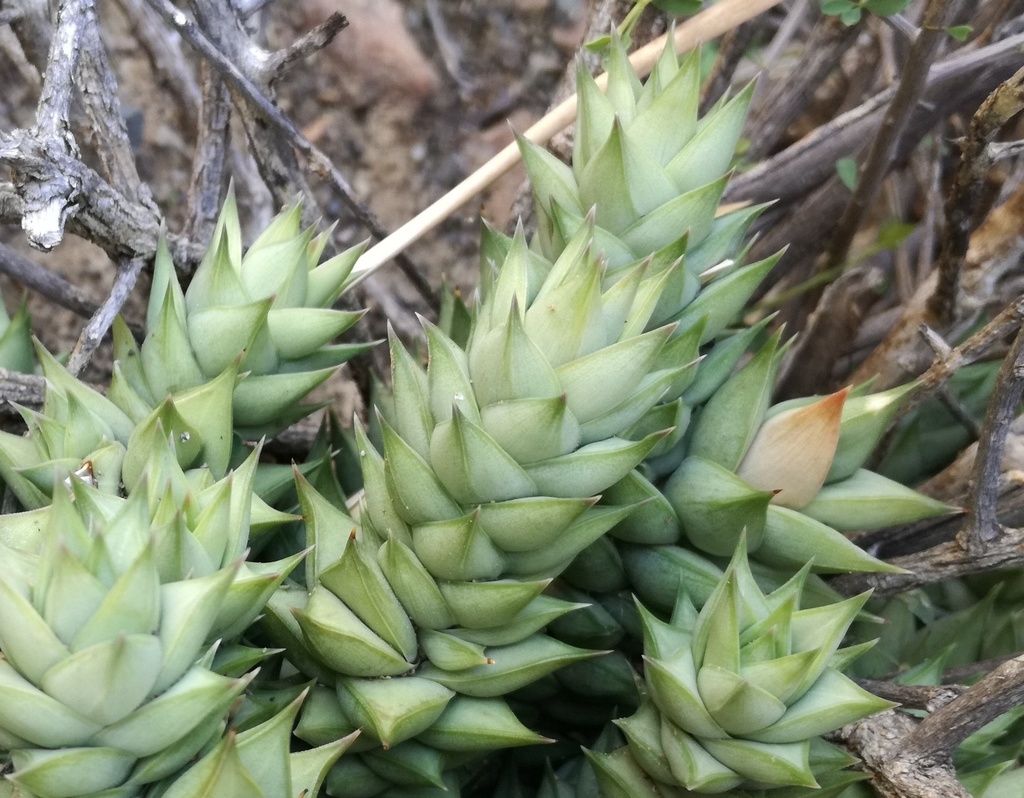
Swartberg Astroloba
Astroloba herrei
Astroloba herrei is a small succulent plant of the genus Astroloba, restricted to the area around the Swartberg mountains, South Africa.
It is listed as a Vulnerable species on the Red List of the South African National Biodiversity Institute (SANBI).
From the article Astroloba herrei on Wikipedia (CC BY-SA), quoted section by section
Description
Astroloba herrei is a compact Astroloba species, with stems growing up to 20 cm high, that are densely covered in pointed succulent leaves. Flowers appear from June to November. With its sharp, grey-green, keeled leaves, and its puffed up, inflated flowers, the species is easily mistaken for the closely related Astroloba spiralis species. However, it is genetically distinct and can always be distinguished by its flowers and its phyllotaxis. Both spiralis and herrei have puffed up, inflated flowers, but those of herrei are smooth (unlike spiralis, which has a wrinkled, transversely rugose, perianth).
Other less reliable ways of identifying A. herrei are the fine, dark, longitudinal lines (striations) which are sometimes visible below the surface of the leaves, and the slight blueish colour which herrei attains in sheltered or shaded environments. Leaves often feature narrowly acuminate leaf tips that spread outwards more strongly than in spiralis. However these are not certain ways of identifying it. Other than by its flowers, the only sure way of distinguishing this species is by its phyllotaxis. The divergence angle of A. herrei is much smaller than that of A. spiralis. This means that the five leaf-ranks of A. herrei will spiral in a direction counter to the direction of the generative spiral. Those of A. spiralis and A. …
Range & habitat
This species has historically been considered rare, disjunct and restricted to small populations near Uniondale in the Little Karoo, and the widely separated Prince Albert in the Great Karoo. In 2017 its distribution was revised when it was found to be widespread in the more remote areas north of the Swartberg mountains. The species is listed as Vulnerable – partly because it was believed to have a very restricted range, and partly because it is threatened by habitat destruction and illegal collecting. In habitat, it grows on Karoo flats, often underneath bushes which provide it with some protection from the sun.
Wikipedia: “Distribution”
Where it lives
Recorded sightings
—
geo-referenced records in GBIF, from museums, herbaria and field observers.
Drag the globe to turn it. Dots are where records exist, not a range map; darker means more records.
In the stacks
Searching the stacks…
Every page naming Astroloba herrei in the Biodiversity Heritage Library →
This page is assembled live from iNaturalist, GBIF, Wikipedia, the Source Library and the Internet Archive. It is not yet part of the hand-edited codex. iNaturalist taxon 580779.