- Plants
- ›Vascular Plants
- ›flowering plants
- ›Dicots
- ›pinks, cactuses, and allies
- ›Stone plants
- ›Brightfig Subfamily
- ›Brightfig Tribe
- ›Cheiridopsis
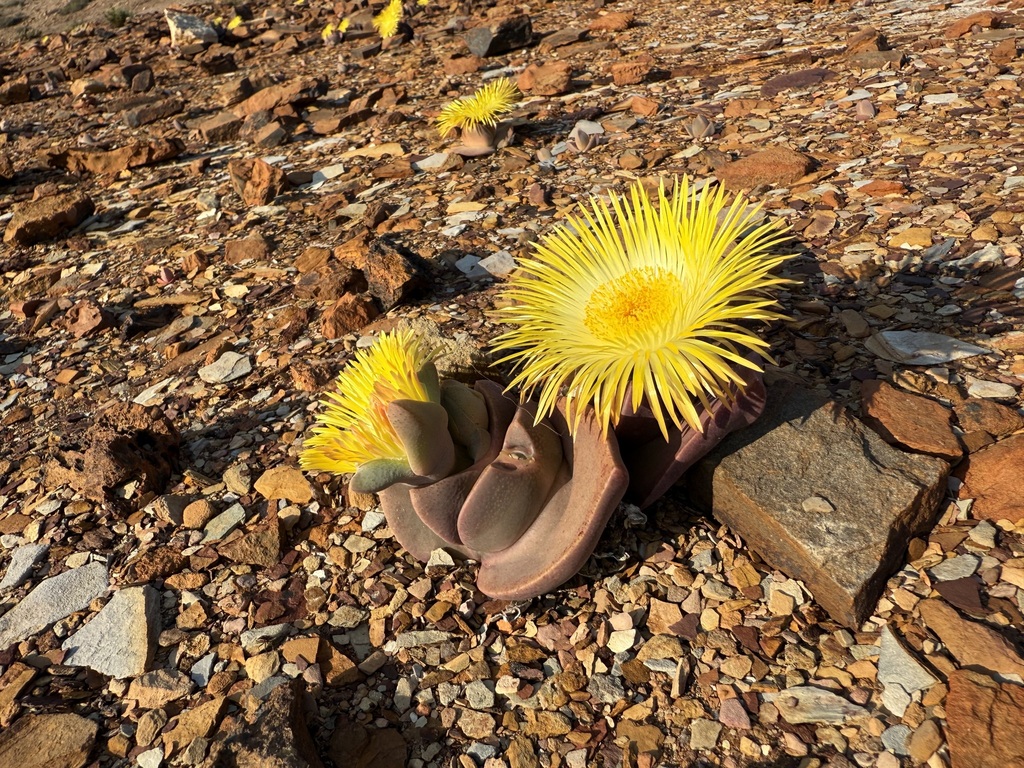
Twoleaf Clockfig
Cheiridopsis peculiaris
Cheiridopsis peculiaris is a critically endangered species of succulent plant in the family Aizoaceae native to South Africa. Its name refers to the peculiar leaf shape compared to other species in its genus. Like other Cheiridopsis it has leaf pairs, but unusually the outer pair grows flat along the ground while the other pair faces toward the sky.
From the article Cheiridopsis peculiaris on Wikipedia (CC BY-SA), quoted section by section
Description
This species is only known from a single population located in the Namaqualand shale shrubland within a 20 km² area. This species typically grows on shale flats or on gneiss slopes. The plant is named for its peculiar habit of producing two alternating leaves that are completely different in appearance, one set which lays flat on the ground during the active growth period and a completely different set of resting leaves during the plant's dormant period which point upwards and enclose the next season's active growth leaves. As the plants mature, the flat, ground hugging leaves become more oval in shape and much larger and thicker, and take on a reddish coloration as camouflage, which allows the plant to blend into it's environment. The plant produces yellow flowers during it's autumn and winter growing period. The plants go completely dormant in the summer months, and if grown in cultivation, will rot and die if they receive too much moisture during their summer dormancy period. Like most members of the genus Cheiridopsis, this species is not cold tolerant and must be protected from frost and freezing temperatures in cultivation. Only a few specific species, such as Cheiridopsis candidissima or Cheiridopsis herrei, can survive brief, light overnight frost down to 23°F to 25°F (-4°C to -5°C).
Where it lives
Recorded sightings
—
geo-referenced records in GBIF, from museums, herbaria and field observers.
Drag the globe to turn it. Dots are where records exist, not a range map; darker means more records.
In the stacks
Searching the stacks…
Every page naming Cheiridopsis peculiaris in the Biodiversity Heritage Library →
This page is assembled live from iNaturalist, GBIF, Wikipedia, the Source Library and the Internet Archive. It is not yet part of the hand-edited codex. iNaturalist taxon 582129.