- Plants
- ›Vascular Plants
- ›flowering plants
- ›Dicots
- ›Legumes, Milkworts, and Allies
- ›Legumes
- ›Faboideae
- ›Dalbergieae
- ›Dalbergia
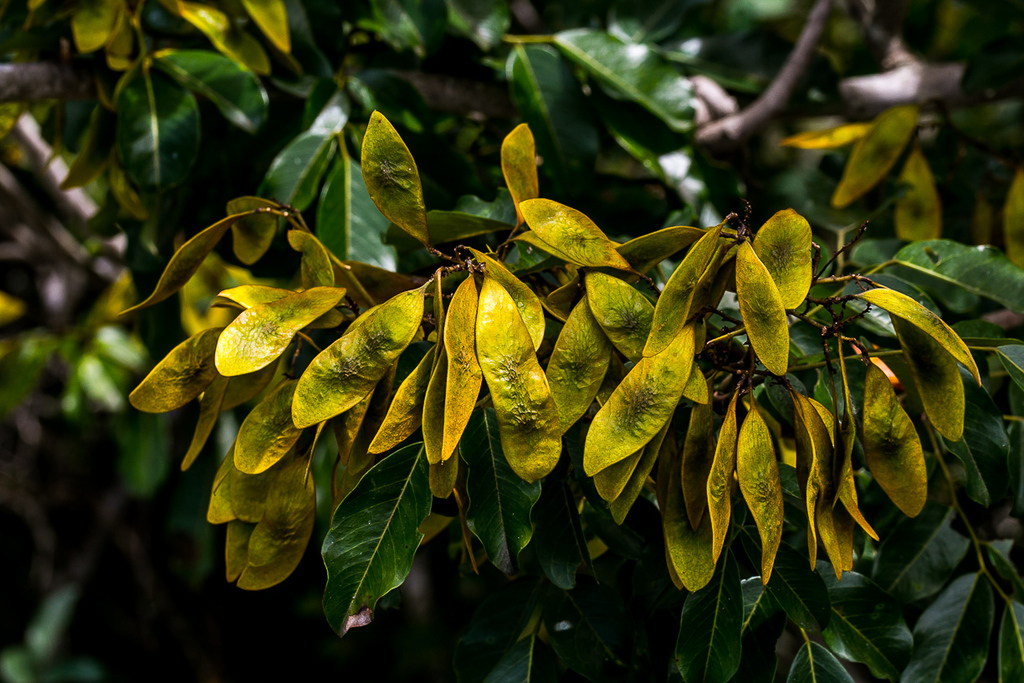
Climbing Flatbean
Dalbergia obovata
Dalbergia obovata is a species of flowering plant in the family Fabaceae. It is sometimes referred to by the common name climbing flat bean. It is a robust shrub or climber that is native to Southern Africa.
From the article Dalbergia obovata on Wikipedia (CC BY-SA), quoted section by section
Description
Dalbergia obovata is a canopy climber that grows up to 30 m tall in the wild or a small tree up to 6 m tall. It has modified, tendril-like branches that enable the plant to support itself on surrounding vegetation. The leaves are compound with alternate leaflets, and glossy green above and blue-grey beneath with a wavy margin. The flowers are produced in dense heads in the leaf axils and ends of the branchlets. The flowers are whitish and fragrant (sweetly scented). The fruits are flattened pods that are pale yellow to brown in colour, and form in clusters. Each pod contains 1-3 seeds.
Range & habitat
This species favours coastal and riverine forest and forest margins as well as wooded slopes, and deciduous woodland. It is found from the Eastern Cape, through KwaZulu-Natal and Mozambique to Tanzania.
Wikipedia: “Distribution”
At the table
The stems are used for traditional woven hut walls and fishing baskets (in Maputaland). The heavy reddish wood is used for sticks and stools. A root infusion is used to treat stomach-ache and toothache, and the roots are used to make a Zulu love charm. The bark is used to treat sore mouths in babies and for making rope (twine), and ash from burnt bark is added to snuff. Dalbergia obovata is also used as a garden plant because of its showy flowers and can make an impenetrable hedge. The leaves can be used to feed livestock.
Wikipedia: “Uses”
Where it lives
Recorded sightings
—
geo-referenced records in GBIF, from museums, herbaria and field observers.
Drag the globe to turn it. Dots are where records exist, not a range map; darker means more records.
In the stacks
Searching the stacks…
Every page naming Dalbergia obovata in the Biodiversity Heritage Library →
This page is assembled live from iNaturalist, GBIF, Wikipedia, the Source Library and the Internet Archive. It is not yet part of the hand-edited codex. iNaturalist taxon 583423.