- Plants
- ›Vascular Plants
- ›flowering plants
- ›monocots
- ›Agaves, Orchids, Irises, and Allies
- ›agave and allies
- ›Century plant subfamily
- ›Hesperoyucca
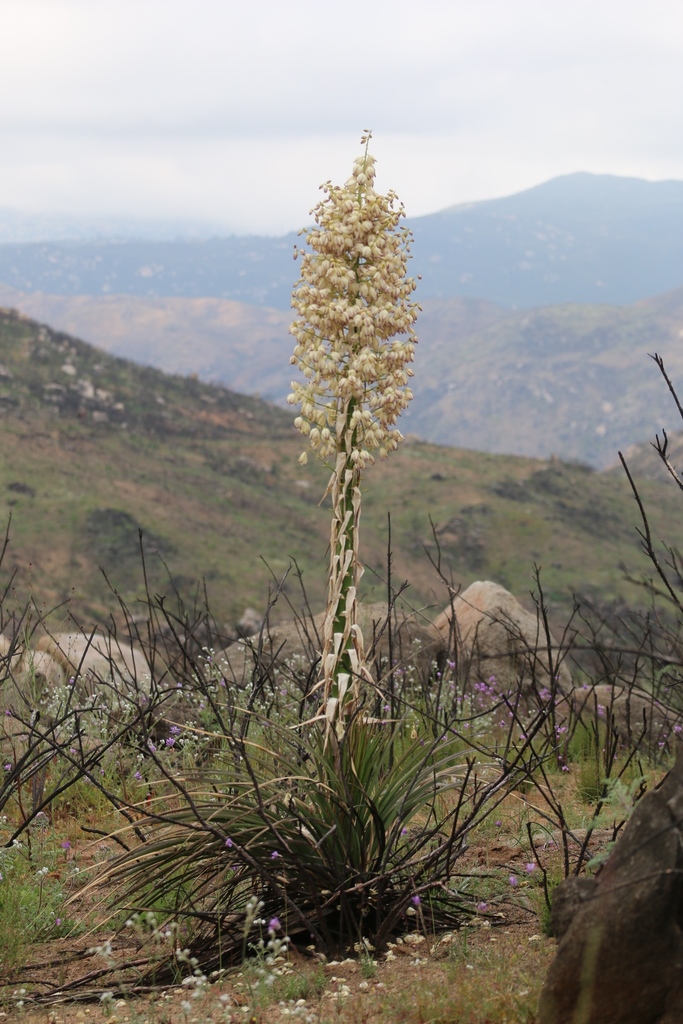
chaparral yucca
Hesperoyucca whipplei
Hesperoyucca whipplei (syn. Yucca whipplei ) (chaparral yucca, our Lord's candle, Spanish bayonet, Quixote yucca or foothill yucca is a species of flowering plant closely related to, and formerly usually included in, the genus Yucca. It is native to southern California, United States and Baja California, Mexico, where it occurs mainly in chaparral, coastal sage scrub, and oak woodland plant communities at altitudes of 0–2500 m.
From the article Hesperoyucca whipplei on Wikipedia (CC BY-SA), quoted section by section
Description
It produces a stemless basal rosette cluster of long, rigid leaves which end in a sharp point. The leaves are 20–90 cm (8–35 in), rarely to 125 cm (49 in), long and 0.7–2 cm (1⁄4–3⁄4 in) wide, and gray-green in color. The leaf edges are finely saw-toothed. The single inflorescence grows extremely fast, and reaches 0.9–3 metres (3–10 ft) tall, bearing hundreds of elliptical (bell-shaped) white to purplish flowers 3 cm (1+1⁄4 in) in diameter on a densely branched panicle up to 70 cm (28 in) broad, covering the upper half of the inflorescence. The flowers are fragrant. The fruit is a dry winged capsule, which splits open at maturity to release the seeds. According to Guinness the inflorescence pedicel of H. whipplei can grow up to 25 cm (9.8 in) a day towards an eventual height of 3.65 m (12.0 ft). The plant takes several (usually 5+) years to reach maturity and flower, doing so in April–May, at which point it usually dies. Most subspecies produce offshoots from the base, so that although the parent plant flowers and dies, a cluster of clones around its base continue to grow and reproduce. It may also grow back from its base after much of its foliage has been scorched off by the wildfires that are frequent in its range.
Range & habitat
It is native to southern California in the United States and Baja California in Mexico, where it occurs mainly in chaparral, coastal sage scrub, and oak woodland plant communities at altitudes of 0–2,500 metres (8,200 feet). Yucca whipplei grows on the rocky slopes and washes of the chaparral area of the transverse mountains of Southern California up to approximately 1,200 m (4,000 ft) above mean sea level. This is the only species of the asparagus family naturally present in the Santa Monica Mountains of the transverse ranges.
Wikipedia: “Distribution”
What it does
It blooms beginning in April through July, blooming abundantly in chaparral and oak woodland up to 2,500 feet (760 metres). The shoots that bear flowers die after flowering, but produce offsets around the old roots. It is pollinated by the California yucca moth (Tegeticula maculata), a relationship which has become a classic example of mutualism. The female yucca moth collects up to a dozen sacks of pollen grains called pollinia and forms them into a massive ball. The moth then flies to another plant and lands on the ovary of a flower. Standing with its head near the stigma, the moth inserts its ovipositor into the ovary wall and lays a single egg. The moth then rubs its pollen mass against the central stigmatic depression, ensuring pollination. The pollinated ovary will now produce many seeds, ensuring an ample food supply for the larva. Although many associations of Yucca and yucca moth exist, Tegeticula maculata and Hesperoyucca whipplei form an exclusive relationship.
Wikipedia: “Ecology”
At the table
Hesperoyucca whipplei is used in xeriscaping in Southern California, but reportedly is difficult to grow outside of its native range (although it is widely available from specialist nurseries in the United Kingdom). It is extremely drought tolerant and thrives in clay soils. It has been used extensively by Native Americans. Yucca species such as Y. whipplei have been documented to have been used as a fiber and food source by Native Americans in the Southwest cultural region, prior to European settlement. Archaeological evidence shows that use of yucca species extends to approximately 5,000 years ago within groups such as the Serrano of the San Bernardino Mountains and San Gabriel Mountains of the transverse mountain ranges of Southern California, where the species grows on rocky slopes and washes in chaparrals. The seeds would be ground into flour. The Serrano harvested the hearts of the plant during the spring growing season. Harvested plants were chosen based on the growth of the stalk; the hearts were the preferred portion of the plant, and would be harvested before the stalk was fully developed. The heart contains the sugars stored to rapidly grow a stalk to flower, and become bitter as the stalk grows in height. The hearts would then be roasted in stone lined pits (earth oven) over several hours in a manner similar to that of agave species. …
Wikipedia: “Uses”
In human culture
"Yuca" is a native name for the unrelated Manihot, a genus in the spurge family. Yucca whipplei is named after Amiel Weeks Whipple (1818–1863), a surveyor who oversaw the Pacific Railroad Survey to Los Angeles in 1853. The name our Lord's candle is derived from its huge, flame-shaped inflorescence. Spanish bayonet refers to the needle-sharp leaf tips which can cause discomfort to the unwary passer-by.
Wikipedia: “Etymology”
Where it lives
Recorded sightings
—
geo-referenced records in GBIF, from museums, herbaria and field observers.
Drag the globe to turn it. Dots are where records exist, not a range map; darker means more records.
In the stacks
Searching the stacks…
Every page naming Hesperoyucca whipplei in the Biodiversity Heritage Library →
This page is assembled live from iNaturalist, GBIF, Wikipedia, the Source Library and the Internet Archive. It is not yet part of the hand-edited codex. iNaturalist taxon 58362.