- Plants
- ›Vascular Plants
- ›flowering plants
- ›Dicots
- ›sandalwoods, mistletoes, and allies
- ›showy mistletoes
- ›Lorantheae
- ›Emelianthinae
- ›Erianthemum
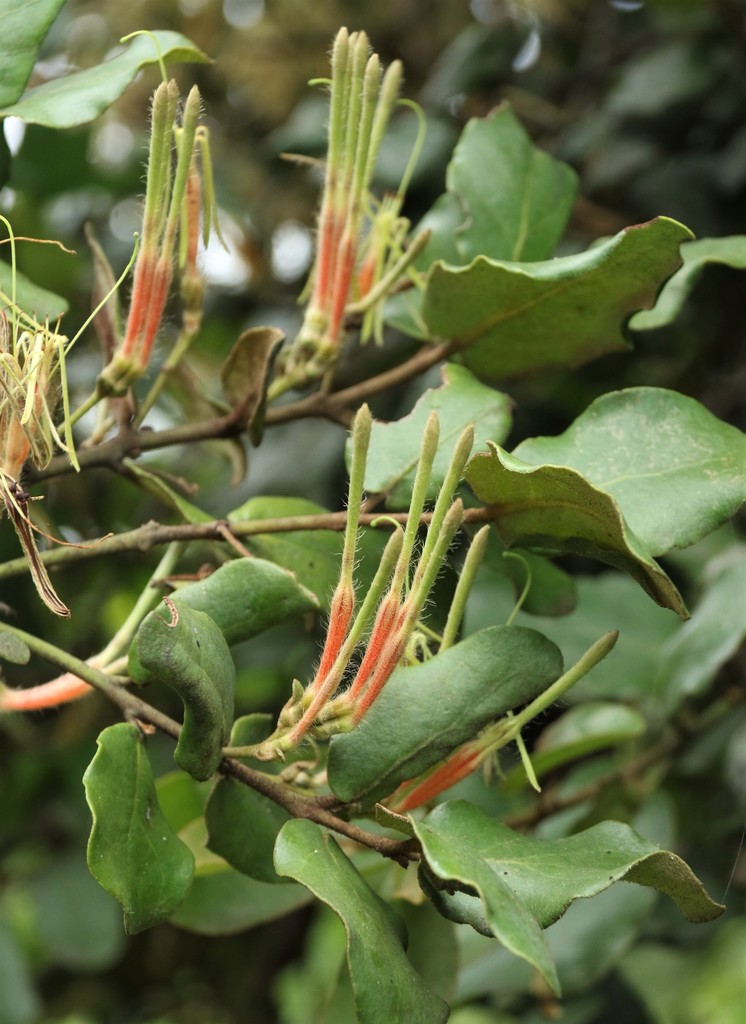
Silky matchflower
Erianthemum dregei
Erianthemum dregei is a species of parasitic plant in the Loranthaceae family, and is commonly known as the hairy mistletoe or wood flower.
From the article Erianthemum dregei on Wikipedia (CC BY-SA), quoted section by section
Description
A branched parasitic shrub with spreading or pendent stems, forming clumps of up to 2m x 1.5m. The leaves are leathery and hairless, usually alternate (sometimes opposite), with conspicuous side veins. The growing points are velvety brown. The flowers are massed in small clusters and are densely hairy, pale yellowish-green and sometimes flushed orange to pink. The fruit is an orange to bright red berry, 10–15 mm in size. Erianthemum dregei shows great variation across its range.
Range & habitat
These plants are native to Africa and are parasitic on a large number of tree species in higher rainfall areas from the Eastern Cape of South Africa, through KwaZulu-Natal, Eswatini and Mpumalanga, to East Africa, as far as northern Ethiopia. They are also found in southern Angola.
Wikipedia: “Distribution and habitat”
At the table
Erianthemum dregei is used in African traditional medicine to treat stomach complaints in children and cattle.
Wikipedia: “Human uses”
Where it lives
Recorded sightings
—
geo-referenced records in GBIF, from museums, herbaria and field observers.
Drag the globe to turn it. Dots are where records exist, not a range map; darker means more records.
In the stacks
Searching the stacks…
Every page naming Erianthemum dregei in the Biodiversity Heritage Library →
This page is assembled live from iNaturalist, GBIF, Wikipedia, the Source Library and the Internet Archive. It is not yet part of the hand-edited codex. iNaturalist taxon 584623.